

An assault by a co-worker, customer, patient, resident, visitor, or intruder can raise more than one legal question. The reason for the encounter, the employee’s assigned duties, who employed the assailant, and who controlled the property can affect which claim paths are available. See the firm’s workers’ compensation overview.
Key takeaways
- The place of the assault is only one part of the analysis.
- The work connection and sequence of the encounter are fact-specific.
- Indiana Code 22-3-2-8[1] lists knowing participation in an assault as a defense and places the burden of proof on the employer.
- The Act generally provides the exclusive remedy against the employer for a covered accidental injury, but intentional torts and the status of a co-worker require careful analysis.
- Indiana Code 22-3-2-13[2] preserves claims against legally liable third parties; it does not itself establish fault by a property owner, staffing company, or security vendor.

What is the Indiana workers’ compensation coverage test?
Indiana Code 22-3-2-2[3] requires personal injury or death by accident arising out of and in the course of employment.
The location is therefore important but not decisive. Useful facts include what task the employee was performing, why the employee encountered the assailant, whether the dispute concerned the work, and whether the job exposed the employee to the kind of encounter that occurred.
| Coverage question | Records that can help answer it |
|---|---|
| What assigned work was underway? | Schedule, job description, dispatch record, assignment, work messages |
| Why did the people interact? | Witness accounts, incident report, customer or patient record, messages |
| Was there earlier conflict? | Prior reports, complaints, texts, emails, witness names |
| Who employed each person? | Employer, staffing-agency, contractor, and identification records |
| Who controlled the location? | Lease, property-management agreement, security contract, access rules |
How does Indiana law address a co-worker assault?
In Thompson v. York Chrysler, 999 N.E.2d 446 (Ind. Ct. App. 2013)[4], the court held that an injury from an assault by a co-worker may arise out of employment and reversed where the only evidence showed the other employee was the aggressor.
Thompson shows that the work connection and sequence of the encounter are fact-specific.

What does “knowing participation in an assault” mean?
Indiana Code 22-3-2-8[1] says no compensation is allowed when an injury or death is due to an employee’s knowing participation in an assault or felony. The same section places the burden of proving a listed defense on the employer.
The section’s wording makes the employee’s conduct and knowledge important; it does not create an automatic bar merely when an employee was present in an altercation. Evidence about who initiated force, what each person did, whether the employee tried to disengage, and how the incident unfolded may matter. Video, prompt witness accounts, and the employee’s contemporaneous report can be especially useful when the participants describe the event differently.
If the employer or carrier denies the claim, the Indiana Worker’s Compensation Board’s employee page[5] explains how employees can seek assistance and file an Application for Adjustment of Claim. Delventhal’s article about other Indiana workers’ compensation defenses gives related context.

Can an injured worker sue the employer or a co-worker?
Indiana Code 22-3-2-6[6] generally makes the Act’s rights and remedies exclusive against the employer for an injury covered by the Act. The analysis can be different when a co-worker commits an intentional tort. In DePuy, Inc. v. Farmer, 847 N.E.2d 160, 164–67 (Ind. 2006), the Indiana Supreme Court explained that the Act’s co-employee immunity applies only to an injury “by accident” and held that the employee could pursue a civil battery claim against the co-worker who intentionally injured him. The court also addressed the relationship between the civil judgment and workers’ compensation.
That decision does not mean every workplace event permits a lawsuit against a co-worker. Whether the injury was accidental, whether the assailant was in the same employ, and whether the Act covers the injury all matter. A staffing-agency worker, contractor, or worker for another company should not be labeled a co-worker without examining the employment relationships.
When can a third-party claim also exist?
Indiana Code 22-3-2-13[2] preserves an action against a person other than the employer and a person in the same employ when that person has legal liability for the injury. It also creates reimbursement, lien, and settlement rules when workers’ compensation benefits and a third-party recovery overlap.
Section 13 preserves the action; it does not establish fault. Any action against a property owner, property manager, staffing company, or security contractor must rest on the particular facts and an independent basis in law. For landowner-invitee claims involving criminal attacks, the landowner-duty foreseeability analysis considers the broad type of plaintiff and broad type of harm. In Cavanaugh’s Sports Bar & Eatery, Ltd. v. Porterfield, 140 N.E.3d 837 (Ind. 2020)[7], the Indiana Supreme Court held that the bar had no notice of present and specific circumstances indicating that the parking-lot fight was impending.
Related reading: Indiana premises-safety overview. Section 13 addresses how payment and settlement of the two actions interact.

What evidence should be preserved?
Preserve a factual record without confronting the assailant, entering restricted areas, or interfering with an investigation. Practical items include:
- The incident report and proof of when it was submitted
- Names and contact information for witnesses
- Photographs, video locations, access logs, and police or security report numbers
- Earlier threat reports, complaints, emails, texts, and security logs
- The schedule, assignment, written duties, and relevant work communications
- Information identifying the assailant’s employer and the entities controlling the location
- Medical records, bills, and work-status documents already received
A written preservation request can identify the date, time range, location, and categories of records at issue. Do not misrepresent authority to obtain private business records, and do not post sensitive medical or claim details publicly.
What notice and filing deadlines apply?
Indiana Code 22-3-3-1[8] requires notice of the injury or death to the employer as soon as practicable. Unless the employer or its agent has actual knowledge, the statute generally prevents compensation until notice is given and bars compensation if notice is not given within thirty days after the occurrence, subject to its stated exceptions.
Indiana Code 22-3-3-3[9] generally bars workers’ compensation proceedings unless an application is filed within two years after the accident, subject to the section’s provisions. A separate injury action is generally governed by the two-year period in Indiana Code 34-11-2-4[10].
Employer notice, a Board application, and a civil complaint are different acts. A police report or internal investigation should not be assumed to complete each one.
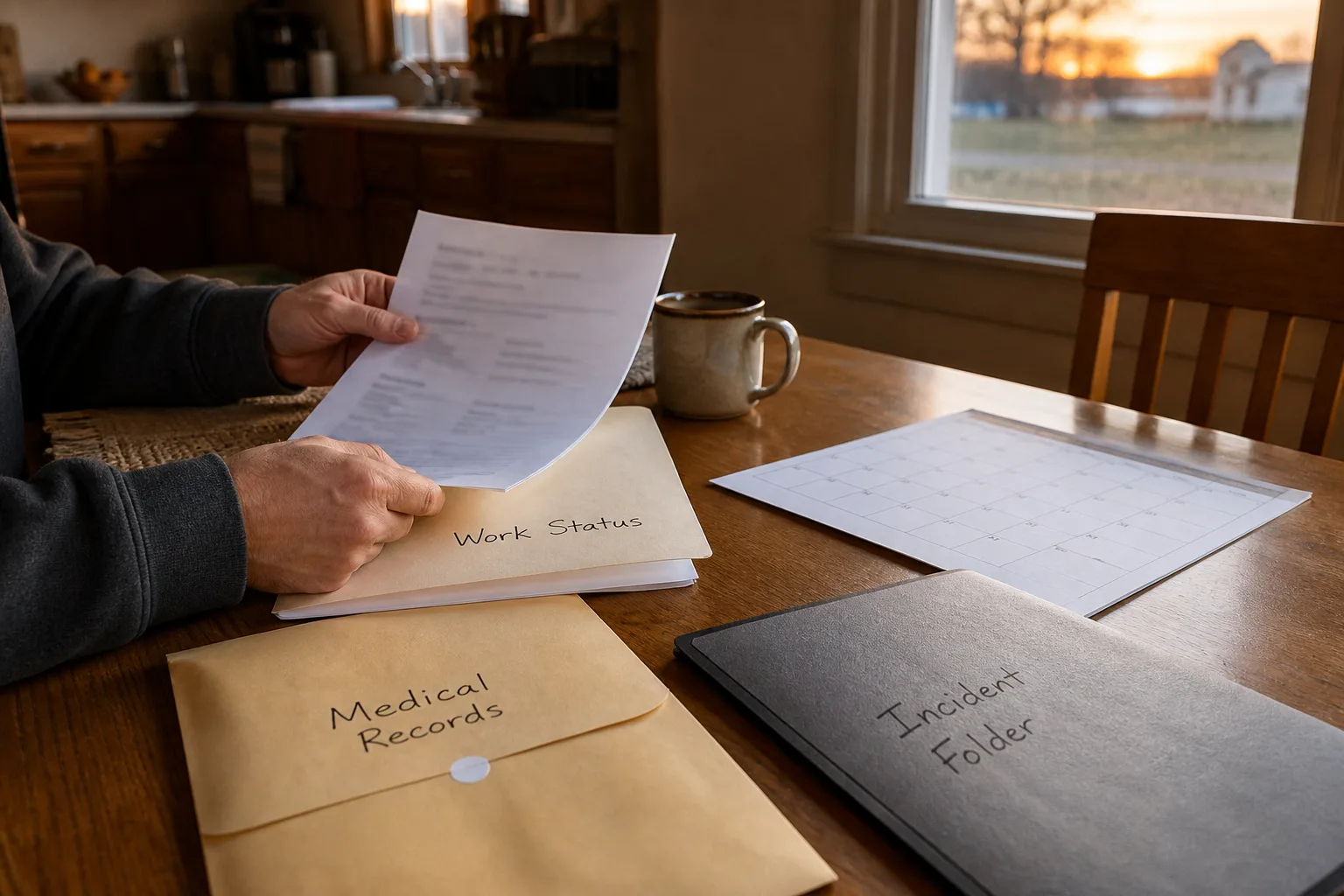
A practical next-step checklist
- Get to a safe location and request emergency help if needed.
- Report the injury to the employer promptly and retain proof.
- Write down the location, assigned work, people involved, witnesses, and sequence of events.
- Keep the medical and work-status documents you receive.
- Identify cameras and request preservation of relevant video and access records.
- Preserve earlier reports, messages, and complaints that may explain the dispute.
- Identify the employer of each person involved and the entity controlling the location.
Frequently asked questions
Is an assault by a co-worker automatically covered by workers’ compensation?
No. The injury must still arise out of and in the course of employment. The reason for the dispute and its connection to the work are important.
What does Thompson say about an assault by a co-worker?
Thompson v. York Chrysler held that an injury from an assault by a co-worker may arise out of employment and reversed where the only evidence showed the other employee was the aggressor. The work connection and sequence of the encounter are fact-specific.
Can the employer argue that I participated in the assault?
Yes. Indiana Code 22-3-2-8[1] lists knowing participation in an assault as a defense, and it places the burden of proof on the employer. The outcome depends on the evidence about the employee’s conduct and knowledge.
Can I bring a civil claim against a co-worker who intentionally attacked me?
Possibly. DePuy v. Farmer explains that the Act’s co-employee immunity applies only to an injury by accident. Employment status, the nature of the conduct, and the interaction between the two proceedings all require analysis.
Can workers’ compensation and a third-party claim proceed together?
They can. Indiana Code 22-3-2-13[2] preserves an action against a legally liable third party while imposing reimbursement, lien, and settlement rules that coordinate the two recoveries.
If you were injured in a workplace assault, Delventhal Law Office can review the employment relationships, available records, and claim paths. You may contact the firm to request a consultation.
This article provides general information, not legal advice.
Sources
- Indiana Code 22-3-2-8 (iga.in.gov) ↩
- Indiana Code 22-3-2-13 (iga.in.gov) ↩
- Indiana Code 22-3-2-2 (iga.in.gov) ↩
- Thompson v. York Chrysler, 999 N.E.2d 446 (Ind. Ct. App. 2013) (public.courts.in.gov) ↩
- Indiana Worker’s Compensation Board’s employee page (in.gov) ↩
- Indiana Code 22-3-2-6 (iga.in.gov) ↩
- Cavanaugh’s Sports Bar & Eatery, Ltd. v. Porterfield, 140 N.E.3d 837 (Ind. 2020) (public.courts.in.gov) ↩
- Indiana Code 22-3-3-1 (iga.in.gov) ↩
- Indiana Code 22-3-3-3 (iga.in.gov) ↩
- Indiana Code 34-11-2-4 (iga.in.gov) ↩