After a wet-road collision in Fort Wayne or elsewhere in Indiana, separate two questions: what caused the tires to lose contact with the road, and what conduct caused the crash and injuries? This guide focuses on claims involving ordinary private motorists. It does not decide a particular case from a photograph, a weather report, or the word “hydroplaning.”
- The posted speed limit is not permission to ignore heavy rain or standing water.
- Investigate the sequence before drawing a conclusion from a skid.
- Preserve what you actually observed; distinguish it from estimates and later explanations.
- Fault can involve more than one person, including a nonparty.
What does Indiana law require on a wet road?
Indiana Code 9-21-5-1[1] prohibits driving faster than is reasonable and prudent under the conditions, considering actual and potential hazards. It also requires restricting speed as necessary to avoid a collision consistently with legal requirements and the duty of due care. Indiana Code 9-21-5-1[2].
Section 9-21-5-4 requires an appropriately reduced speed when a special hazard exists because of weather or highway conditions. It also addresses intersections, curves, hill crests, narrow or winding roads, and hazards involving pedestrians or other traffic. Indiana Code 9-21-5-4, pages 416–417[3].
For following distance, section 9-21-8-14(b) prohibits following more closely than is reasonable and prudent, considering both vehicles’ speeds, the time interval between them, and the highway’s condition. Subsection (a) excludes vehicles following another vehicle in the same vehicle platoon. Indiana Code 9-21-8-14[4].
These rules explain why “I was below the speed limit” does not end the inquiry. Investigate the reason for the loss of control rather than assuming the answer. Identify the specific allegedly unsafe act and how it contributed to the collision. Our Fort Wayne car accident guide covers the broader claim process.

What does hydroplaning explain—and what does it not?
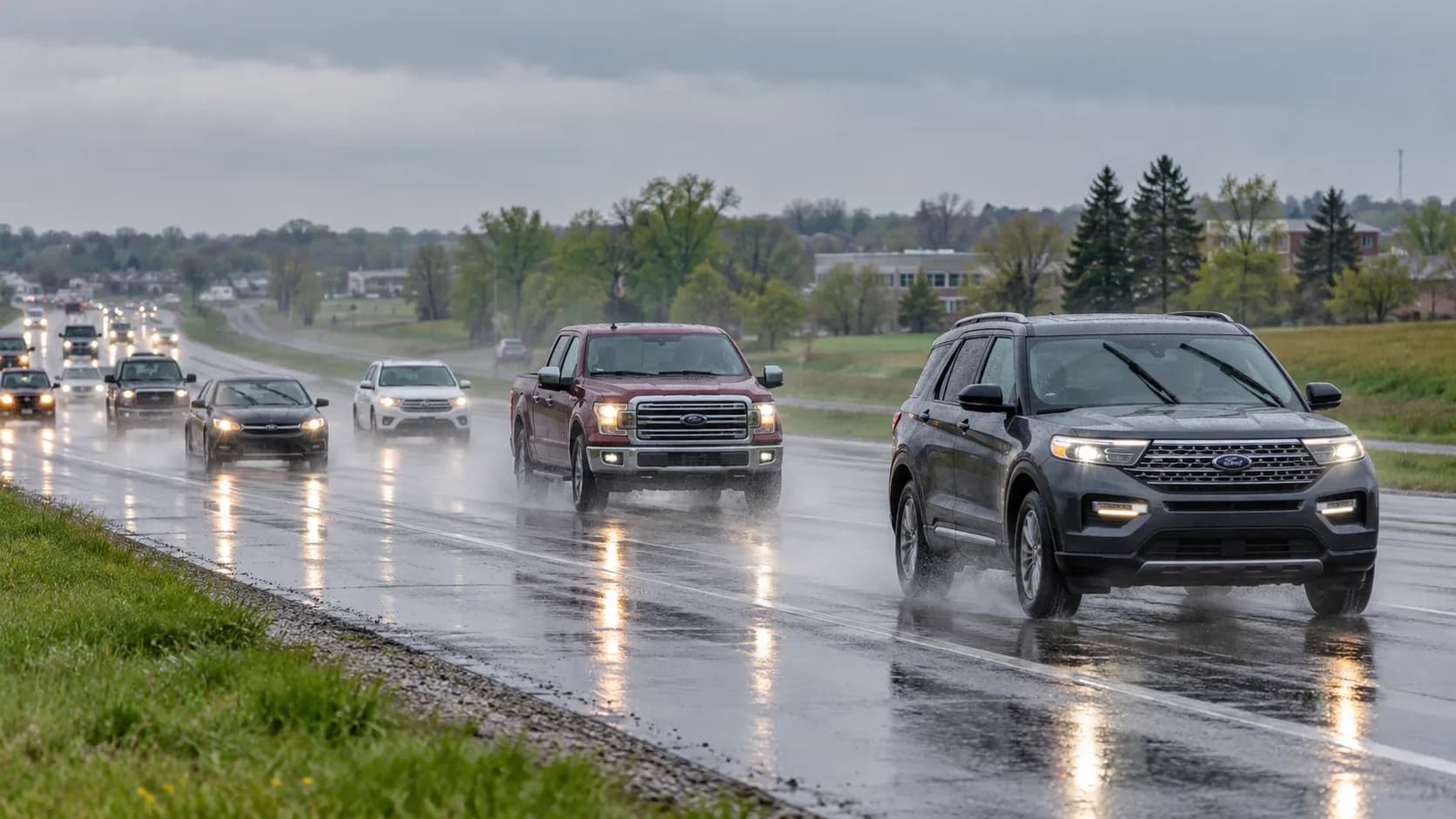
The Indiana BMV manual explains that wet roads can lead to hydroplaning and that hydroplaning increases with speed. It describes tires contacting only the layer of oil, dirt, and water instead of the roadway, leaving no friction to brake, accelerate, or turn. The manual advises against driving on bald or badly worn tires and calls for slowing down in heavy rain, standing water, or slush. Indiana BMV Driver’s Manual, printed pages 43–44 (PDF pages 48–49)[5].
That is general driving guidance, not a reconstruction of your crash. Record the known speed, tire condition, and water observations; leave unknowns open for further investigation. A qualified examination may be needed to evaluate a disputed explanation.
For an initial consultation, useful questions include: When did the driver first see water? Was visibility already limited? What steering, braking, or lane movement occurred before control was lost? Were the tires photographed before replacement? Which details come from a witness rather than an assumption?

How does shared fault affect an ordinary private-driver claim?
For claims governed by Indiana’s Comparative Fault Act, the claimant’s contributing fault proportionately reduces compensatory damages. The statutory jury instructions bar recovery if the claimant’s share exceeds 50% of the total fault. They include fault assigned to nonparties, not only named defendants. When recovery is allowed, the instructions calculate a verdict using each defendant’s percentage of fault. Indiana Code 34-51-2-5 through 34-51-2-8, pages 617–618[6].
For example, a hypothetical allocation of 20% to the injured claimant, 60% to a defendant, and 20% to a nonparty does not make the defendant responsible for the entire remaining 80%. Under the stated allocation, the defendant’s share would be 60% of the total damages. This is an illustration of the statutory calculation, not a prediction of a settlement or collectability.
Causation remains required for both liability and contributory fault under section 34-51-2-3. A condition that existed at the scene is not automatically a legal cause of the injury. Indiana Code 34-51-2-3[7].
The Act expressly excludes tort claims against governmental entities or public employees under the Indiana Tort Claims Act. Do not apply the private-driver percentage explanation to a claim against a public road authority. Indiana Code 34-51-2-2[8].
Our Indiana comparative-fault guide discusses the general framework. If pooled water raises questions about a public road, consult the separate government-claim guide promptly; different defenses and notice requirements may apply. Identify who controlled a drain rather than assuming ownership from a photograph.

A wet-road evidence worksheet
This is Delventhal’s practical organizing aid, not a government checklist. Collect information only from a safe location and through lawful access. Do not enter traffic, floodwater, or private property to complete it.
| Topic | What to organize | Important limit |
|---|---|---|
| Conditions before the skid | Rain intensity, visibility, visible water, travel direction, curve or grade | Separate what you saw before impact from what you saw afterward. |
| Vehicle sequence | Lane positions, following interval, braking or steering you actually observed | Mark estimates as estimates; do not invent a speed or distance. |
| Tires and vehicle | Dated photographs, tire receipts, maintenance records, tow destination | Record measured inflation and tread depth separately from a photograph. |
| Video and witnesses | Original dashcam files; names, contact details, viewing locations | Keep originals unchanged and identify who recorded or supplied each file. |
| Road and water | Safe photos of pooling, drains, markings, and sight lines | Record when the photo was taken; later conditions may differ. |
| Weather records | Crash time and location, observation station, reporting interval | A nearby station is not a measurement of water depth in the crash lane. |
The National Weather Service’s Northern Indiana climate page offers past-weather tools. National Weather Service: Northern Indiana climate and past weather[9].
Use our weather and road records guide for the record-gathering process. This article uses those records to frame the narrower wet-road driving questions; the existence of rain is not a finding of fault.

Practical next steps after the collision
- Prioritize safety and emergency help. Call 911 if emergency assistance is needed and obtain appropriate medical care. Do not delay care to complete a checklist.
- Keep your account factual. Note your location, direction of travel, what you observed, and what you do not know. Avoid guessing about another driver’s speed or tire condition.
- Save the original material. Keep photographs, dashcam files, messages, the crash report, tow documents, and claim correspondence together.
- Address preservation before material changes when possible. Tell your lawyer where the vehicle is stored and ask promptly about inspection before tire replacement, repair, or salvage. Do not ignore storage charges, safety needs, or contractual obligations while waiting.
- Identify outside records. Note possible cameras and witnesses and request that relevant material be retained. Do not access someone else’s account or assume a recording is available.
These are preparation suggestions; ask what electronic information and other records may exist for this particular vehicle. The car accident evidence guide provides broader context.

Frequently asked questions
Does hydroplaning automatically excuse a driver?
No. Indiana requires a reasonable and prudent speed and an appropriate reduction for weather-related hazards. The conduct and evidence still need evaluation.
Can driving below the posted limit still be too fast?
Yes. The two Indiana speed provisions discussed above require a speed suited to actual conditions and hazards. A posted speed limit does not replace those duties.
Do worn tires matter?
They are worth documenting. The Indiana BMV advises against driving on bald or badly worn tires in its wet-road guidance. Whether tire condition contributed to a specific crash requires evidence, not an assumption.
Is fault limited to the drivers named in a lawsuit?
No. For a claim governed by the Comparative Fault Act, the statutory instructions include nonparty fault. The claimant is barred if their share exceeds 50% of total fault; otherwise each defendant’s allocated share matters.
Should I preserve the vehicle before repairs?
As a practical step, ask promptly about an inspection or preservation before changes that could affect disputed evidence. Also address safety, storage charges, and contractual obligations; do not simply abandon those decisions.
Does the same comparative-fault rule apply to a public road authority?
No. Indiana Code 34-51-2-2[10] excludes governmental-entity and public-employee tort claims under the Indiana Tort Claims Act. Those claims require a separate analysis.
Prepare for a private consultation
Bring your account of the collision, photographs, report, tow location, and insurance correspondence to a free case evaluation. Delventhal Law Office can discuss the information available and the questions that still need investigation. You do not need a complete reconstruction before asking for help.
This article is general information about Indiana law and is not legal advice. Reading it does not create an attorney-client relationship, and neither does contacting us.
Sources reviewed October 19, 2026. Illustrations do not depict an actual client incident.
Sources
- Indiana Code 9-21-5-1 (iga.in.gov) ↩
- Indiana Code 9-21-5-1 (iga.in.gov) ↩
- Indiana Code 9-21-5-4, pages 416–417 (iga.in.gov) ↩
- Indiana Code 9-21-8-14 (iga.in.gov) ↩
- Indiana BMV Driver’s Manual, printed pages 43–44 (PDF pages 48–49) (in.gov) ↩
- Indiana Code 34-51-2-5 through 34-51-2-8, pages 617–618 (iga.in.gov) ↩
- Indiana Code 34-51-2-3 (iga.in.gov) ↩
- Indiana Code 34-51-2-2 (iga.in.gov) ↩
- National Weather Service: Northern Indiana climate and past weather (weather.gov) ↩
- Indiana Code 34-51-2-2 (iga.in.gov) ↩