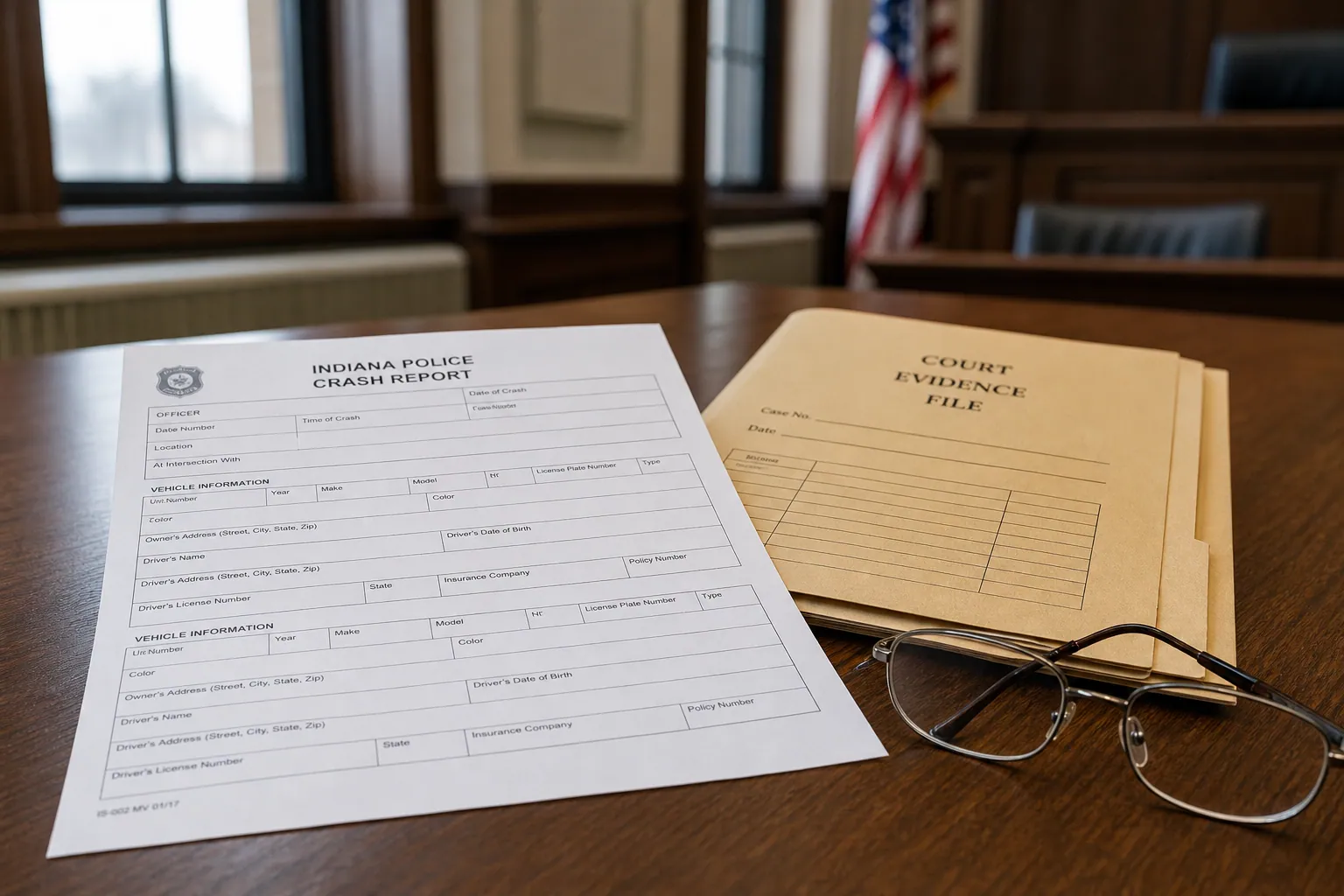
A police crash report can be important to an insurance investigation without becoming a courtroom exhibit. That distinction is the key to understanding Indiana law. Adjusters may read the report, attorneys may use it to identify people and evidence, and the parties may examine the underlying facts in discovery. But Indiana Code 9-26-3-4[1] places a specific restriction on using the required report as evidence at a trial arising from the crash.
What does Indiana Code 9-26-3-4[1] actually restrict?
The statute states: "A report made as required by this chapter may not be used as evidence in a trial, civil or criminal, arising out of an accident." Its wording matters. It addresses a report required by Indiana Code Chapter 9-26-3 and its use as evidence in a trial arising from the accident.
It is safer to describe that rule precisely than to say a police report is "always inadmissible" for every purpose in every proceeding. Questions about a particular document, a hearing outside trial, a use unrelated to proving the crash, or another source of the same information can depend on the statute, the evidence rules, the purpose for which the material is offered, and the trial judge's ruling.
The restriction also does not make the underlying facts inadmissible. It separates the statutory report from evidence that has its own foundation and basis for admission.
The report is not the same thing as the underlying evidence
A crash report often combines several kinds of information: the officer's observations, statements attributed to drivers or witnesses, a diagram, identifying information, and conclusions drawn after the event. Excluding the report itself does not automatically answer whether any underlying item can be proved another way.
| Information connected to the investigation | Why it is different from offering the statutory report | Common evidence issue |
|---|---|---|
| Officer firsthand testimony | The officer testifies from personal knowledge about what the officer saw, heard, measured, or did. | Personal knowledge, relevance, opinion limits, and hearsay still apply. |
| Photos or video | The image or recording is offered as an exhibit independent of the report. | It must be authenticated and otherwise admissible. |
| Witness testimony | A witness describes what the witness personally perceived. | Personal knowledge, relevance, and credibility are evaluated in court. |
| Vehicle or electronic data | Event-data-recorder, telematics, or device data comes from the vehicle or system, not from the report. | Authentication, reliability, expert foundation, and other rules may matter. |
| Party admissions | A party's own statement may be offered against that party under the evidence rules. | The proponent must prove the statement and context; embedded statements can raise separate hearsay issues. |
| Other records or physical evidence | 911 audio, dispatch material, measurements, damaged parts, medical records, or business video may have an independent source. | Each item needs its own foundation and must survive applicable objections. |
Can the investigating officer still testify?
Potentially, yes. Indiana Evidence Rule 602 generally requires a witness to have personal knowledge of the matter. An officer who arrived after a collision ordinarily did not personally see the impact, but may have personally observed vehicle positions, damage, debris, weather, road conditions, injuries, or statements made at the scene. The statutory restriction on the report does not, by its text, erase those observations.
That does not make every officer conclusion admissible. Testimony can still draw objections involving relevance, hearsay, improper lay opinion, expert qualification, unfair prejudice, or lack of foundation. The Indiana Rules of Evidence[2] govern those questions, and the court decides them based on what is offered and why.
What evidence may be used instead of the report?
The parties ordinarily build the trial record from sources independent of the statutory crash report. Depending on the facts and a judge's rulings, those sources may include:
- Firsthand witnesses: drivers, passengers, bystanders, and responding personnel can testify about matters they personally perceived.
- Scene and vehicle images: phone photos, dashcam footage, business surveillance, and body-worn or in-car video may help show positions, signals, visibility, damage, or conduct. A witness or other permitted method must authenticate the item.
- Physical measurements and objects: roadway measurements, debris, damaged components, and vehicle inspections may be presented with an adequate foundation.
- Vehicle and device data: event-data-recorder or telematics evidence may help reconstruct speed, braking, or other events, but collection, interpretation, authenticity, and reliability can be contested.
- Party statements: what a driver said may sometimes be offered against that driver as an opposing party's statement under Evidence Rule 801(d)(2). That rule does not automatically admit every statement quoted inside a police narrative.
- Qualified expert analysis: a properly qualified expert may offer admissible opinions based on sufficient facts or data when the evidence rules are satisfied.
None of these categories is automatically admissible simply because it appears in or was attached to a police file. Likewise, an item is not automatically excluded merely because the officer later mentioned it in the report. The source, purpose, foundation, and applicable objection matter.
Why insurers use a report that may not be trial evidence
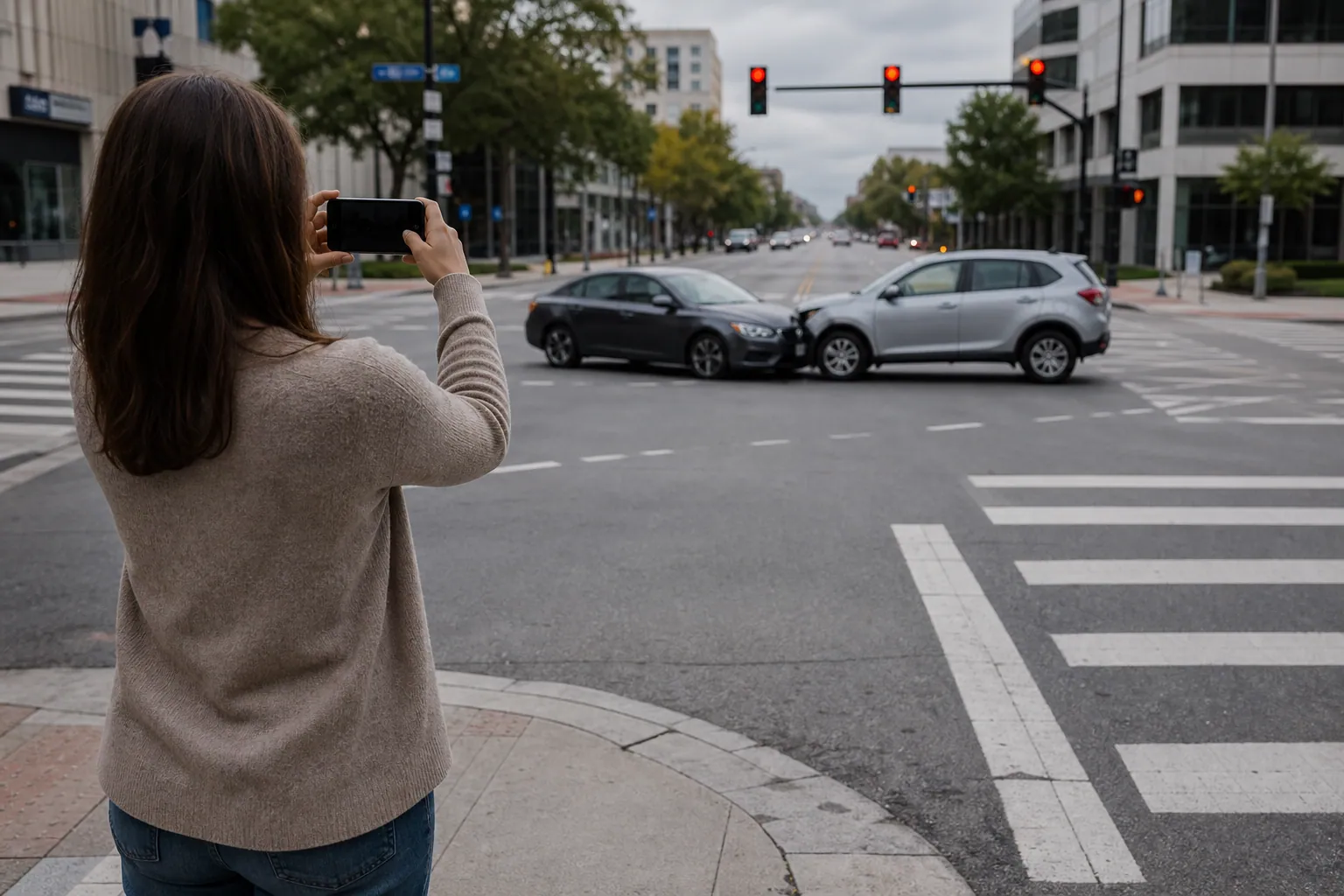
Insurance claim handling is not a trial. An adjuster can review material to investigate coverage, liability, and damages even if that material would not itself be admitted as a courtroom exhibit. A report may provide a quick account of the scene, identify drivers and witnesses, list insurance information, point to photographs or video, and reveal issues that need follow-up.
That practical use does not make the report conclusive. An insurer may accept, question, or reject parts of it after reviewing statements, damage photographs, video, medical documentation, or other evidence. If the dispute is specifically about an officer's fault notation, see our separate discussion of what happens when an Indiana police report says you are partly at fault. If the document contains an objective mistake, our guide to correcting factual errors in an Indiana crash report addresses that different problem.
Can the report matter during investigation and discovery?
Yes, even if it cannot be used as trial evidence under Section 9-26-3-4. Before a lawsuit, the report can serve as an investigative roadmap. It may identify an officer, agency, witness, vehicle, citation, diagram, or potential source of recordings and dispatch records.
After a lawsuit begins, discovery and trial admissibility are related but distinct concepts. Indiana Trial Rule 26 governs the general scope of discovery, while the evidence rules and statutes govern what may ultimately be presented at trial. Lawyers may use the report to frame document requests, subpoenas, depositions, inspection requests, or questions about independently provable facts. Whether the report itself must be produced, can be used for a particular pretrial purpose, or can be shown to a witness may require case-specific analysis and a court ruling.
The official Indiana Rules of Trial Procedure[3] contain the discovery rules. Discovery is not a shortcut around Section 9-26-3-4; it is a process for locating and testing evidence that may be independently admissible.
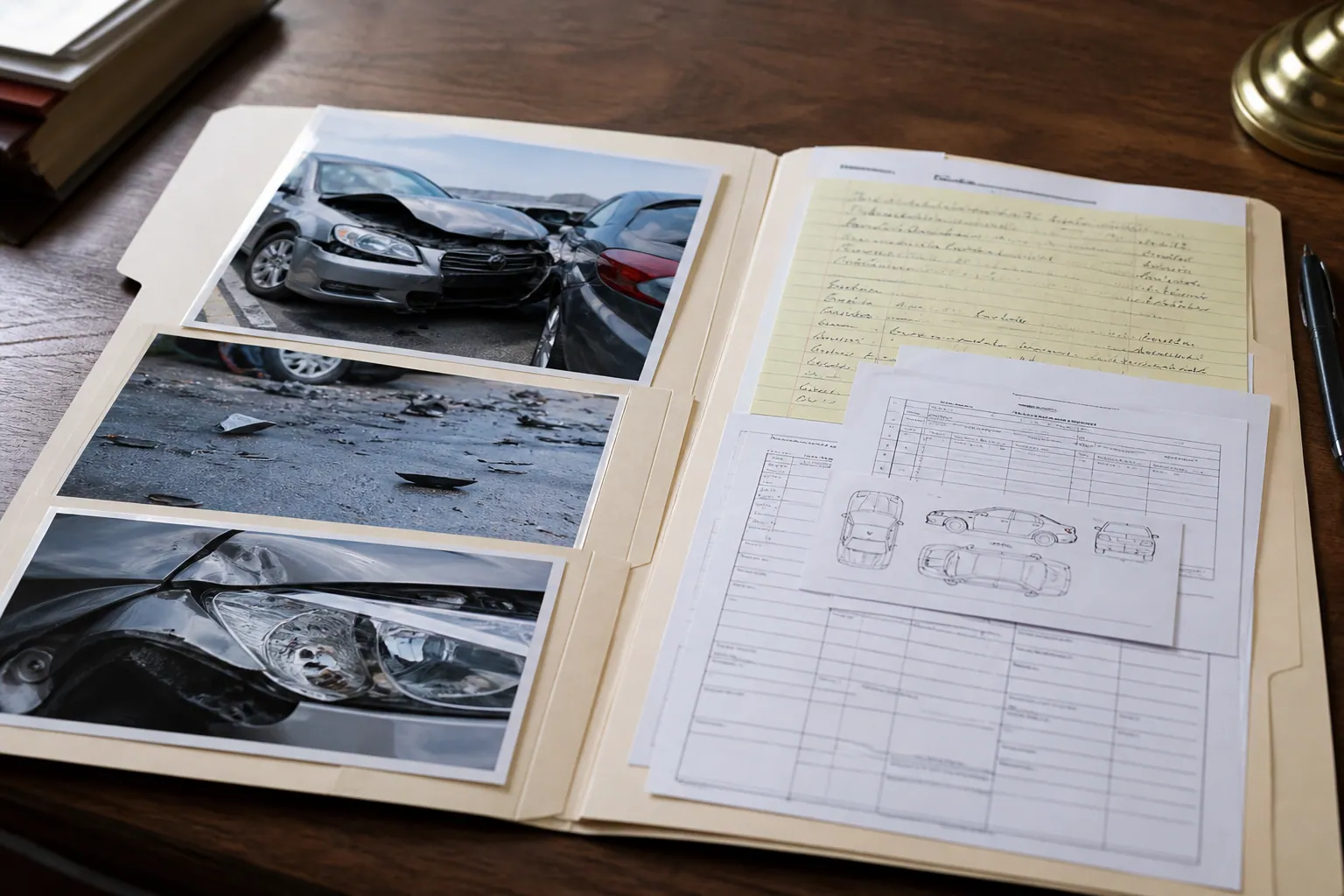
Preserve the evidence behind the report
A statutory exclusion is not a reason to ignore the report. Read it promptly for leads, then preserve the original sources before they disappear.
- Download original phone and dashcam files without editing or compressing them, and keep backup copies.
- Identify nearby cameras quickly; many systems overwrite footage on short cycles.
- Keep witness names and current contact information, and avoid coaching anyone's account.
- Photograph every side of the vehicles before repair, sale, salvage, or destruction.
- Do not attempt a vehicle-data download without appropriate equipment and a sound preservation process.
- Request available 911, dispatch, body-camera, in-car-camera, and scene-photo material through the appropriate channel.
- Keep the report in its original form and record when and where it was obtained.
Preservation does not establish admissibility, but losing the original source can make proof much harder. In a serious or disputed crash, counsel can evaluate whether prompt preservation letters, inspection arrangements, subpoenas, or expert involvement are appropriate.
Frequently asked questions
Will an Indiana jury receive the police crash report?
Indiana Code 9-26-3-4[1] says a report required by that chapter may not be used as evidence in a civil or criminal trial arising out of the accident. A court still must decide disputes about the particular document and proposed use.
Can the officer testify even if the report cannot be used?
Potentially. The statute addresses the report. An officer may testify about firsthand observations if the testimony satisfies the Indiana Rules of Evidence. The officer ordinarily cannot supply personal knowledge of an impact the officer did not witness, and opinions or repeated statements may draw additional objections.
Are photographs or body-camera videos attached to the police file also excluded?
Not automatically merely because they are associated with the file. A proponent may try to offer an original photo or recording through an independent foundation. Authentication, relevance, hearsay, completeness, and other objections can still determine whether it is admitted.
Can something a driver told the officer be used in court?
Sometimes. A party's own statement offered against that party may qualify as an opposing party's statement under Evidence Rule 801(d)(2). But a quotation in the excluded report is not necessarily the proper way to prove it, and statements by other people may require a different hearsay analysis.
Can an insurance company rely on the report?
An insurer may review and consider it while investigating a claim because claim handling is not a trial. The report does not bind a court, jury, or insurer, and other evidence may support or undermine its contents.
Does inadmissible mean undiscoverable?
No, not necessarily. Discovery and trial admissibility are different. The report may identify witnesses and evidence or become the subject of pretrial inquiry, while Section 9-26-3-4 still restricts use of the required report as evidence at trial.
The practical takeaway
In an Indiana crash case, do not confuse the document with the evidence. Section 9-26-3-4 restricts using the required crash report as trial evidence. The officer's firsthand observations, authenticated images, witness accounts, vehicle data, party admissions, and other independently sourced proof remain separate questions under the evidence rules.
If injuries are significant or the facts are contested, a Fort Wayne car accident attorney can review what the report identifies, preserve underlying evidence, and assess what may be usable in court. You can also contact Delventhal Law Office for a case-specific discussion.
This article provides general information about Indiana law, not legal advice. Evidentiary rulings depend on the facts, the purpose for which evidence is offered, and the judge's decision. This article is general information, not legal advice. Reading it does not create an attorney-client relationship, and neither does contacting us. If you do contact us about a possible claim, Indiana Rule of Professional Conduct 1.18 requires us to keep what you tell us confidential whether or not we take the case — but please do not send documents or detailed facts until we have agreed in writing to represent you.