

A Fort Wayne worker may therefore need to coordinate more than one system after an injury. The U.S. Department of Labor’s medical-leave overview[1] explains that workers’ compensation, FMLA, and ADA rules can apply to the same employee in some circumstances. Each law has its own coverage and eligibility tests.
Key takeaways
- Indiana workers’ compensation may provide medical, rehabilitation, and income benefits after a job-related injury.
- Eligible employees may receive up to 12 workweeks of FMLA leave during a 12-month leave year for their own qualifying serious health condition.
- Workers’ compensation leave and FMLA leave may run at the same time when the injury qualifies under both systems and the employer properly designates the absence.
- The ADA covers employers with at least 15 employees and may require reasonable accommodation for a qualified employee with a disability unless the accommodation would cause undue hardship.
- Exhausting FMLA leave does not automatically end the ADA analysis; the employer may still need to consider additional leave or another effective accommodation.

How the three systems differ
The simplest way to understand the overlap is to ask what each law is designed to address.
| System | Primary function | Important threshold |
|---|---|---|
| Indiana workers’ compensation | May provide authorized medical care, rehabilitation, and income benefits for a job-related injury. | Indiana’s Board states that an employee is covered from the first day on the job, although coverage still depends on the employment and injury facts. |
| FMLA | Provides eligible employees with unpaid, job-protected leave for qualifying family and medical reasons. | An employee generally must work for a covered employer, have at least 12 months of service, have at least 1,250 hours of service during the preceding 12 months, and work where the employer has at least 50 employees within 75 miles. |
| ADA | Prohibits disability discrimination and may require reasonable accommodation for a qualified employee with a disability. | Title I generally covers employers with at least 15 employees. |
One program does not replace the others. The facts may activate one, two, or all three systems.
What Indiana workers’ compensation may provide
The Indiana Worker’s Compensation Board’s employee guide[2] describes workers’ compensation as an employer-funded program that may provide medical, rehabilitation, and income benefits after a job-related injury. In Indiana, the employer generally directs the worker’s authorized medical care.
If the authorized treating physician determines that you cannot work, temporary total disability benefits are generally calculated at 66 2/3% of your average weekly wage, subject to the statutory maximum applicable to the injury date. The Board also states that weekly income benefits generally apply when you cannot return to work for more than seven days and that the first seven days are paid only if the disability lasts at least 21 days.
You can learn more through Delventhal Law Office’s Indiana workers’ compensation resource.

When FMLA may protect medical leave
The U.S. Department of Labor’s FMLA fact sheet[3] states that eligible employees of covered employers may take up to 12 workweeks of unpaid, job-protected leave during a 12-month period for specified reasons, including the employee’s own serious health condition that makes the employee unable to work. During FMLA leave, the employer must maintain group health coverage on the same terms that would have applied if the employee had continued working.
For a private-sector employee, the usual eligibility tests are:
- You work for a covered employer. Private employers generally are covered when they employ 50 or more employees in 20 or more workweeks in the current or preceding calendar year; public agencies and public or private elementary and secondary schools are covered regardless of employee count.
- You have worked for that employer for at least 12 months, which generally need not be consecutive.
- You have completed at least 1,250 hours of service during the 12 months immediately before leave begins.
- You work at a location where the employer has at least 50 employees within 75 miles.
Public agencies and public or private elementary and secondary schools are covered employers regardless of their number of employees, but an individual employee must still satisfy the applicable eligibility requirements.
A workers’ compensation absence may count as FMLA leave when the work injury also meets the FMLA definition of a serious health condition. The employer must provide the notices required by the FMLA and designate qualifying leave appropriately.
When the ADA may require an accommodation
The ADA analysis is different from the workers’ compensation and FMLA analyses. A qualified employee with a disability is someone who meets the legitimate requirements for the position and can perform its essential functions with or without reasonable accommodation.
Depending on the individual facts, reasonable accommodation may include job restructuring, a modified work schedule, equipment changes, reassignment to a vacant position, or leave. A covered employer does not have to provide an accommodation that would impose an undue hardship.
A doctor’s note describing work restrictions may alert an employer that an accommodation is needed and may trigger an interactive discussion about effective options. An employer generally may not demand that an employee be “100% healed” if the employee could perform the essential job functions with a reasonable accommodation and would not pose a direct threat.
For more Indiana-focused context, review the firm’s guides to light duty and work restrictions and termination while receiving workers’ compensation.
How workers’ comp, FMLA, and ADA can work together
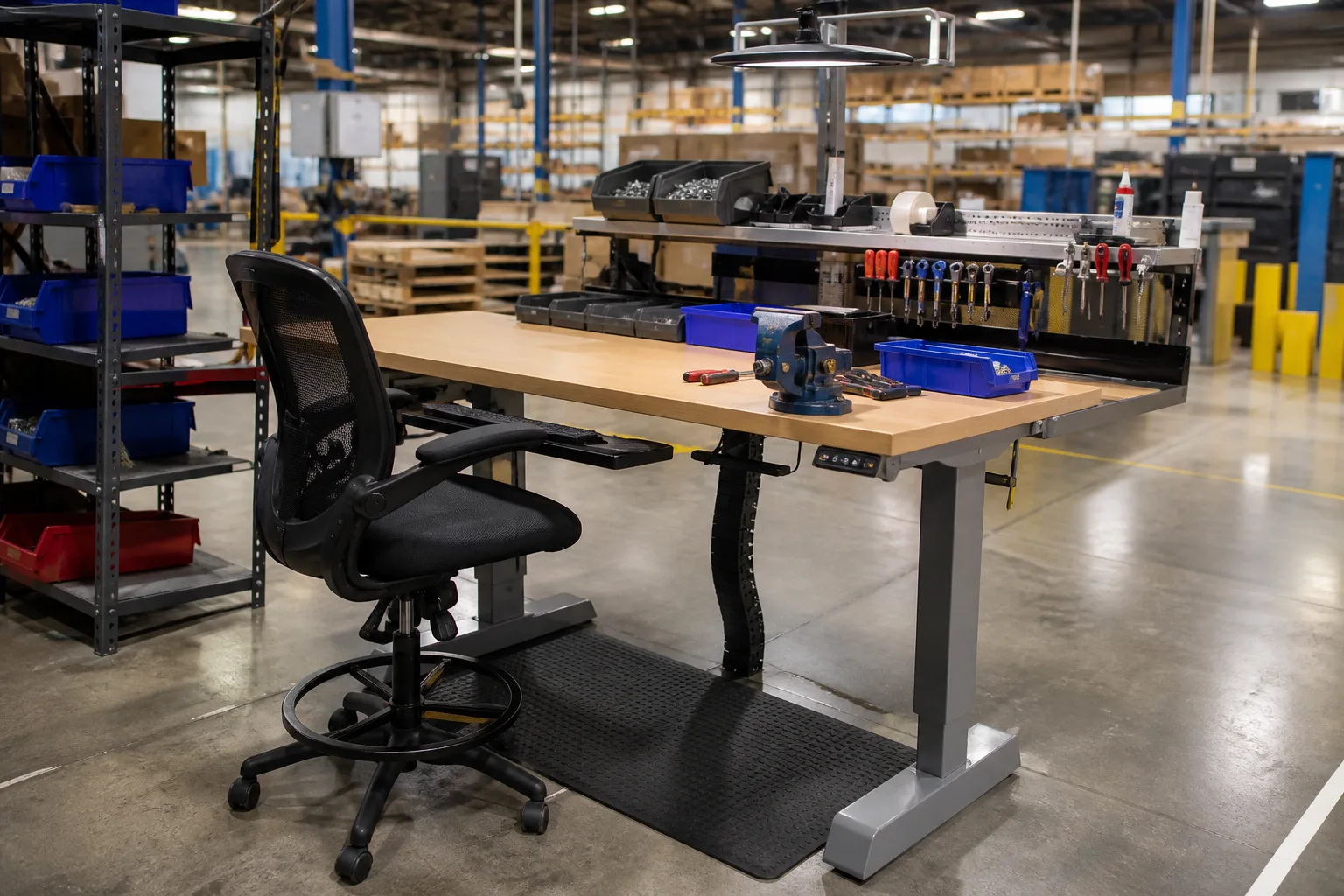
Consider a warehouse employee who has authorized medical restrictions after an Indiana work injury. The employee may receive workers’ compensation medical care, may use FMLA leave if the federal eligibility and serious-health-condition requirements are met, and may request an ADA accommodation if the employee is a qualified individual with a disability.
Workers’ compensation and FMLA may run concurrently
When a workers’ compensation absence also qualifies for FMLA leave, the employer may count the absence against the employee’s FMLA entitlement while workers’ compensation benefits are being paid. FMLA leave is unpaid, but workers’ compensation wage benefits may provide income during the same period.
The ADA question may remain after FMLA ends
After an employee exhausts FMLA leave, the EEOC’s leave guidance[4] explains that a covered employer may still have to consider additional unpaid leave or another accommodation for a qualified employee with a disability, unless the accommodation would cause undue hardship. FMLA exhaustion therefore should not be treated as an automatic answer to every return-to-work question.
Light duty requires careful coordination
Under 29 C.F.R. § 825.207(e)[5], an employee whose workers’ compensation doctor releases the employee to light duty but not to the same or an equivalent job may decline the light-duty offer and remain on available unpaid FMLA leave. The regulation also warns that declining the offer may end workers’ compensation payments.
Indiana Code § 22-3-3-11[6] states that compensation may be suspended when an injured employee refuses employment that is suitable to the employee’s capacity and has been offered or procured, unless the Worker’s Compensation Board finds the refusal justified. Keep the written offer, current restrictions, job description, schedule, and wage information together before responding.

A practical action plan after an Indiana work injury
- Report the injury promptly. Indiana Code § 22-3-3-1[7] generally requires notice within 30 days after the accident, while preserving statutory exceptions for employer knowledge and reasonable excuse.
- Ask how the absence is being classified. Request copies of any workers’ compensation, FMLA, attendance, or leave notices.
- Keep restrictions specific. Ask the treating provider to document the functional limits and their expected duration.
- Make an accommodation request clear. You do not need special words, but explain that a medical condition is affecting work and that you need a workplace change.
- Compare the proposed job with the written restrictions. Record duties, lifting demands, schedule, location, breaks, and wages.
- Track every leave day and payment. Maintain a calendar showing missed work, FMLA designations, workers’ compensation checks, appointments, and return-to-work dates.
- Read before signing. Keep a copy of any proposed agreement, resignation, or other document and consider asking questions about its actual language before deciding.
For related reading, see the firm’s documentation guide.
Documents worth organizing
- Incident report and claim number
- Work-status notes and updated restrictions
- FMLA eligibility, rights, and designation notices
- Written accommodation requests and employer responses
- Job description and any light-duty offer
- Pay stubs and workers’ compensation payment records
- Attendance records and correspondence with human resources
Keep a clean copy of each document and a dated log of important conversations. Avoid sending medical records to people who have not asked for them through an appropriate process.

Frequently Asked Questions
Can my employer count workers’ compensation leave as FMLA leave?
Yes, when the work injury qualifies as an FMLA serious health condition, you are eligible for FMLA leave, and the employer satisfies the FMLA notice and designation requirements, the two forms of leave may run concurrently.
Does FMLA provide an additional workers’ compensation check?
No. FMLA leave is generally unpaid; workers’ compensation wage-replacement benefits arise under a separate system and may be paid during an FMLA-covered absence.
Can I request an accommodation after my FMLA leave is exhausted?
Yes. If the ADA applies, the employer may need to consider additional leave or another reasonable accommodation for a qualified employee with a disability unless it would cause undue hardship.
Must I accept light duty instead of using FMLA leave?
No. Federal FMLA rules do not permit an employer to require an employee to accept light duty instead of taking otherwise available FMLA leave.
What if my employer is too small for FMLA coverage?
FMLA may not apply to a private employer that does not satisfy its coverage rules, but workers’ compensation or the ADA may still require a separate analysis because those laws use different standards.
If you have questions about how these systems may apply to your work-injury documents, you may contact Delventhal Law Office to discuss whether the firm can assist.
This article provides general information, not legal advice. The Scope of Indiana’s Rules of Professional Conduct[8] explains that whether an attorney-client relationship exists can depend on the circumstances and may be a question of fact. Indiana Rule of Professional Conduct 1.18[9] addresses duties relating to prospective clients. Contacting the firm does not necessarily mean that the firm represents you.
Sources
- U.S. Department of Labor’s medical-leave overview (dol.gov) ↩
- Indiana Worker’s Compensation Board’s employee guide (in.gov) ↩
- U.S. Department of Labor’s FMLA fact sheet (dol.gov) ↩
- EEOC’s leave guidance (eeoc.gov) ↩
- 29 C.F.R. § 825.207(e) (ecfr.gov) ↩
- Indiana Code § 22-3-3-11 (iga.in.gov) ↩
- Indiana Code § 22-3-3-1 (iga.in.gov) ↩
- Scope of Indiana’s Rules of Professional Conduct (rules.incourts.gov) ↩
- Indiana Rule of Professional Conduct 1.18 (rules.incourts.gov) ↩