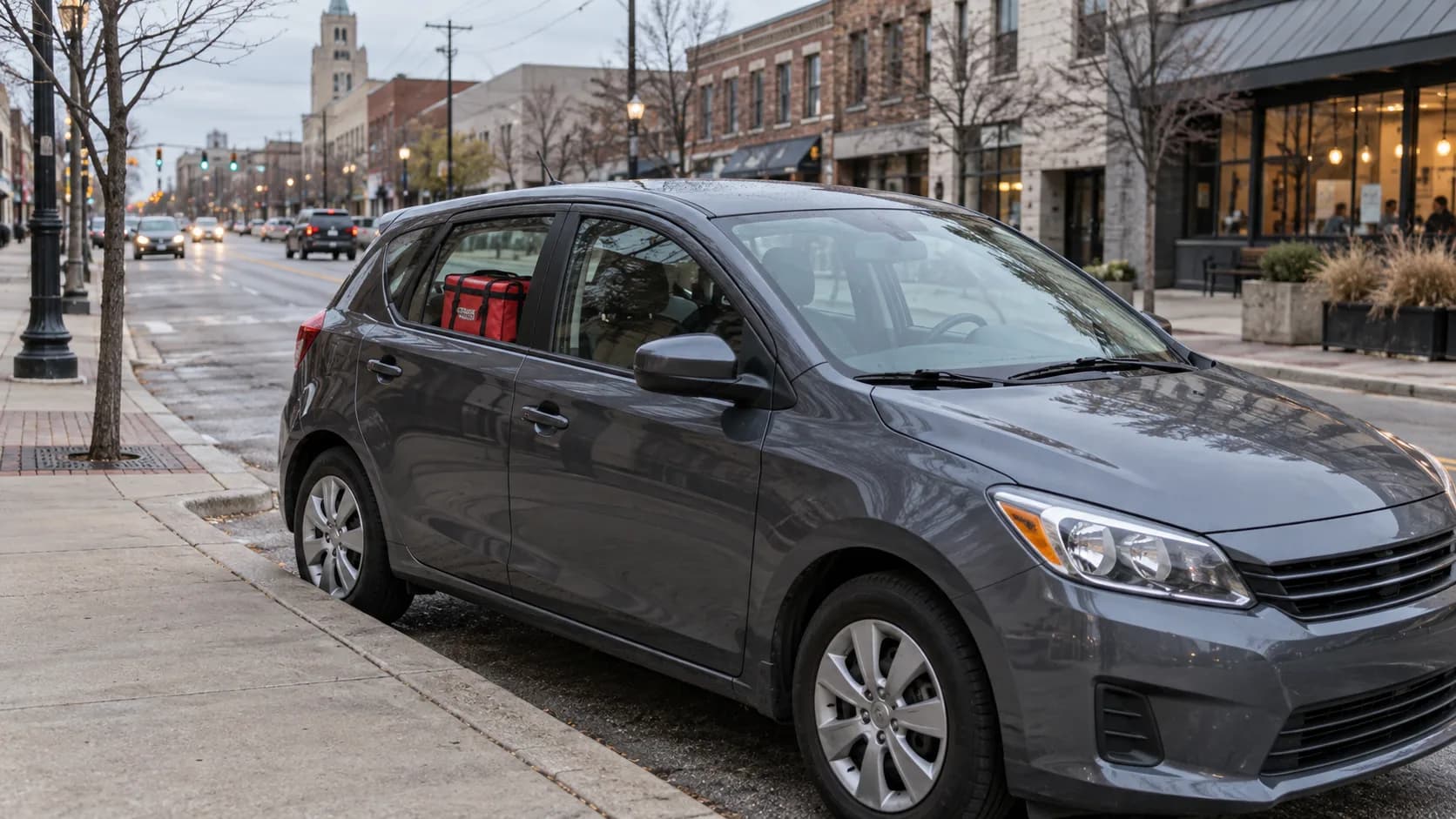
If you were hit by a food-delivery driver in Fort Wayne, a useful first question is whether the person was working through an app, delivering directly for a restaurant, or driving for a personal purpose. This guide focuses on identifying the insurance after a motor-vehicle crash. For the broader process, visit our Fort Wayne car-accident page.
Key takeaways
- The Indiana delivery-network framework applies after June 30, 2024. It sets primary liability insurance requirements for two defined delivery periods (IC 8-2.1-19.3-1 and -3).
- A personal policy can exclude delivery activity, but the statute also permits contracts or endorsements that cover it (IC 8-2.1-19.3-5).
- Network insurance cannot depend on a personal insurer first denying the claim (IC 8-2.1-19.3-3(c)).
- Practical preparation: keep the crash details, app or order information available to you, and correspondence together.
Why the driver's delivery status matters
Indiana defines a delivery network company, or DNC, as an entity doing business in Indiana that uses a digital network to connect customers and drivers for delivery of goods. The DNC-driver definition concerns an individual using a personal vehicle through that network. A qualifying vehicle may be owned, leased, or otherwise authorized for the driver's use (IC 8-2.1-17-5.3, -5.7 and -13.2[2]).
The comparison below summarizes the statutory framework for qualifying DNC activity after June 30, 2024. The required policy must recognize delivery use and cover both delivery periods. The minimums below are liability insurance amounts, not a promised payment to any injured person (IC 8-2.1-19.3-3(a)).
- Logged on and available, operating a personal vehicle, but not providing delivery services or operating in the delivery-service period
-
Indiana framework: The delivery-available period requires at least $50,000 per person and $100,000 per incident for death and bodily injury, plus $50,000 per incident for property damage (Section 3(a)(3)).
Practical records to request: Login and availability history; vehicle details; crash time
- En route to pick up goods, transporting them, or completing a series of deliveries
-
Indiana framework: The delivery-service period requires at least $1 million per incident for death, bodily injury and property damage combined (Section 3(a)(4)).
Practical records to request: Pickup route, timestamps, order sequence, final delivery or return records
- Outside both defined periods
-
Indiana framework: The two period-specific requirements above do not answer the policy question outside those periods. Delivery-period definitions
Practical records to request: Personal trip facts; all potentially relevant policies and endorsements
The statutory delivery-service period starts when the driver operates the vehicle en route to pick up goods as documented by the digital network, regardless of when the request was accepted. It continues through transportation and ends with the directed delivery to the customer or last customer in a series, or delivery or return to a location designated by the DNC. The delivery-available definition excludes both providing delivery services and operating in the delivery-service period (IC 8-2.1-17-5.2 and -5.4).
Platform summaries need their own context. DoorDash's Indiana insurance summary[3] describes its service period using acceptance and completion, unassignment, or cancellation. That wording differs from the statutory definition above. Uber's delivery insurance page[4] distinguishes deliveries from passenger rides and directs drivers to state-specific documents in the app. Practical suggestion: request the Indiana documents effective on the crash date and compare the actual trip timeline with the definitions above; do not substitute a nationwide help page for that analysis.
Food delivery and passenger rideshare have separate statutory provisions: the DNC chapter is IC 8-2.1-19.3, while passenger transportation network insurance is addressed in IC 8-2.1-19.1-8 (IC 8-2.1-19.1-8; delivery chapter linked above[5]). A restaurant's direct delivery arrangement should be examined against the DNC definitions rather than assumed to be identical to app-based work.
Which policies and documents should be investigated?
For qualifying DNC activity, the required primary insurance can be maintained by the driver, the network, or a combination. If the driver's qualifying insurance lapses or does not provide the required coverage, the DNC's insurance must respond from the first dollar and its insurer has a duty to defend (IC 8-2.1-19.3-3(a)–(b)).
Indiana permits personal auto policies to exclude losses during either delivery period, including liability, UM/UIM, medical payments, comprehensive and collision. It also permits delivery protection by contract or endorsement. An exclusion therefore needs to be read in the actual policy; delivery work does not itself establish that every personal policy excludes the crash (IC 8-2.1-19.3-5 and -6).
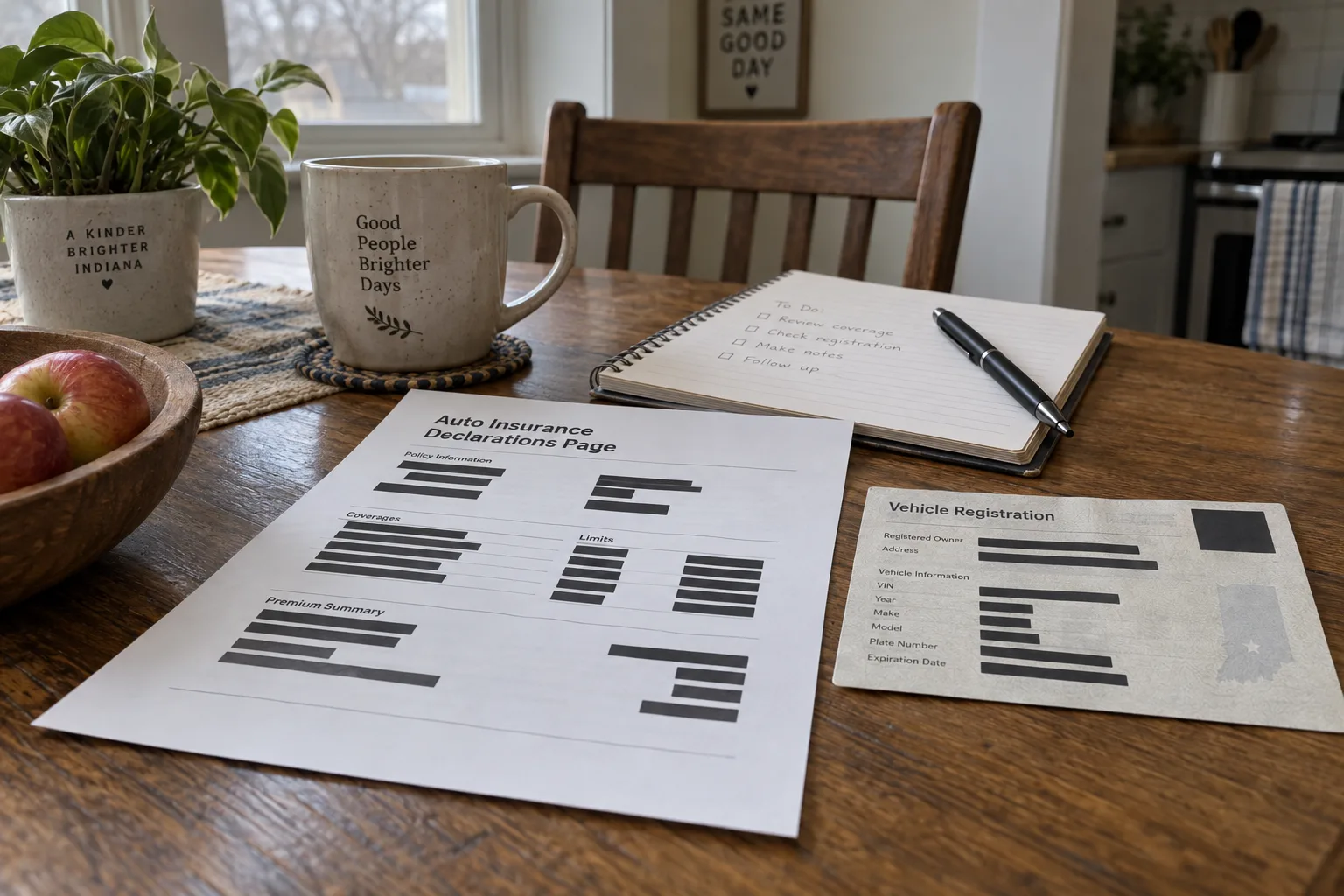
Practical document checklist: request the driver's and vehicle owner's declarations, complete policy and endorsements; the platform's applicable policy or certificate and claim contact; and, for direct restaurant work, the employer name, vehicle ownership, dispatch records and commercial auto documents. This is a preparation list, not a statement that every document must be furnished on informal demand or that every listed policy will pay.
For your own auto policy, the Indiana Department of Insurance describes medical-payments, collision, and uninsured/underinsured motorist protection[6]. Medical payments addresses qualifying occupant medical bills up to policy limits; collision addresses vehicle damage subject to a deductible. UM/UIM addresses an uninsured or underinsured motorist under the applicable terms. Whether you are an insured, what vehicle or event is covered, exclusions, limits and notice conditions all require a policy-specific review. The IDOI claim guide[7] emphasizes understanding the contract and its exclusions and deductibles.
Our uninsured and underinsured motorist page is a related resource. Practical suggestion: bring any written UM/UIM selection or rejection with your policy documents. Do not assume a delivery driver's third-party liability policy is also health or vehicle-damage insurance for that driver.
What if the personal insurer denies coverage?
For a qualifying DNC claim, Indiana does not allow network insurance to depend on a personal insurer first denying the claim (IC 8-2.1-19.3-3(c)). Practical next step: report the matter through the relevant platform's accident channel as well as the identified carrier, rather than waiting for one denial before asking about the other policy.
IDOI advises asking for a written explanation of a denial and the policy language supporting it. IDOI claim tips As practical preparation, compare that explanation with the complete policy, endorsements, crash date and trip records. A dispute about whether a driver was making a delivery calls for a factual timeline, not a guess based on a bag or logo.
IDOI accepts consumer complaints about claim disputes and coverage concerns, recommends first trying the company, agent or broker, and requests supporting documents such as a declarations page, denial letter and correspondence. It asks for copies rather than originals. Its authority concerns insurance businesses within its jurisdiction; out-of-state policies and self-funded health plans can raise jurisdiction limits. IDOI consumer complaints[8]
Practical caution: ask a lawyer what must be filed, with whom, and by what date while a complaint or insurance investigation is pending.
Evidence to preserve after a delivery-driver crash
For a DNC accident, the driver must provide proof of the required insurance and disclose the delivery-period status upon request to directly interested parties, insurers and investigating law enforcement (IC 8-2.1-19.3-3(e)).
The DNC and potentially covering insurer must cooperate in the coverage investigation, including exchange of specified delivery-period timing information from the twelve hours before and twelve hours after the accident and descriptions of applicable protection, exclusions and limitations. If a dispute arises over when a period began or ended and the DNC lacks, did not retain, or fails to provide the required information, the statute directs the DNC insurer to assume primary liability for the claim (IC 8-2.1-19.3-7).
Practical preservation suggestions, not additional legal requirements:
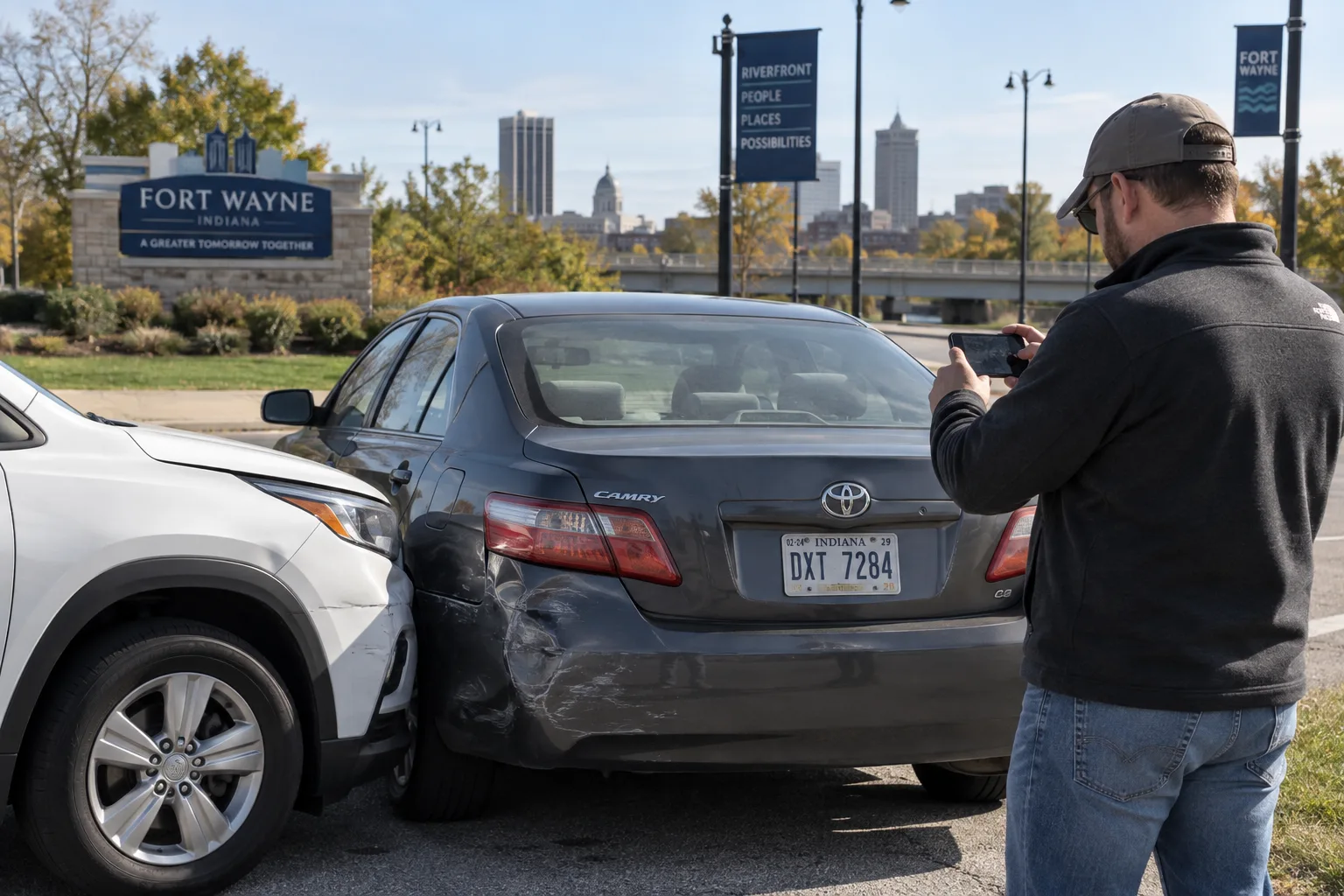
- From a safe location, photograph vehicle damage, plates, roadway conditions and visible delivery identifiers.
- Keep the driver's name, vehicle registration, business or app name, and the police agency and report number.
- Save messages, receipts, order screenshots and original files that you lawfully possess. Do not enter another person's account or device without permission.
- Write down witness contact details and the driver's actual words about the trip; distinguish what you observed from what someone told you.
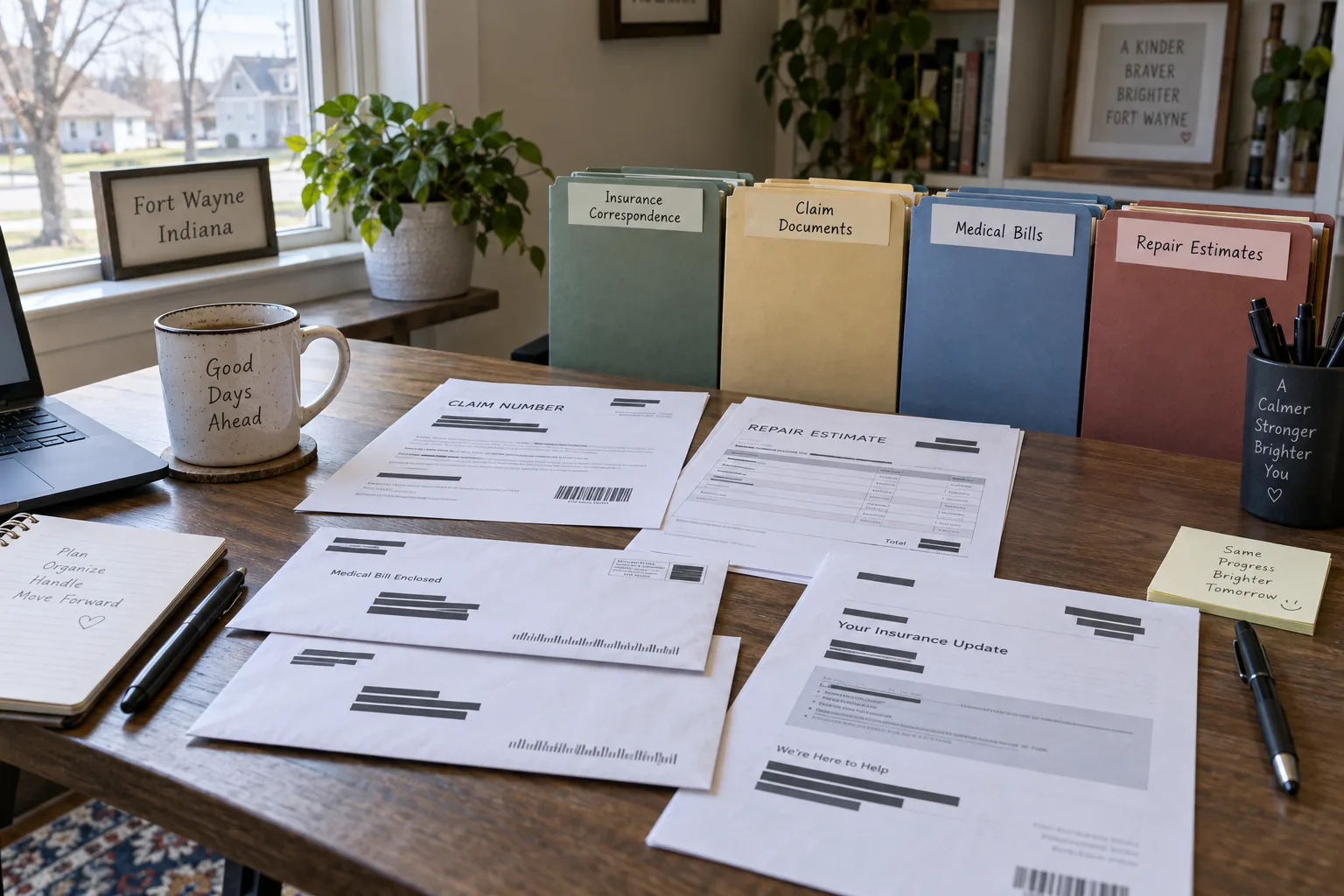
- Keep bills, wage records, repair estimates, claim numbers and correspondence together.
- If more than one app or order was involved, note each one and ask for the individual timelines.
| Record | What to note |
|---|---|
| Trip timeline | Crash time, app status, pickup and delivery timestamps, and any other active orders. |
| Policy documents | Insurer, policy dates, vehicle, named insured, and delivery endorsements or exclusions. |
| Claim correspondence | Claim number, contact, reporting date, requests for information, and any written denial. |
For a broader preparation checklist, see evidence that helps prove an Indiana car-accident claim.
What should you do next, and which deadlines matter?
IDOI recommends reporting claims promptly, supplying accurate information, and checking the policy's notification time frame. IDOI claim tips Practical suggestion: ask each claim contact what information is missing and keep a dated record of the answer.
Indiana's general rule for actions involving injury to a person or personal property is two years after the cause of action accrues (IC 34-11-2-4(a)[9]). That is a lawsuit filing period, not the same thing as reporting an insurance claim.
Do not calculate a case-specific filing date from this article. A child's claim, a death, a government defendant, or an insurance-contract dispute needs its own analysis. Indiana has separate provisions for legal disabilities, wrongful death and government-claim notices (IC 34-11-6-1[10]; IC 34-23-1[11]; IC 34-13-3[12]). Practical next step: ask an attorney to identify the applicable parties, filing dates and policy conditions promptly.
Frequently asked questions
Does DoorDash or Uber Eats always pay?
No particular payment follows merely from a platform's name. For qualifying DNC activity, Indiana requires period-specific liability insurance and specifies when the network's policy must respond if the driver's qualifying insurance fails. Those requirements do not establish the amount owed for an individual crash (IC 8-2.1-19.3-3).
What if the delivery driver borrowed the car?
The DNC definition of a personal vehicle includes a vehicle otherwise authorized for the driver's use, as well as one owned or leased by the driver (IC 8-2.1-17-13.2(b)). Practical suggestion: identify the owner, document permission facts, and request both the owner and delivery documents. Borrowing does not answer every policy question.
What if the driver worked directly for a restaurant?
Start with the actual arrangement. The DNC definition requires a digital network connecting customers and drivers for delivery requests (IC 8-2.1-17-5.3). As practical preparation, gather the restaurant's identity, work schedule, dispatch method, vehicle details and auto-policy information for individual review.
Must I obtain a personal-policy denial first?
For the network insurance addressed by the Indiana DNC statute, no: that protection cannot depend on a personal carrier first denying the claim (IC 8-2.1-19.3-3(c)).
If you want to discuss a food-delivery crash, contact Delventhal Law Office. A useful starting packet is the crash report information, photographs, trip details, policies and letters. You can also read about attorney Chad Delventhal.
This article provides general information, not legal advice. Reading it does not establish an attorney-client relationship. Contacting the firm does not automatically establish representation; whether a relationship exists depends on the circumstances. Please confirm whether the firm has agreed to represent you and avoid sending sensitive details before discussing an appropriate channel.
Sources
- Indiana delivery-network provisions (iga.in.gov) ↩
- IC 8-2.1-17-5.3, -5.7 and -13.2 (iga.in.gov) ↩
- Indiana insurance summary (help.doordash.com) ↩
- delivery insurance page (uber.com) ↩
- IC 8-2.1-19.1-8; delivery chapter linked above (iga.in.gov) ↩
- Indiana Department of Insurance describes medical-payments, collision, and uninsured/underinsured motorist protection (in.gov) ↩
- IDOI claim guide (in.gov) ↩
- IDOI consumer complaints (in.gov) ↩
- IC 34-11-2-4(a) (iga.in.gov) ↩
- IC 34-11-6-1 (iga.in.gov) ↩
- IC 34-23-1 (iga.in.gov) ↩
- IC 34-13-3 (iga.in.gov) ↩