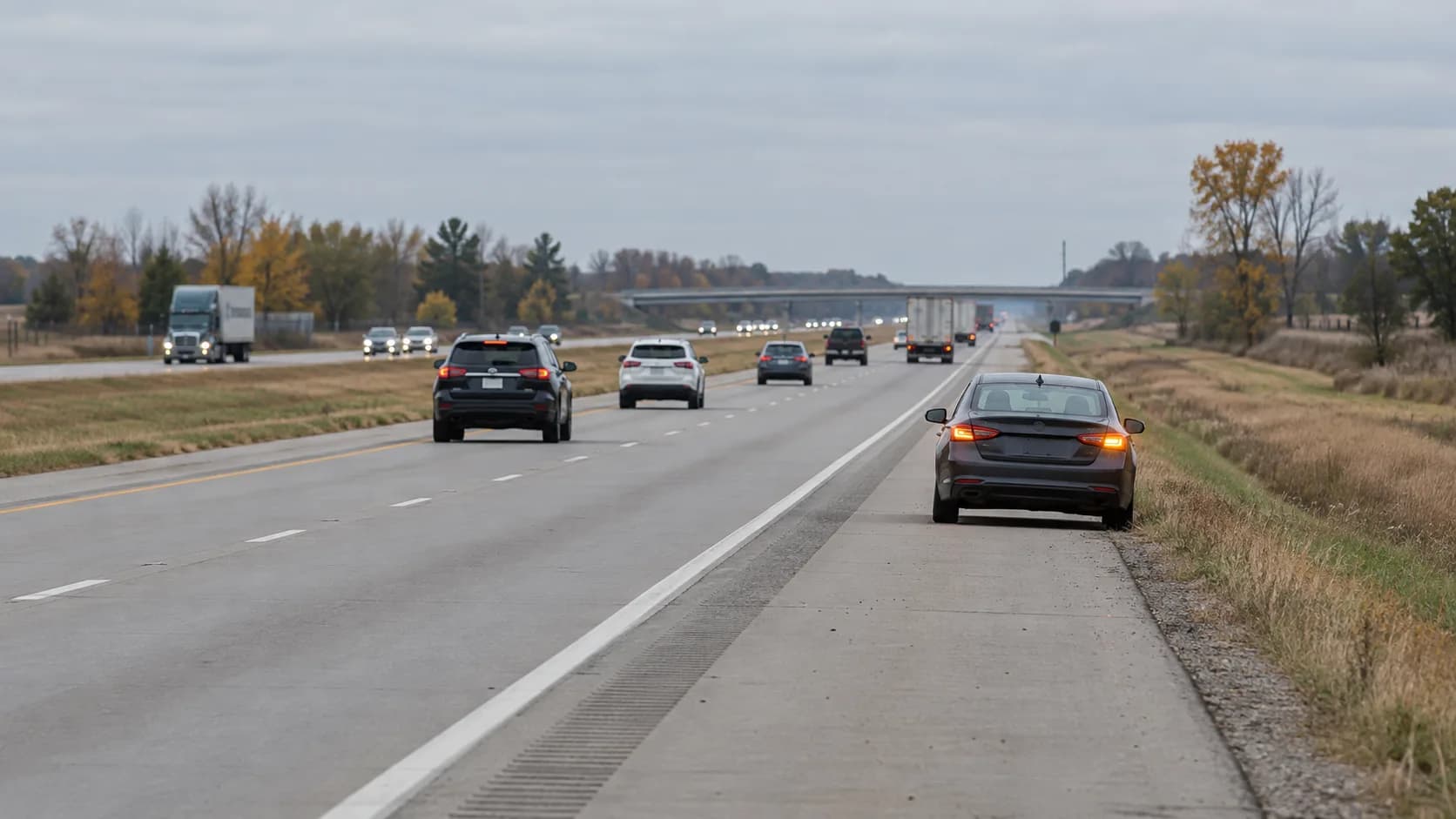
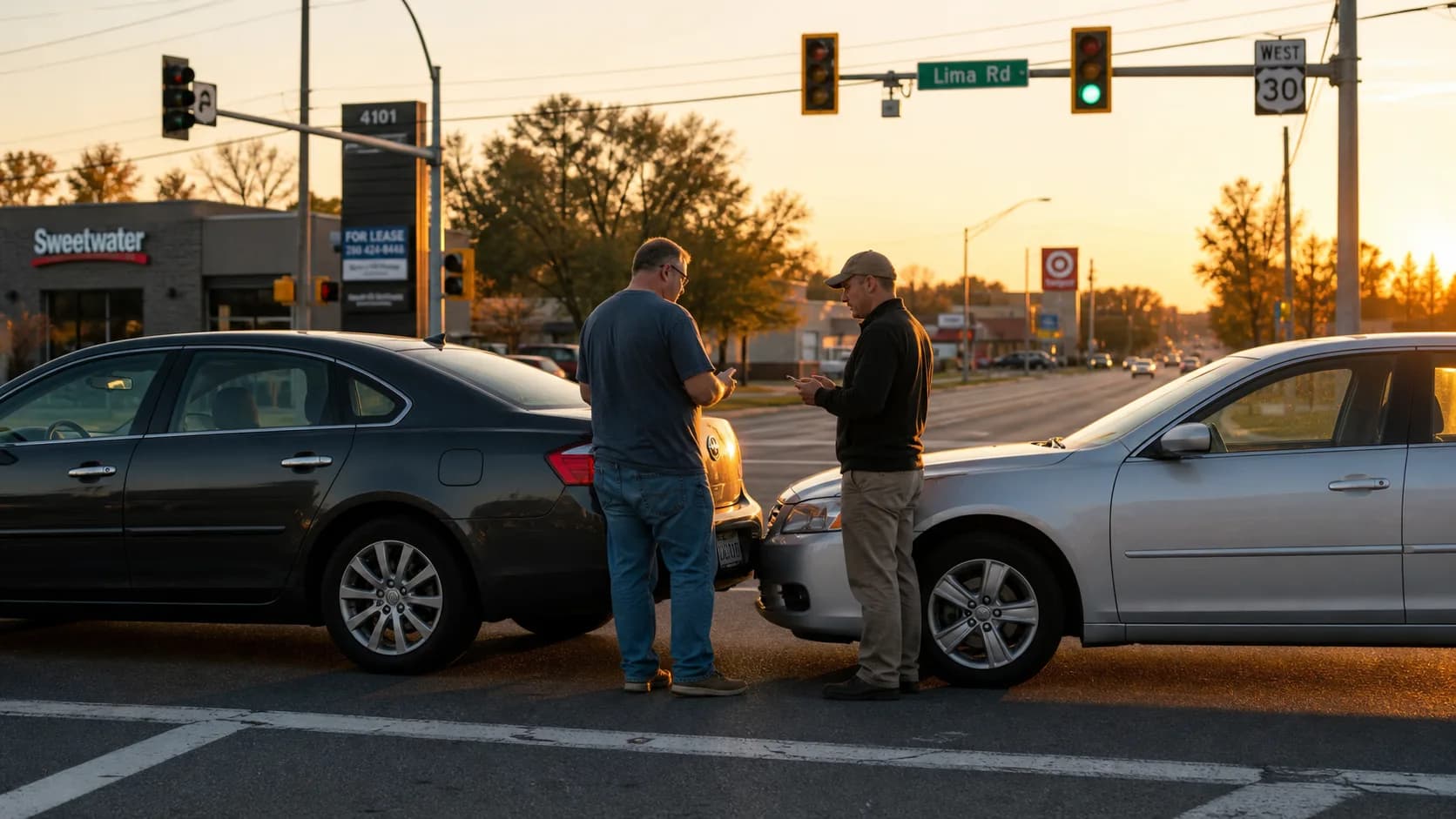
If you have heard that "Indiana is an at-fault state," you may be wondering what that actually means for your bills and your claim after a Fort Wayne or Allen County crash. It is not just legal jargon. The at-fault system decides who pays, how much, and what can reduce or cancel your recovery. This guide explains the rules in plain language, with links to the Indiana statutes and official sources behind them.

Key takeaways
- At-fault means fault decides payment. The negligent driver's liability insurance is the primary source of compensation, unlike a "no-fault" state where you turn first to your own policy.
- Comparative fault can shrink your check. Your damages are reduced by your percentage of fault, and being more than 50% at fault bars recovery entirely.
- Policy limits matter. Indiana's minimum liability coverage is 25/50/25, which may not cover a serious injury.
- Your own coverage can fill gaps. Uninsured/underinsured motorist (UM/UIM) coverage may pay when the at-fault driver has too little insurance or none.
- Deadlines are strict. Most Indiana car accident injury lawsuits must be filed within two years.
What "at-fault state" actually means in Indiana
In an at-fault (also called "tort") state, the person who negligently causes a crash is financially responsible for the harm they cause. In practice, that means you — the injured person — build a claim against the at-fault driver and file it with their liability insurance company. If that insurer will not pay fairly, you can file a lawsuit against the driver within the deadline.
This is different from a true "no-fault" state, where each driver's own insurance pays certain medical and wage losses regardless of who caused the crash. Indiana does not work that way for injury claims. Here, fault is the central question, and proving the other driver's negligence is what unlocks compensation.
To recover, you generally have to show the four classic elements of negligence — that the other driver owed you a duty of care, breached it, caused the crash, and caused you real damages. If you want a deeper walkthrough, our overview of how a Fort Wayne car accident claim works breaks down the process step by step.

Indiana's comparative fault rule: the 51% trap
Being an at-fault state does not mean fault is all-or-nothing. Indiana uses a modified comparative fault system. Under the state's Comparative Fault Act, your recovery is reduced in proportion to your share of the fault — and there is a hard cutoff.
The practical rule: If your own fault is greater than the combined fault of everyone else who contributed to the crash (in a typical two-car case, that means more than 50%), you are barred from recovering anything.
Indiana law states that a claimant "is barred from recovery if the claimant's contributory fault is greater than the fault of all persons" whose fault contributed to the injury (Ind. Code 34-51-2-6[1]). So at 50% fault you can still recover (reduced by half); at 51% you recover nothing.
Here is how that math typically plays out on a $100,000 claim:
| Your share of fault | Total damages | What you can recover |
|---|---|---|
| 0% | $100,000 | $100,000 |
| 10% | $100,000 | $90,000 |
| 25% | $100,000 | $75,000 |
| 50% | $100,000 | $50,000 |
| 51% or more | $100,000 | $0 (barred) |
Illustration only. Your actual fault percentage and damages depend on the evidence in your case.
This is exactly why insurance adjusters often try to pin part of the blame on you — every percentage point they assign lowers what they owe, and pushing you past the 51% line erases the claim. We explain the mechanics in more detail in our guide to Indiana's 51% fault rule.

Who pays, and how much: liability limits and policy caps
In an at-fault state, the at-fault driver's liability insurance is your first stop. But that insurance only pays up to the policy's limits. Indiana requires every driver to carry minimum liability coverage of $25,000 for the injury or death of one person, $50,000 for two or more people in one crash, and $25,000 for property damage — often written as "25/50/25" (Indiana BMV, Proof of Financial Responsibility[2]).
Those are minimums, not typical damages. A single ambulance ride, ER visit, and surgery can blow past $25,000 quickly. When the at-fault driver carries only minimum coverage, the liability policy may not be enough — which is where your own coverage becomes important.
When the at-fault driver has too little insurance — or none
Indiana's at-fault system has a built-in backstop: uninsured motorist (UM) and underinsured motorist (UIM) coverage on your own auto policy. UM coverage can apply when the at-fault driver has no insurance or flees the scene; UIM coverage can apply when the at-fault driver's limits are too low to cover your injuries.
Indiana law generally requires insurers to offer this coverage unless you reject it in writing, and underinsured motorist coverage must be made available in limits of not less than $50,000 (Ind. Code 27-7-5-2[3]). Many drivers do not realize they carry this protection until they need it. If you were hit by a driver with little or no coverage, our article on what to do when the at-fault driver has no insurance walks through your options.
How fault affects what you can recover
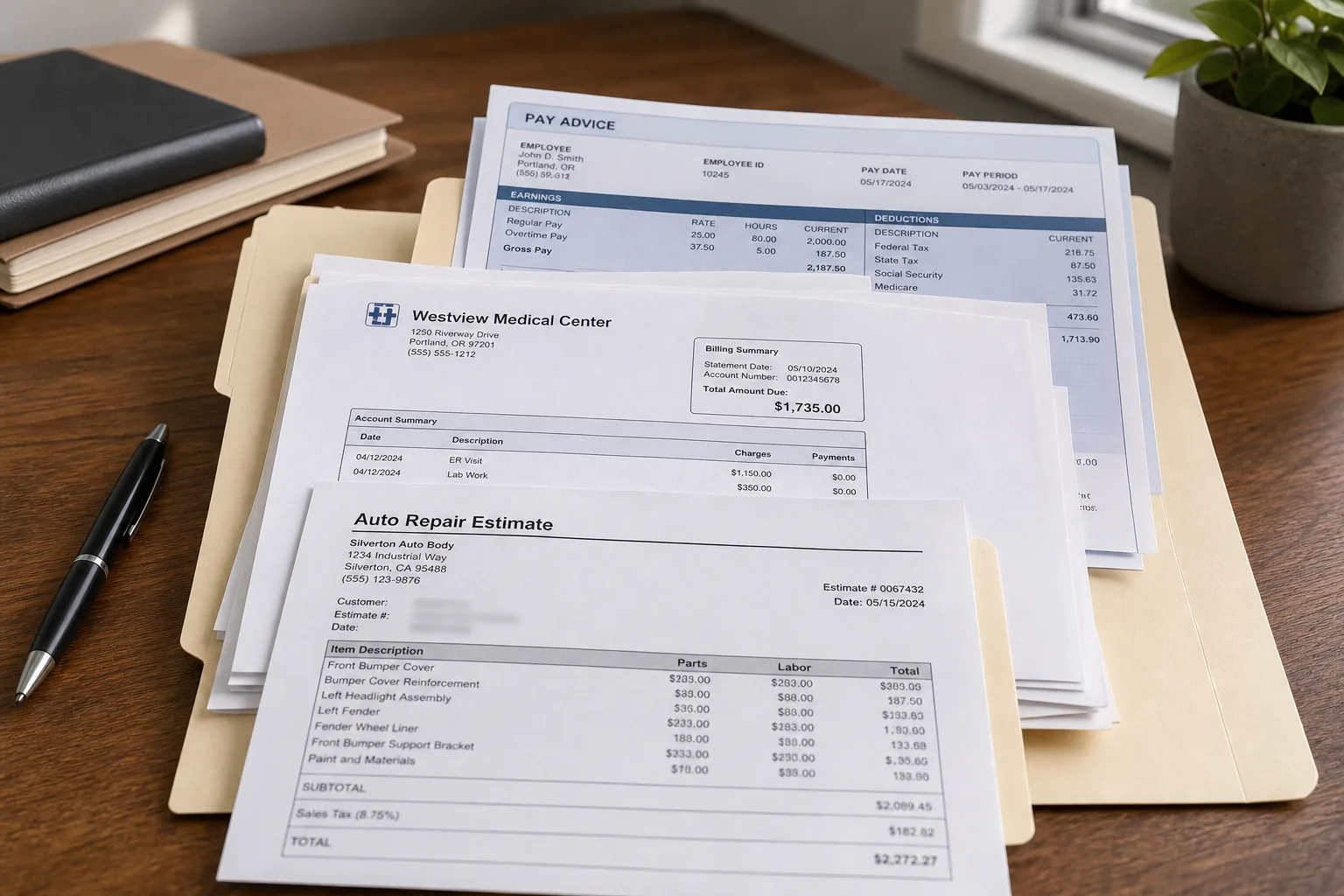
In an Indiana at-fault claim, compensable losses (called "damages") generally fall into economic and non-economic categories. Fault percentages reduce all of them the same way.
| Type of damage | What it can include | How to document it |
|---|---|---|
| Medical expenses | ER, imaging, surgery, therapy, future care | Bills, records, provider statements |
| Lost wages | Missed work, reduced hours, lost earning capacity | Pay stubs, employer letters, tax records |
| Pain and suffering | Physical pain, limitations, emotional distress | Records, journals, testimony |
| Property damage | Vehicle repair or replacement value | Estimates, photos, valuation reports |
Because medical proof drives the value of nearly every category, prompt and consistent treatment matters. Gaps in care give insurers room to argue your injuries were minor or unrelated. For the wage side, see our guide to recovering lost wages after an Indiana car accident, and for the big picture, how Indiana settlement value is built.
The deadline that can end an at-fault claim
No matter how clear the other driver's fault is, you can lose the right to recover if you wait too long. In Indiana, an action for injury to a person generally must be filed within two years of the crash (Ind. Code 34-11-2-4[4]). Different, shorter deadlines can apply when a government vehicle or entity is involved, so it is wise to confirm the timeline early.

What to do to protect an at-fault claim
- Get medical care promptly and follow through with treatment.
- Report the crash and get the official police report and its number.
- Photograph vehicles, the scene, and visible injuries; collect witness contacts.
- Notify your own insurer, but be careful giving recorded statements to the other driver's insurer.
- Keep records of bills, missed work, and out-of-pocket costs.
- Confirm your deadlines and your own UM/UIM coverage before you settle anything.
Frequently Asked Questions
What is the difference between an at-fault and a no-fault state?
In an at-fault state like Indiana, the negligent driver (and their liability insurer) pays for the harm they cause. In a no-fault state, each driver's own insurer pays certain losses regardless of who caused the crash. Indiana bases injury recovery on proving fault.
Can I still recover if I was partly at fault in Indiana?
Yes, as long as your share of fault is not greater than 50%. Your recovery is reduced by your percentage of fault, but if you are found more than 50% at fault, you are barred from recovering under Ind. Code 34-51-2-6.
What if the at-fault driver's insurance is not enough?
Your own underinsured motorist (UIM) coverage may make up part of the gap, and uninsured motorist (UM) coverage may apply if the driver had no insurance. Reviewing your policy is an important early step.
Why does the insurance company keep suggesting the crash was my fault?
Because in a comparative fault state, every percentage of blame assigned to you lowers what the insurer pays — and pushing you past 50% eliminates the claim. That is why documenting fault carefully is so important.
How long do I have to file an Indiana car accident claim?
Most personal injury lawsuits from a car crash must be filed within two years under Ind. Code 34-11-2-4. Shorter notice deadlines can apply to claims involving government entities.
Talk through your situation
Indiana's at-fault system rewards drivers who understand it and can be unforgiving to those who do not. If you were hurt and are not sure who pays or how fault might affect your claim, a free consultation can help you understand your options and the deadlines that may apply. Delventhal Law Office can review what happened, explain how comparative fault and insurance coverage fit your facts, and help you decide the next step. You do not have to figure out the insurance process alone.
This article is general information about Indiana law and is not legal advice. Reading it does not create an attorney-client relationship. For advice about your specific situation, speak with a licensed Indiana attorney.