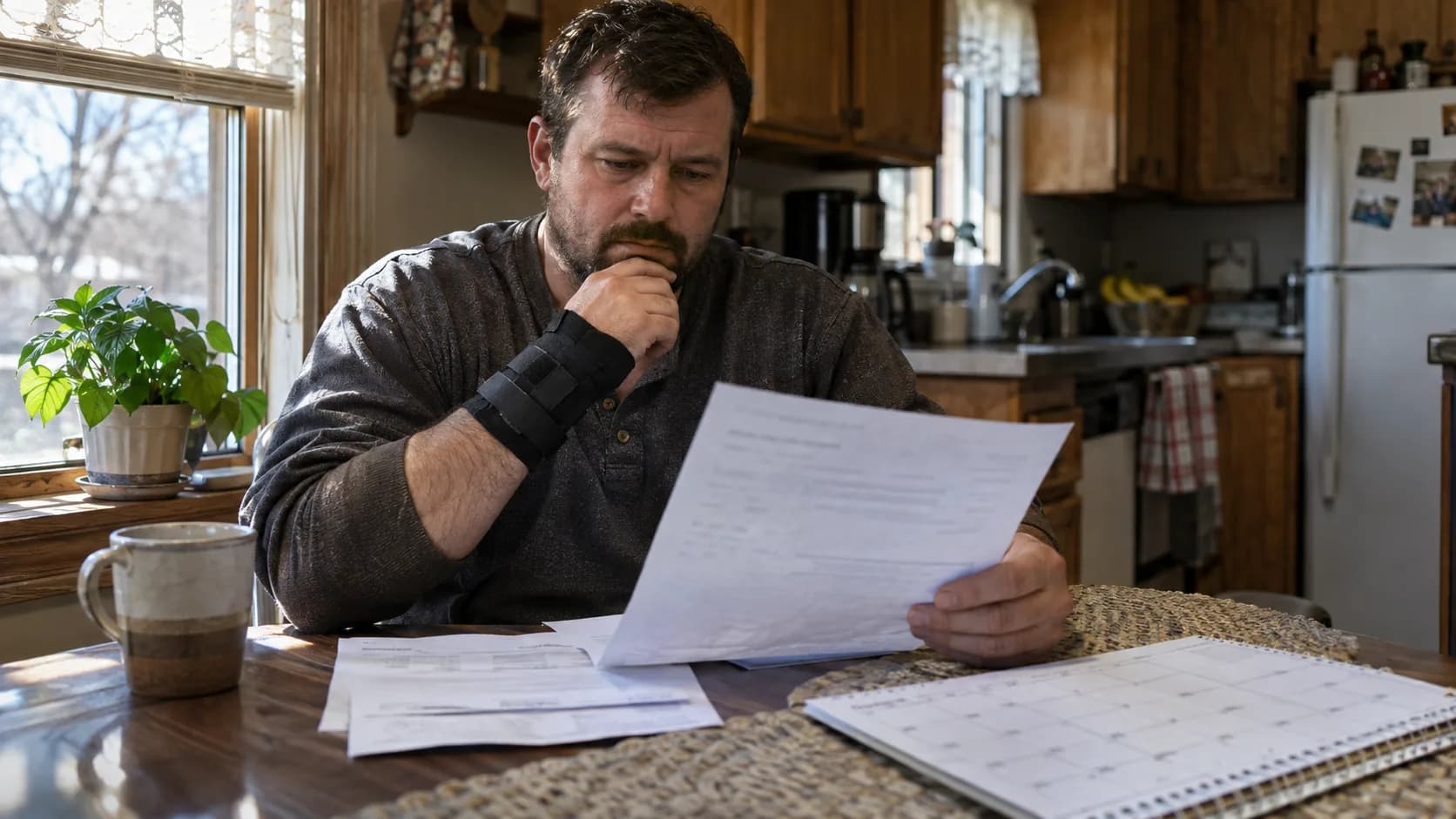
If a clinic sends you a bill while your work-injury claim is delayed, the bill does not by itself establish who is legally responsible. Start by separating an unpaid authorized-treatment bill from a denial of the injury, a denial of a particular service, or treatment you arranged independently.
Key takeaways
- Indiana Code 22-3-3-4[3] generally requires the employer to furnish necessary treatment for a compensable injury without charge to the employee.
- The employer or carrier generally directs medical care in an Indiana workers’ compensation claim.
- A provider may not knowingly try to collect from the worker or the worker’s family for medical services or products covered under Indiana workers’ compensation law.
- State Form 45442 begins the Board’s informal Request for Assistance process, which specifically addresses unpaid medical bills and billing injured employees.
- For an unresolved employee claim, the formal hearing process uses an Application for Adjustment of Claim, State Form 29109. A provider’s fee claim is a different proceeding.

The basic Indiana payment rule
Under IC 22-3-3-4(a) and (b)[4], after a covered injury and before permanent impairment is adjudicated, the employer must furnish an attending physician and services and products deemed necessary by the physician or Board, free of charge to the employee. The statute also addresses care during temporary total disability. Later care after an impairment agreement or award is governed by subsection (c), including its review-period and Board-application conditions. This is not a promise that every future bill is covered.
The payment protection is especially important when a provider’s billing system sends a balance to you automatically. Under IC 22-3-3-5(b) through (d)[1], the employee and the employee’s estate are not liable to a provider for services obtained under Indiana Code 22-3-3-4[3]. Claims for those covered services are directed against the employer or its insurance carrier through the Worker’s Compensation Board.
The key distinction is between the provider’s payment dispute and your entitlement to care. A disagreement over the amount owed for covered services should not simply become your personal balance. For a broader overview, visit our Fort Wayne workers’ compensation page.

Why did the medical bill reach you?
An invoice may reach you because the provider lacks the correct carrier information, the carrier has not received the bill or records, the payer contests the service, or the employer disputes that the injury is compensable. The useful first question is not simply “Who sent this?” but “What exact reason was given for nonpayment?”
| Situation | What it means | Useful document to request |
|---|---|---|
| Authorized care, no stated denial | A covered authorized-treatment charge is generally directed to the employer or carrier rather than the employee. | Itemized bill and carrier billing record |
| Provider lacks claim details | The bill may need to be routed to the correct workers’ compensation payer. Ask the billing office what claim information it needs. | Claim number and adjuster contact information |
| Payer contests the bill | Find out whether the disagreement concerns the charge, missing records, authorization, or whether the service relates to the injury. Ask for a copy of any written explanation. | Written contest or denial notice |
| Entire injury claim is denied | The Board advises asking the carrier or self-insured employer why the claim was denied[5] and considering Board procedures if the dispute remains unresolved. | Denial notice and the records relied on |
| Worker chose separate care | Because the employer generally directs care, independently arranged treatment may create a payment dispute unless a statutory exception or Board order applies. | Authorization communications and medical referral |
Save the envelope, every page of the bill, collection notices, explanation codes, portal screenshots, and messages with the employer, adjuster, and provider. Do not alter the records; organize them by date.
A practical response plan
- Confirm the bill. Ask the provider for an itemized statement showing the service date, charge, payments, adjustments, and current balance.
- Confirm authorization. Identify who selected or referred you to the provider and preserve the appointment notice, referral, approval, or claim email.
- Send the correct claim information. Give the billing office the employer’s name, carrier, adjuster, claim number, and date of injury, without posting private medical information publicly.
- Ask for the reason in writing. Request the carrier’s exact position: missing information, fee dispute, treatment dispute, causation dispute, or denial of the whole claim.
- Keep a contact log. Record the date, person, telephone number, subject, promised action, and follow-up date for each communication.
- Escalate a continuing dispute. The Board lists billing injured employees and unpaid medical bills among the issues handled through its informal dispute process.
If the adjuster does not respond, use the more detailed recordkeeping steps in what to do when an Indiana workers’ compensation adjuster is not responding.

What if a collection agency contacts you?
IC 22-3-3-5.1(a)[2] prohibits a provider or someone collecting for the provider from knowingly attempting to collect a charge for covered workers’ compensation medical services or products from the employee, the employee’s estate, or family members. That protection depends on the charge actually being covered, so a collection notice should be answered with documentation rather than assumptions.
Send a concise written response identifying the account as connected to a pending or accepted workers’ compensation claim. Include the carrier and claim information, ask that the account be reviewed, and preserve proof of delivery. Ask for advice before signing a payment agreement that treats a disputed charge as your personal debt. Do not ignore a lawsuit or a stated response date. A letter to a billing office is not a court filing or an automatic collection hold.
Who pays for unauthorized or self-selected care?
The Board explains in its doctor-selection guidance[5] that the employer directs medical care in Indiana. If you believe the care is inadequate, communicate the problem and consider a Board application rather than assuming an independently chosen appointment will be paid.
IC 22-3-3-4(d)[4] addresses other care during temporary total disability because of an emergency, the employer’s failure to provide required care, or another good reason. Payment of the reasonable cost is subject to Board approval. Those limits matter: a delay does not automatically authorize any provider or service you choose. Subsection (e) separately prohibits delaying emergency care considered necessary in the professional judgment of the attending health care facility physician.
Before arranging nonemergency treatment on your own, preserve the authorized doctor’s recommendation, the carrier’s response, appointment delays, and your written request for care. Related guidance appears in the firm’s articles about who chooses the workers’ compensation doctor and disputed physical therapy.

Request for Assistance versus a formal claim
The Worker’s Compensation Board’s informal dispute process starts when a completed Request for Assistance, State Form 45442, is filed. A Board case coordinator may then contact the parties and investigate in an effort to resolve the dispute without a formal hearing.
You can download the current form from the Board’s official forms directory[6] and read the Board’s informal-dispute instructions[7]. Delventhal Law Office also provides a plain-language guide to the Indiana Request for Assistance.
If informal assistance does not resolve the dispute, the Board states that unresolved issues may move forward only after State Form 29109, the Application for Adjustment of Claim, is filed. For an accidental-injury claim, IC 22-3-3-3(a)[8] generally requires filing with the Board within two years after the accident. Under subsection (b), if temporary total disability under section 7 or temporary partial disability under section 9 was paid, that two-year period begins on the last date for which that compensation was paid. That is not necessarily the check date. Payment of a medical bill alone is not one of the payments listed in subsection (b).
A Request for Assistance is not a substitute for a timely formal claim. Do not wait for informal discussions to finish if a filing deadline may be close. Death and radiation injuries have distinct provisions in section 3(a)[8]; section 30[9] addresses limitations for minors or mentally incompetent persons without a guardian or trustee. Proceedings involving an existing award may require analysis under section 27[10]. Have the accident date, payment periods, prior filings, and orders reviewed rather than calculating the deadline from a bill or collection letter. The provider’s fee-dispute deadline under IC 22-3-3-5(d)[1] is separate from your employee-claim deadline.

Documents to organize
- Itemized bills, balance statements, and collection letters
- Authorization, referral, and appointment records
- Carrier name, claim number, adjuster contact details, and denial notices
- Medical records and work-status notes already provided to you
- Emails, portal messages, certified-mail receipts, and a dated call log
- Copies of assistance requests, formal claims, denial notices, and Board orders connected to the dispute
Frequently Asked Questions
Can a medical provider bill me while workers’ compensation is deciding the claim?
The fact that a statement arrived does not decide who owes it. Under IC 22-3-3-5.1(a)[2], a provider or its collector may not knowingly collect or attempt to collect a covered charge from the employee, the employee’s estate, or family members. Preserve the statement and ask the provider and carrier to clarify coverage; do not assume every collection effort is lawful or every disputed charge is covered.
Should I submit the bill to my health insurance?
Ask the health plan how it handles disputed work-injury bills, accurately disclose that the injury happened at work, and provide any denial notice it requests. Do not assume coverage or reimbursement. Get the plan’s answer in writing and seek claim-specific advice before treating health insurance as the final payer. These are practical questions to ask, not a statement that every health plan must pay.
Which Board form can I use for unpaid medical bills?
State Form 45442 is the Request for Assistance used to start the Board’s informal dispute process, and the Board lists unpaid medical bills and billing injured employees among the issues that process handles.
Does a Request for Assistance protect my filing deadline?
The Board describes State Form 45442 as an informal process and State Form 29109 as the application required to move an unresolved dispute into the formal hearing process. Do not assume the informal request replaces a timely formal filing.
What if the carrier refuses treatment instead of merely delaying a bill?
A treatment-authorization dispute is different from a provider-payment delay; document the authorized doctor’s recommendation, the carrier’s written response, and any stated reason for refusal, then consider Board assistance or legal review.
If a work-injury bill is being delayed, denied, or sent to collections and you are unsure which process applies, Delventhal Law Office can review the documents, explain the available Indiana procedures, and help you decide whether a free consultation would be useful.
This article is general information about Indiana law and is not legal advice. Reading it does not create an attorney-client relationship, and neither does contacting us.
Sources
- IC 22-3-3-5(b) (iga.in.gov) ↩
- IC 22-3-3-5.1(a) (iga.in.gov) ↩
- Indiana Code 22-3-3-4 (iga.in.gov) ↩
- IC 22-3-3-4(a) and (b) (iga.in.gov) ↩
- Board advises asking the carrier or self-insured employer why the claim was denied (in.gov) ↩
- official forms directory (secure.in.gov) ↩
- informal-dispute instructions (in.gov) ↩
- IC 22-3-3-3(a) (iga.in.gov) ↩
- section 30 (iga.in.gov) ↩
- section 27 (iga.in.gov) ↩