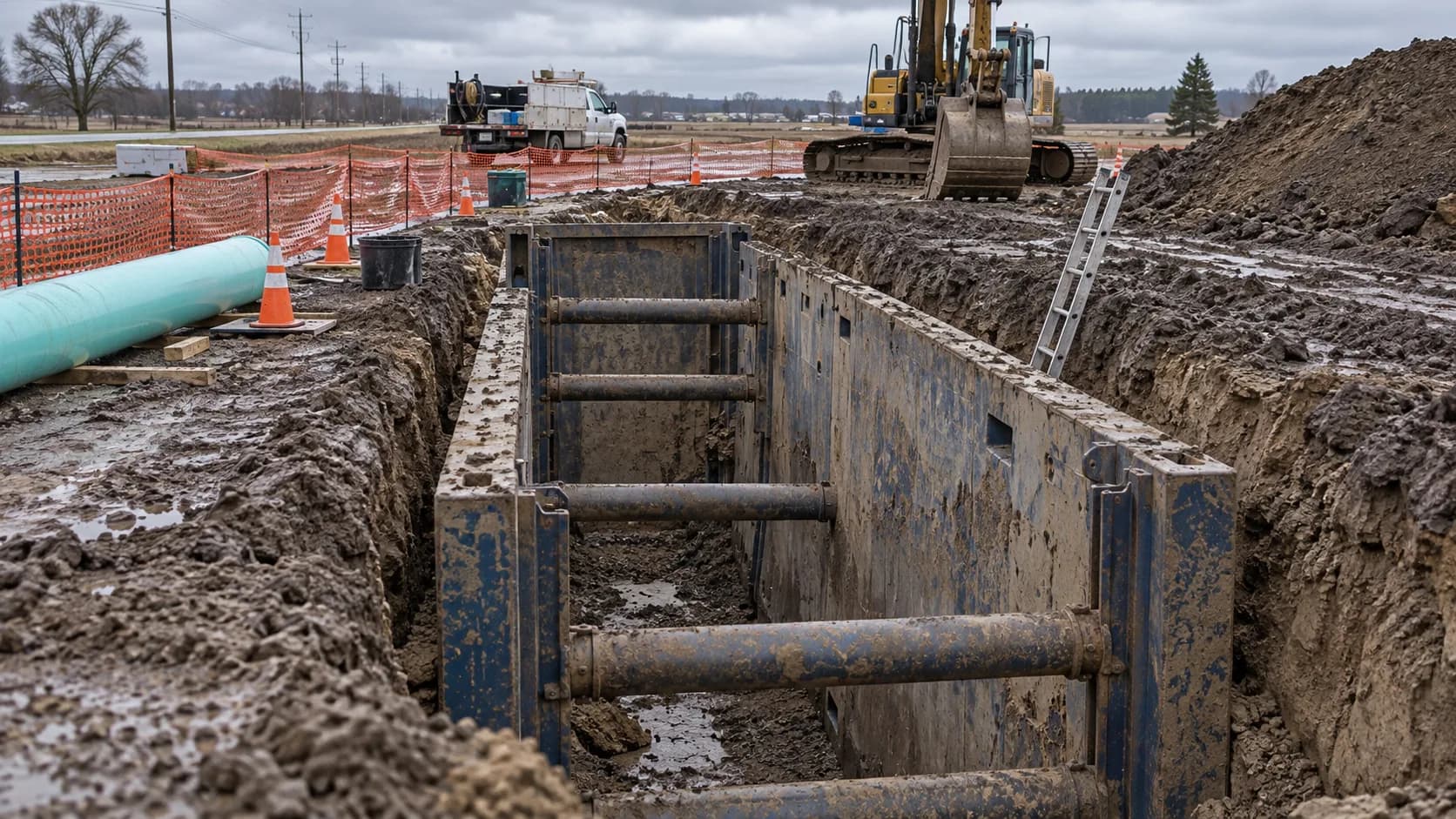
For an injured worker or family, the first questions are practical: who is arranging care, who employed the worker, and what was happening in the trench? This guide focuses on excavation-specific records and the different roles of workplace paperwork, a safety investigation, and a civil claim.
Key takeaways
- Put emergency help first; leave rescue and site access to trained responders.
- Notify your employer promptly and keep a copy of your report.
- Separate the employer, each contractor, and the company that supplied the trench equipment.
- Record what you actually saw, including the trench protection, ladder, water, and spoil piles.
- Keep the safety-investigation file and your personal claim paperwork organized separately.
Your first priorities
Call 911 for an emergency. Do not enter an unstable trench to retrieve tools, clothing, or a phone. From a safe place, identify the site entrance for responding crews and follow their instructions.
CDC/NIOSH[1] identifies direct trauma, including crush injury, as a risk factor for rhabdomyolysis. Muscle pain more severe than expected, dark urine, and unusual weakness or tiredness are warning signs for which it advises immediate medical care. Symptoms alone cannot establish the diagnosis.
Tell the medical team what happened and which parts of your body were compressed or struck. Do not guess about a condition or wait for an employer’s paperwork before seeking emergency help.
Indiana Code 22-3-3-4(e)[2] prohibits an employer or its carrier from delaying emergency medical care considered necessary in the attending health care facility physician’s professional judgment.

Workers’ compensation rights
The Indiana Worker’s Compensation Board[3] describes an employer-paid accident insurance program that may provide medical, rehabilitation, and income benefits for a job injury.
Indiana Code 22-3-2-2[4] requires a covered accidental injury to arise out of and in the course of employment and places the burden of proof on the employee. An OSHA citation is not listed as a prerequisite to a claim.
For a covered accidental work injury, Indiana Code 22-3-2-6[5] generally makes workers’ compensation the exclusive remedy against the employer. The actual employment relationship and statutory exceptions need individual review.
Start by identifying the employer shown on your pay records, the supervisor assigning your work, and any staffing agency involved. Do not assume the name on a truck or site sign identifies your employer.
The Board explains that the employer generally directs medical care and offers dispute-resolution procedures when benefits or care are contested.
For the broader process, see our Indiana workers’ compensation overview. Keep the adjuster’s name, claim number, written work restrictions, appointment records, pay stubs, and correspondence together.

Trench-safety rules
OSHA’s protective-system rule[6] requires cave-in protection except when the excavation is entirely in stable rock, or is less than 5 feet deep and a competent person’s examination finds no indication of a potential cave-in. A shallow trench is not automatically exempt.
Appendix F[7] specifies that protective systems for excavations more than 20 feet deep must be designed by a registered professional engineer in accordance with the protective-system standard. The threshold is more than 20 feet, not “at least 20 feet.”
OSHA’s excavation requirements[8] call for competent-person inspections before work, as needed during the shift, and after every rainstorm or other hazard-increasing occurrence, when employee exposure can reasonably be anticipated. Exposed employees must be removed from a hazardous area until necessary precautions have been taken.
The same rule requires safe egress in trenches 4 feet or more deep, with no more than 25 feet of lateral travel. It also requires protection against materials or equipment falling or rolling into the excavation, using at least a 2-foot setback, sufficient retaining devices, or both if necessary.
These are selected safeguards, not a complete excavation-design manual. For a consultation, note what you observed and leave soil classification, engineering, and compliance conclusions to qualified reviewers.

Possible civil claims
Indiana Code 22-3-2-13[9] allows proceedings against another legally responsible person who is not the employer and is not in the same employment, even when workers’ compensation is payable. The statute requires an underlying legal liability; a company’s presence on the project alone does not satisfy that requirement.
Useful questions include who selected and installed the protective system, who directed the excavation, who supplied equipment, and who performed inspections. Identify the documents and people behind each answer instead of assuming every contractor had the same role.
A third-party recovery may require repayment of workers’ compensation payments and affect future benefits. Section 13 also addresses liens, allocation of expenses, and written consent to settlements, with an exception for an employer or carrier fully indemnified or protected by court order.
Before signing settlement papers, have the overlapping claims reviewed together. Our guide to coordinating claims covers that broader framework; the construction-accident page explains the firm’s related services.

Trench evidence checklist
The following is a practical consultation checklist, not a list of records you must obtain yourself. Use “unknown” for anything you did not observe. Do not re-enter the site, remove equipment, or take someone else’s records.
| Trench-specific question | What to record safely | Records to identify for counsel |
|---|---|---|
| Where was the worker? | Work assignment, location, time, and nearby crew members | Daily work logs, site plans, witness contacts |
| What protection was in place? | Visible trench box, shoring, sloped walls, and any markings shown in existing photos | Designs, manufacturer instructions, rental and installation records |
| What changed before the collapse? | Rain, standing water, moving equipment, vibration, and changes you personally noticed | Inspection logs, weather records, crew messages |
| How could workers get out? | Ladder or ramp location and obstructions visible from a safe location | Scene photographs and responder reports |
| Who directed each task? | Names, company names, and the instructions you actually heard | Contracts, work orders, staffing records, safety assignments |
Save original photos and messages without editing them. Record when each image was taken and whether it shows the scene before rescue, during rescue, or after equipment was moved. Separate firsthand observations from what someone told you later. For general organization, use our injured-worker recordkeeping checklist.
Notice and filing periods
Under Indiana Code 22-3-3-1[10], written notice should be given as soon as practicable unless the employer or its representative has actual knowledge. The statute addresses a 30-day notice period, delayed compensation, and prejudice to the employer; late notice is not automatically a complete bar in every case.
Report promptly rather than relying on an exception. If a report was late or only verbal, obtain advice about your circumstances and preserve any evidence that the employer already knew.
Indiana Code 22-3-3-3[11] generally requires a compensation claim to be filed with the Board within two years after the accident, or within two years after death if death results. When qualifying temporary total or temporary partial disability compensation is paid, subsection (b) measures the two-year period from the last date for which that compensation was paid.
Section 13(e) separately states a two-year period after accrual for the employee’s third-party action. Do not assume that the workers’ compensation payment-based timing rule extends that civil-claim period.
These are general rules, not a calendar for your case. Different claims or parties may require a separate analysis. Ask counsel to identify the filing and notice requirements that apply to each potential claim rather than waiting for the safety investigation to finish.
IOSHA’s reporting guidance[12] separately directs employers to report work-related fatalities within 8 hours and work-related inpatient hospitalizations, amputations, or loss of an eye within 24 hours. Those are employer safety-reporting duties, not the employee’s filing periods discussed above.

Frequently Asked Questions
Can I file for workers’ compensation if no company was cited?
Yes. For covered workers, the statute focuses on an accidental injury arising out of and in the course of employment; it does not require an OSHA citation.
Can I sue my employer after a trench collapse?
Workers’ compensation is generally the exclusive remedy against a covered employer for an accidental work injury. Employment status and statutory exceptions must be examined.
Can another contractor be responsible?
Possibly. Section 13 permits a claim against a legally responsible person other than the employer or someone in the same employment. Being at the site does not itself establish liability.
Should I wait for IOSHA before reporting my injury?
No. Indiana’s notice statute calls for notice as soon as practicable unless the employer has actual knowledge. Report promptly and do not wait for the safety investigation.
Are trenches under 5 feet automatically exempt from protection?
No. Apart from excavations entirely in stable rock, the under-5-foot exception requires a competent person’s examination finding no indication of a potential cave-in.
What if the trench collapse was fatal?
The Board states that workers’ compensation provides benefits to dependents when a worker dies from a job-related injury.
If a family member died, seek individualized guidance about who may act for the family or estate and how to coordinate the paperwork.
Delventhal Law Office serves Fort Wayne and northeast Indiana. For help sorting the companies, site records, and next steps, request a free case evaluation.
Legal and safety sources checked October 21, 2026. General Indiana guidance; the facts and parties in a particular case matter.
This article is general information about Indiana law and is not legal advice. Reading it does not create an attorney-client relationship, and neither does contacting us.
Sources
- CDC/NIOSH (cdc.gov) ↩
- Indiana Code 22-3-3-4(e) (iga.in.gov) ↩
- Indiana Worker’s Compensation Board (in.gov) ↩
- Indiana Code 22-3-2-2 (iga.in.gov) ↩
- Indiana Code 22-3-2-6 (iga.in.gov) ↩
- OSHA’s protective-system rule (osha.gov) ↩
- Appendix F (osha.gov) ↩
- OSHA’s excavation requirements (osha.gov) ↩
- Indiana Code 22-3-2-13 (iga.in.gov) ↩
- Indiana Code 22-3-3-1 (iga.in.gov) ↩
- Indiana Code 22-3-3-3 (iga.in.gov) ↩
- IOSHA’s reporting guidance (in.gov) ↩