

For an ongoing file covering payroll, payment notices, treatment, and correspondence, use our Indiana work-injury recordkeeping checklist.
An incorrect average weekly wage (AWW) can affect temporary disability payments because Indiana generally sets temporary total disability (TTD) compensation at 66⅔% of AWW, subject to statutory limits. This guide focuses on auditing the employer-reported wage information and disputing a mismatch—not on every rule governing AWW.
Key takeaways
- Compare the reported AWW with pay stubs, payroll records, time records, and the dates used.
- Indiana Code § 22-3-6-1[1](d) ordinarily uses earnings in the injury employment during the preceding 52 weeks, but statutory alternatives may apply.
- You may request review and supply records; do not assume the employer or adjuster must accept your calculation.
- The Board lists TTD and TPD payment discrepancies among issues handled through its informal Request for Assistance process.
Why the wage information matters
Indiana Code § 22-3-3-8[2] generally sets TTD compensation at 66⅔% of AWW during the period of temporary total disability. Indiana Code § 22-3-3-22[3] supplies the applicable maximums and minimums. A wage input that is too low can therefore produce a TTD calculation that is too low.
For general information about the system, visit Delventhal Law Office’s Indiana workers’ compensation practice page. For the broader calculation rules, read the firm’s Indiana AWW explainer. Questions about overtime, bonuses, or concurrent work belong in the focused guide to special wage inputs.
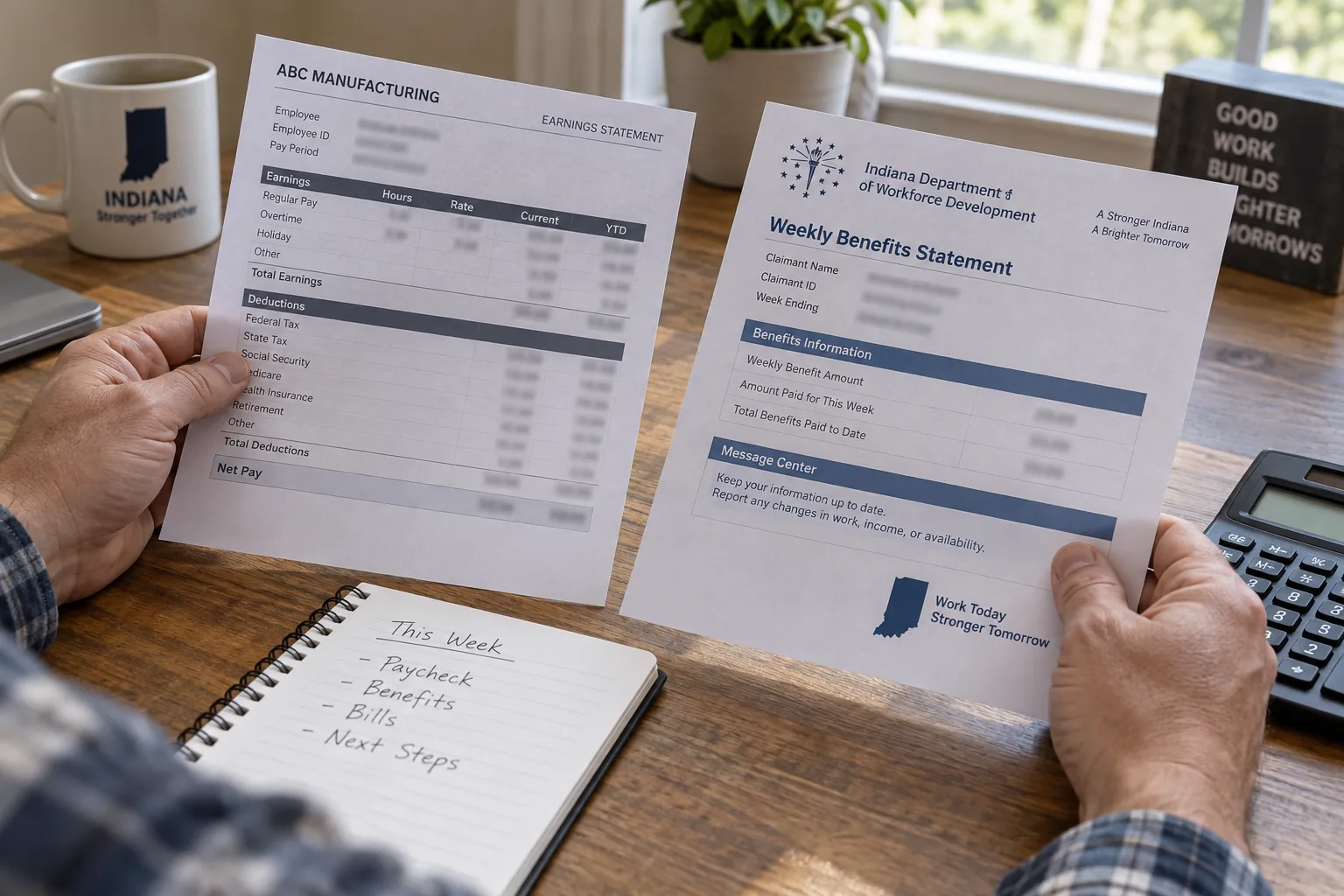
What to audit on the wage statement
Under Indiana Code § 22-3-6-1(d)[4], the ordinary starting point is earnings in the employment where the worker was injured during the 52 weeks immediately before the injury, divided by 52. The same subsection provides alternatives for at least seven lost calendar days, employment lasting less than 52 weeks, and circumstances in which the ordinary calculation is impracticable because the employment was short or casual. It also treats specified allowances made in place of wages as earnings.
This article does not duplicate those calculation rules. Its practical question is whether the dates, earnings, and method shown in the claim records match the worker’s actual employment history.

Records to compare
| Record | What to compare | Possible mismatch |
|---|---|---|
| Pay stubs or payroll register | Gross earnings, pay dates, and pay frequency | A pay period is missing, duplicated, or totaled incorrectly |
| Time and attendance records | Weeks worked and calendar days away | The work history does not match the period used |
| Employment and compensation records | Start date, wage terms, and specified allowances | The stated terms differ from the records |
| Calculation paperwork | Reported AWW and weekly payment amount | The figures differ across documents |
The Board’s official First Report of Employee Injury form and instructions[5] include wage, pay-period, hours-per-day, days-per-week, and average-weekly-wage fields. The instructions define “AVG WG/WK” by totaling the latest 52 weeks of wages, including overtime and tips, and dividing by 52. The statutory alternatives remain important when reviewing that form.

How to request review of a suspected error
- Identify the AWW and weekly payment amount currently being used.
- Create a pay-period list from the records available to you.
- Mark the exact missing, duplicated, or inconsistent entries.
- Send a concise written request asking the employer or claim administrator to review the disputed figure, and provide copies of the supporting records.
- Ask for the calculation and a written response.
- Keep a copy of the request, attachments, and response.
This is a request for review supported by records. It is not an official correction power or a promise that the other side will agree. Keep original documents and avoid sending unnecessary sensitive identifiers by ordinary email.

If the wage dispute continues
The Board advises an employee having trouble receiving benefits to speak first with the employer’s carrier or self-insured employer and share relevant information. Its informal-dispute guidance[6] says filing a completed Request for Assistance (State Form 45442) starts an inquiry by a Board case coordinator. The Board specifically lists delays and discrepancies in TTD or TPD payments among issues commonly encountered in that process.
Informal assistance does not itself decide a contested claim. The Board’s disputed-claims guidance[7] says unresolved disputes may move forward only when an Application for Adjustment of Claim (State Form 29109) is filed, after which a Single Hearing Member determines unresolved issues. For detail about the informal option, see Delventhal Law Office’s Request for Assistance guide. For the formal path, see the guide to an Application for Adjustment of Claim.

Frequently Asked Questions
Can I ask the employer or adjuster to review wrong wage information?
Yes. You may identify the disputed figure and supply payroll records while asking the employer or claim administrator to review it. If the issue remains unresolved, the Board provides informal and formal dispute paths.
What period does Indiana ordinarily use for AWW?
The ordinary rule in Indiana Code § 22-3-6-1[1](d) uses earnings in the injury employment during the 52 weeks immediately before the injury, divided by 52. Statutory alternatives may apply.
What if I worked there for less than 52 weeks?
Section 22-3-6-1(d)(2) generally uses earnings during that employment divided by the weeks and parts of weeks in which wages were earned, if the result is just and fair to both parties.
Can a Request for Assistance address a payment discrepancy?
The Board lists delays and discrepancies in TTD or TPD payments among issues commonly encountered in its informal process, which begins with State Form 45442.
Talk with an Indiana workers’ compensation attorney
If the wage records and claim paperwork do not match, Delventhal Law Office can review the documents, explain which Indiana rules may apply, and help you evaluate the next step. You may request a free case evaluation.
This article provides general information about Indiana law, not legal advice for any person.