
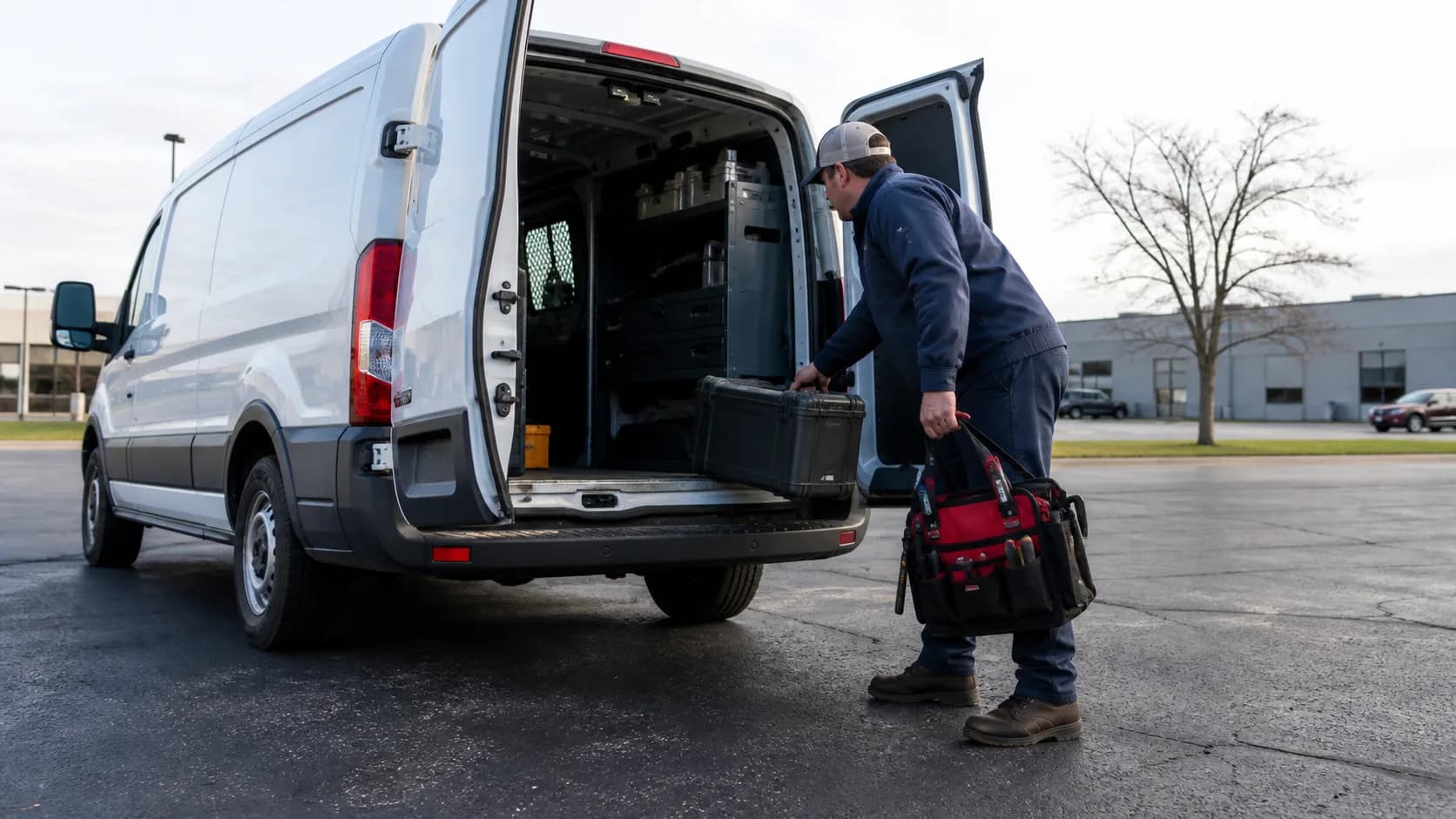
Not every work injury happens on a factory floor or in a warehouse. In Fort Wayne and across northeast Indiana, people get hurt driving between job sites, running errands for a boss, making deliveries, visiting clients, or traveling out of town for a conference. When that happens, the first question is usually the same: Is this still covered? The answer depends less on where you were standing and more on why you were there.

Key takeaways
- Indiana covers injuries "by accident arising out of and in the course of the employment," not just injuries that happen inside a building.
- Your normal commute to and from a fixed workplace usually is not covered under the coming-and-going rule.
- Travel between job sites, employer-directed errands, and travel by employees who routinely travel for work are often covered.
- A traveling employee may remain within the course of employment during reasonably necessary activities on a work trip, but coverage can stop during a distinct personal errand.
- An injury outside Indiana may still fall under Indiana workers' compensation law, but jurisdiction depends on the employment relationship and other facts.
- If another driver or company caused the harm, you may have a separate third-party claim in addition to workers' comp.
- Report the injury promptly and obtain case-specific advice about filing deadlines; Indiana's notice and limitation statutes contain important exceptions and extensions.
The core test: "arising out of and in the course of employment"
Indiana's Worker's Compensation Act covers "personal injury or death by accident arising out of and in the course of the employment." That phrase is the heart of every off-site coverage question, and Indiana courts break it into two separate parts, both of which have to be met (Ind. Code § 22-3-2-2[1]).
- In the course of employment looks at the time, place, and circumstances — was the injury connected to your job activity and reasonably part of it?
- Arising out of employment looks at causation — did the risk that hurt you come from your work rather than from something purely personal?
Because workers' comp is a no-fault system, you generally do not have to prove your employer did anything wrong. But the burden is on you to show that both prongs are met, and proving one prong does not create a presumption about the other. That is exactly why off-site and travel injuries get disputed — the location alone doesn't answer the question. If you are still sorting out whether your situation qualifies at all, our overview of who qualifies for workers' compensation in Indiana walks through the basics.
Your daily commute: the coming-and-going rule
The general rule in Indiana is that an injury while traveling to or from work — an ordinary commute between home and a fixed workplace — does not arise out of or in the course of employment, and so it is usually not covered. That principle is often called the "coming-and-going rule" (sometimes the "going-and-coming" rule).
But the rule has well-recognized exceptions. Indiana authorities have described situations where the commute may still be covered, including when the employee is being paid for travel time, is required to use a vehicle in connection with the work, or does not have a fixed place of employment. In other words, the closer your travel is tied to actually doing your job, the more likely it is covered.

Off-site and travel situations that are often covered
Several categories of work travel commonly fall inside the "course and scope" of employment in Indiana, even though you are not at your main worksite:
- Travel between job sites. Moving from one location to another during the workday — whether in a personal or company vehicle — is usually connected to the job.
- Special errands and one-time trips. If your employer sends you out to pick something up, drop something off, or make a special trip, an injury on that errand is often compensable.
- Employees who travel as part of the job. Delivery drivers, field technicians, home-health workers, sales reps, and others who routinely travel are frequently covered while on the move.
- Out-of-town and overnight business trips. Employees on business travel are often treated as continuously working, which we cover next.
Note that some off-site injuries happen while you are driving for work. When that involves a crash, the analysis overlaps with vehicle-crash law — see our guide on being hurt in a work vehicle crash in Indiana.
The traveling-employee rule and the "personal errand" limit
Indiana recognizes a "traveling employee" doctrine for workers whose jobs take them away from a fixed workplace. Indiana decisions recognize that a traveling employee can remain within the course of employment while doing activities reasonably necessary to the work trip, such as eating or sleeping away from home. That does not create automatic round-the-clock coverage: the connection to the employment still must be proved, and coverage can stop when the worker makes a "distinct departure on a personal errand."
The hard part is where the line falls. Grabbing dinner near your hotel on an overnight trip is usually still part of the covered trip. A significant, personally motivated side excursion that has nothing to do with the work purpose can fall outside coverage. These disputes are fact-specific, and insurers know it, so documentation of your travel purpose and route matters.
What if I was hurt in another state while working?
Indiana workers who travel out of state sometimes assume their coverage stops at the state line. It generally does not. Indiana Code § 22-3-2-20[2] provides that the Act can apply even when the accident occurs in another state or country (Ind. Code § 22-3-2-20[3]). That provision does not make every out-of-state injury an Indiana claim. A Fort Wayne–based employee injured while working in Ohio, Michigan, or Illinois may have rights under Indiana law, another state's law, or both, depending on the employment relationship, where the employment was formed or principally located, and the facts of the trip.
Quick guide: common off-site scenarios
This table is a general orientation, not a promise about your case. Coverage turns on the specific facts, and any of these can be disputed.
| Situation | Often covered? | Why it usually comes out this way |
|---|---|---|
| Ordinary commute, home to a fixed office/plant | Usually no | Coming-and-going rule; travel isn't part of job duties |
| Driving between two job sites during the workday | Often yes | Travel is connected to performing the job |
| Boss sends you on a special errand (supplies, bank, drop-off) | Often yes | Special-errand exception; travel serves the employer |
| Delivery driver or field tech hurt on the route | Often yes | Travel is a normal, required part of the job |
| Dinner near your hotel on an overnight business trip | Often yes | Traveling-employee rule covers reasonable personal needs |
| Long, personal side-trip unrelated to the work purpose | Often no | "Distinct departure on a personal errand" |
| Commuting in an employer-required vehicle or paid for travel time | Sometimes yes | Recognized exceptions to the commute rule |

When you may have two claims: workers' comp plus a third-party case
Off-site injuries — especially crashes — often involve someone other than your employer. If a negligent driver, a property owner, or another company caused your harm while you were working, Indiana lets you pursue that at-fault party in a separate civil claim, even though workers' comp is normally your exclusive remedy against your employer[4] (Ind. Code § 22-3-2-6).
The two systems cover different losses. Workers' comp pays medical care and a portion of lost wages regardless of fault; a third-party claim can seek damages workers' comp does not pay, such as pain and suffering. If you recover from the third party, your employer or its insurer generally has a lien and a right to be reimbursed for what it paid — reduced by a pro-rata share of your costs and attorney fees under Ind. Code § 22-3-2-13[5]. Coordinating these claims (and any settlement) carefully matters, because settling a third-party case the wrong way can affect your comp benefits. Our comparison of workers' comp vs. a third-party claim explains how the two fit together.
Medical documentation and causation
Because off-site claims get scrutinized, medical records are often the difference between an accepted and a denied claim. Report symptoms accurately, describe how the injury happened and what you were doing for work at the time, and follow through with treatment. Delays or gaps give insurers room to argue the injury was not work-related or came from something else. In an Indiana comp claim, the employer or carrier usually directs your authorized medical care — see who chooses the doctor in an Indiana workers' comp claim for how that works and where you still have rights.

Deadlines: report fast, file within two years
Two separate timelines apply to every Indiana work injury, including off-site ones:
- Notice to your employer. Report the injury as soon as practicable. Indiana Code § 22-3-3-1[6] addresses notice within 30 days and the consequences of delayed notice, but employer knowledge and statutory prejudice rules can matter; 30 days should not be described as an absolute cutoff (Ind. Code § 22-3-3-1[7]). Reporting the same day is safest — details on how soon you have to report a work injury.
- Filing a claim. An Application for Adjustment of Claim generally must be filed within two years after the accident. Indiana law contains extensions in some circumstances, including rules tied to compensation paid, so the deadline should be calculated from the actual claim history rather than assumed.
A separate third-party injury claim has its own deadline, which is typically two years but can differ depending on who is at fault (for example, government defendants have shorter notice rules). Because more than one clock can be running, it is worth confirming the deadlines that apply to your specific facts.
What to do after an off-site work injury
- Get medical care and tell the provider it happened at work and how.
- Report the injury to a supervisor promptly, in writing when possible.
- Write down what you were doing for work, your route, and your purpose for being there.
- Save texts, dispatch messages, delivery logs, mileage records, or emails showing you were working.
- If a crash was involved, get the police report, photos, and other drivers' insurance information.
- Note any non-employer party who may share fault (another driver, a property owner, a contractor).
- Keep copies of medical bills and any wage information.

Frequently asked questions
Is my commute to work covered by workers' comp in Indiana?
Usually not. Under the coming-and-going rule, an ordinary commute to and from a fixed workplace generally does not arise out of or in the course of employment. Exceptions exist — for example, when you are paid for travel time, are required to use a vehicle for work, or have no fixed workplace.
I got hurt running an errand for my boss. Is that covered?
Often yes. When your employer sends you on a special errand or one-time trip that serves the business, an injury during that travel is frequently compensable, because the travel is part of your job duties rather than a personal commute.
Can I get Indiana workers' comp if I was hurt in another state?
Possibly. Indiana Code § 22-3-2-20[2] provides that the Act binds employers and employees whether the injury occurs in Indiana, another state, or another country. Whether you have an Indiana claim depends on the employment relationship, so it is worth having the facts reviewed.
If another driver caused my work crash, do I sue or file workers' comp?
Frequently both. Workers' comp covers medical care and part of your lost wages regardless of fault, while a third-party claim against the at-fault driver can seek additional damages like pain and suffering. Your employer or its insurer may have a reimbursement lien on the third-party recovery under Ind. Code § 22-3-2-13.
What is a "distinct departure on a personal errand"?
It is the main limit on the traveling-employee rule. A traveling employee may remain covered during activities reasonably necessary to a work trip, but coverage can stop during a significant, personally motivated detour unrelated to the work purpose. Whether an activity crosses that line is fact-specific and often disputed.
Talking with a Fort Wayne workers' comp attorney
Off-site and travel injuries are among the most disputed workers' compensation claims in Indiana, precisely because coverage turns on the details of what you were doing and why. If you were hurt while traveling or working away from your main site in Fort Wayne, Allen County, or anywhere in Indiana, a Fort Wayne workers' compensation attorney can review what happened, explain the deadlines that may apply, and help you decide the next step. You do not have to figure the system out alone — a free consultation can help you understand your options.
This article is general information about Indiana law and is not legal advice. Reading it does not create an attorney-client relationship. For advice about your specific situation, speak with a licensed Indiana attorney.