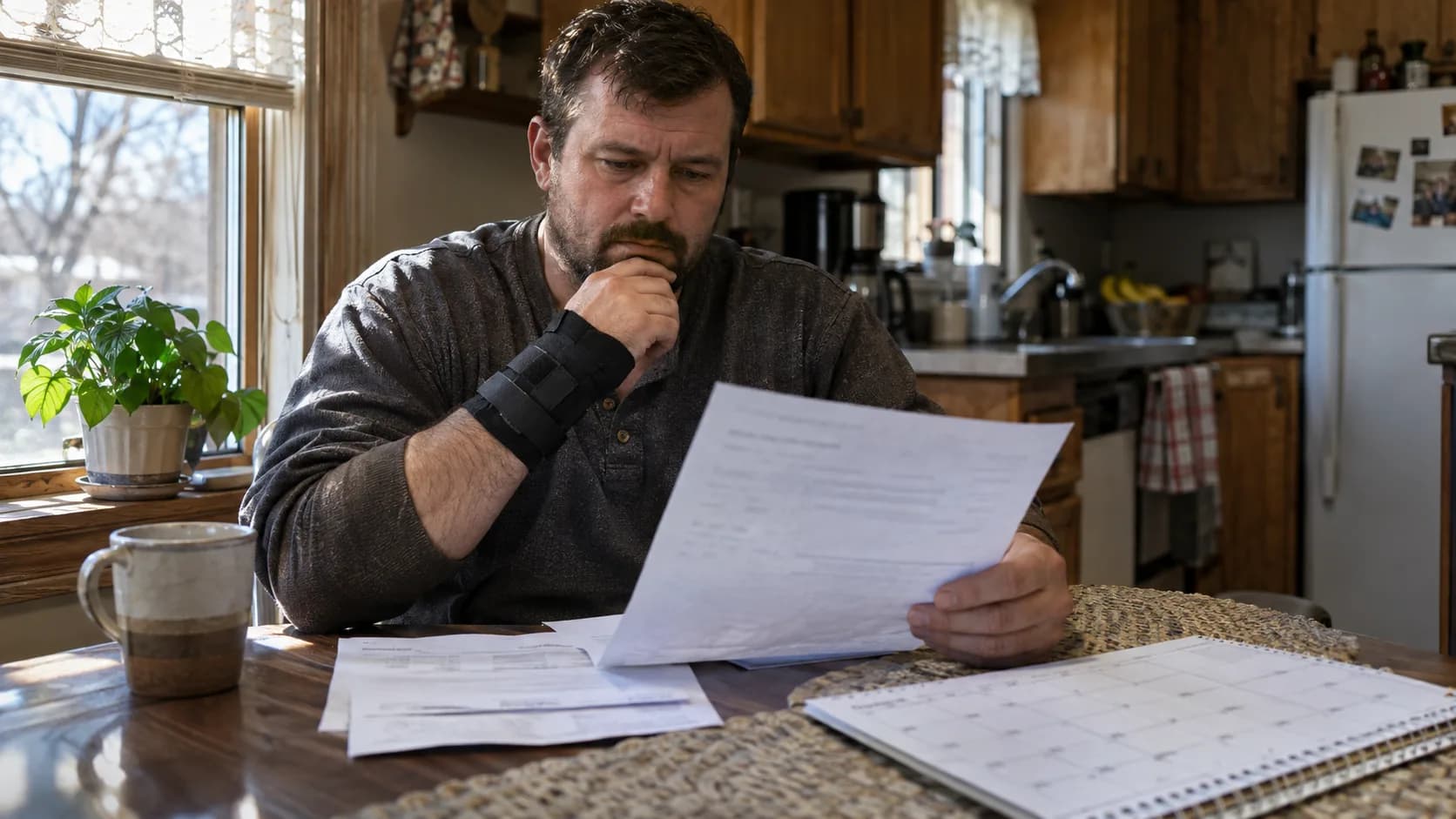

These records serve different purposes. IOSHA handles workplace-safety reporting and enforcement, while the Worker’s Compensation Board administers Indiana workers’ compensation matters. You should verify each step separately instead of assuming that one report completed the others. Compare the IOSHA reporting instructions[1] with the Board’s separate injury-report and formal-claim forms[2]. This guide focuses on checking which record exists, not repeating the full notice or claim-filing instructions linked below.
Key takeaways
- An IOSHA serious-event report is not a workers’ compensation filing.
- A First Report of Injury is an employer or insurance-carrier report; it is not the employee’s formal Application for Adjustment of Claim.
- Report a work injury promptly. The notice rule accounts for the employer’s actual knowledge and prejudice from missing or defective notice; 30 days is not an automatic complete bar.
- An unresolved dispute generally moves into the Board’s formal process through an Application for Adjustment of Claim, State Form 29109.
- The Board provides a tool that workers can use to confirm whether a First Report of Injury is on file.

Four records that should not be confused
The easiest way to understand the paperwork is to ask who sends it, who receives it, and what it is intended to do.
| Record | Who handles it | What it does | What it does not establish |
|---|---|---|---|
| IOSHA serious-event report | Employer and IOSHA | Reports specified severe workplace events for occupational-safety purposes. | It does not establish that a First Report of Injury or an employee’s formal claim was filed. |
| First Report of Injury (FROI) | Employer, carrier, and Worker’s Compensation Board | Reports qualifying injury information through the Board’s electronic system. | It is not the employee’s Application for Adjustment of Claim. |
| Notice to the employer | Injured worker and employer | Alerts the employer that a work accident or injury occurred. | It is separate from filing a formal disputed claim with the Board. |
| Application for Adjustment of Claim (State Form 29109) | Injured worker and Worker’s Compensation Board | Starts the Board’s formal process for an unresolved workers’ compensation dispute. | It is not replaced by an IOSHA report or a First Report of Injury. |
The IOSHA report
Indiana requires employers to report work-related fatalities to IOSHA within eight hours. Employers must report a work-related in-patient hospitalization, amputation, or loss of an eye within 24 hours. The Indiana Department of Labor explains these duties on its IOSHA accident-and-fatality reporting page[1].
That report concerns occupational safety. The Board’s disputed-claims process[3] separately addresses whether the worker has proved entitlement to compensation. An IOSHA report does not itself decide that question.

The First Report of Injury
The Worker’s Compensation Board says an employer must keep a record of all claimed workplace injuries and, for an injury requiring medical care beyond first aid or causing death, send the required report to its carrier or the Board if self-insured within seven days after learning of the injury. See the Board’s injury-reporting guidance under IC 22-3-4-13[4]. The carrier must submit the First Report of Injury to the Board within seven days after receipt or 14 days after the employer learned of the injury, whichever is later.
The Board identifies the First Report of Injury as State Form 34401 and requires that form to be submitted through an approved electronic process. The current form list is available on the Board’s official forms page[2].
A First Report can create a Board record, but it is still not the employee’s formal Application for Adjustment of Claim.
Your notice to the employer
Under IC 22-3-3-1[5], give written notice as soon as practicable unless the employer or its representative already has actual knowledge. If neither notice nor knowledge exists within 30 days, compensation is not payable until and from the date notice is given or knowledge obtained. Missing, defective, or inaccurate notice bars compensation only to the extent the employer proves prejudice. Do not assume either that an IOSHA report proves timely employer knowledge or that late notice automatically ends the entire claim.
For more detail, read how soon to report an Indiana work injury. Keep a copy of your written notice and note when, how, and to whom you sent it.
The Application for Adjustment of Claim
The Board lists State Form 29109, Application for Adjustment of Claim[2], for its formal hearing process. The Board states that an unresolved dispute may proceed formally only after this application is filed.
This is the critical distinction: an IOSHA report, an internal incident report, and a First Report of Injury do not substitute for the worker’s Application for Adjustment of Claim. Our separate guide explains what an Indiana Application for Adjustment of Claim does.

How to verify whether a First Report of Injury exists
The Board’s employee resources include an online “Confirm First Report Filing” tool. Use the link provided on the Worker’s Compensation Board employee page[6].
You can also ask the employer or insurance adjuster for the carrier’s name, claim number, and a copy of the injury report. Compare the injury date, body part, accident description, and employer information with your own records. If something is missing or inaccurate, identify the disputed entry in writing and keep your message.
If you cannot find a record: Save the search date and result, ask the employer or adjuster to clarify, and contact the Board if the records still do not match. A missing search result alone does not establish that no report was ever submitted. Likewise, a carrier claim number alone does not establish that a formal Board case exists. These are verification steps, not substitutes for a timely filing.
Practical next steps
The following checklist is practical recordkeeping advice, not a list of legally required filings.
- Confirm your employer received notice. Save the email, text, incident form, or other record showing when you reported the injury.
- Check for the First Report of Injury. Use the Board’s confirmation tool rather than relying only on an oral assurance.
- Identify the carrier and claim number. Keep letters, forms, and adjuster contact information together.
- Compare the paperwork with what happened. Check the injury date, affected body parts, work activity, witnesses, and treatment information.
- Track the response. Keep a simple log of calls, messages, appointments, work restrictions, and documents received.
- Address a dispute through the correct channel. The Board offers informal assistance through State Form 45442, while State Form 29109 begins the formal disputed-claim process.
A broader Indiana work-injury recordkeeping checklist can help you organize the paperwork without mixing these separate processes.

Do not let one report create a false sense of security
For an accidental-injury claim, IC 22-3-3-3(a)[7] generally requires filing with the Board within two years after the accident. Under subsection (b), when temporary total disability under section 7 or temporary partial disability under section 9 was paid, that period begins on the last date for which that compensation was paid. This is not necessarily the date a check arrived. Payment of medical bills alone is not one of the payments listed in subsection (b). Death and radiation injuries have different provisions in subsection (a); this is not a calculation of any reader’s deadline.
Because the correct deadline can depend on the record, do not assume an IOSHA report, internal accident form, claim number, benefit payment, or ongoing discussion preserves every right. Review the Board’s official disputed-claims guidance[3] and consider individual legal advice well before a possible deadline.
For a fuller explanation, see our guide to the Indiana workers’ compensation filing deadline.
Frequently Asked Questions
Does an IOSHA report open my workers’ compensation claim?
No. An IOSHA report serves a workplace-safety function and does not, by itself, establish that a First Report of Injury or an Application for Adjustment of Claim was filed.
Does a First Report of Injury mean my employer accepted the claim?
No. The First Report communicates injury information to the workers’ compensation system; it does not by itself determine compensability or require an award of benefits.
Can I check whether the First Report was filed?
Yes. The Worker’s Compensation Board’s employee page provides a “Confirm First Report Filing” tool.
When is State Form 29109 used?
State Form 29109 is the Application for Adjustment of Claim used to begin the Board’s formal process for an unresolved workers’ compensation dispute.
Should I still give my employer written notice if the accident was reported to IOSHA?
A written record is useful even if the employer already knows about the accident. IC 22-3-3-1[5] recognizes actual employer knowledge and limits a notice-based bar to proven prejudice. Preserve evidence of who knew what and when; do not rely on an IOSHA report as a substitute for checking your own records.

If you were hurt at work and are unsure which reports were made, Delventhal Law Office can review the available paperwork, explain the different Indiana processes, and help you decide what to do next. Learn more about the firm’s Indiana workers’ compensation practice or request a consultation.
This article is general information about Indiana law and is not legal advice. Reading it does not create an attorney-client relationship, and neither does contacting us.
Sources
- IOSHA reporting instructions (in.gov) ↩
- separate injury-report and formal-claim forms (in.gov) ↩
- disputed-claims process (secure.in.gov) ↩
- injury-reporting guidance under IC 22-3-4-13 (secure.in.gov) ↩
- IC 22-3-3-1 (iga.in.gov) ↩
- Worker’s Compensation Board employee page (in.gov) ↩
- IC 22-3-3-3(a) (iga.in.gov) ↩