
An insurance denial feels personal, but it is usually built around one of a few categories: fault, coverage, medical causation, documentation, policy limits, or claim procedure. The right response depends on which reason the company gives and whether that reason is supported by the evidence.
This guide explains why insurers refuse payment, what to do next, and how Delventhal Law Office reviews denied or stalled Indiana car accident claims.
Key takeaways
- Get the denial or low-payment reason in writing.
- Separate liability disputes from coverage disputes and medical-causation disputes.
- Do not miss Indiana deadlines while arguing with an adjuster.
- Insurance complaints may address company conduct, but they do not replace an injury claim.
- A denial can often be challenged with better evidence, legal pressure, or litigation when appropriate.
Why insurance companies refuse to pay after an Indiana car accident
Common reasons include:
- Fault dispute: the insurer says its driver did not cause the crash or says you were partly or mostly at fault.
- Coverage problem: the policy was cancelled, excluded, too small, or does not apply to the vehicle or driver.
- Medical causation dispute: the insurer argues your symptoms came from a prior condition, later event, treatment gap, or low vehicle damage.
- Documentation dispute: bills, records, wage proof, photos, repair estimates, or lien information are missing.
- Policy-limit issue: the damages may exceed available liability coverage, especially with minimum insurance.
- Release or procedural issue: the insurer claims a form, proof, statement, or deadline has not been satisfied.
Indiana’s unfair claim settlement practices statute, Indiana Code § 27-4-1-4.5[1], addresses insurer conduct such as failing to acknowledge communications reasonably promptly, refusing to pay without reasonable investigation, and failing to provide a reasonable explanation for denial or compromise offers. Whether that statute changes your practical options depends on the facts and the type of claim. You can use our Indiana car accident settlement calculator to organize the factors that may affect a claim’s value; it is an educational tool, not a promise of any result.
First steps if the insurer says no
- Ask for the reason in writing. A vague phone explanation is easy to change later.
- Request the claim number, adjuster name, and policy information. You need to know which coverage is being discussed.
- Do not sign a release. A release usually ends the injury claim even if you later discover more bills or wage loss.
- Preserve evidence. Keep the vehicle photos, dashcam footage, repair documents, medical records, bottles, braces, and damaged personal items.
- Check deadlines. Indiana personal injury claims generally have a two-year lawsuit deadline under Indiana Code § 34-11-2-4[2], but shorter notice rules can apply to government-related claims.
- Organize the missing proof. Denials based on “insufficient documentation” can sometimes be challenged with a better packet.
If the adjuster wants a recorded statement or broad medical release, review Delventhal’s guide on recorded statements and medical releases after an Indiana accident before responding. If the stated reason is an unfinished investigation, see when “still investigating” may be reasonable—and when repeated delay deserves closer attention.
Records-request checklist for a delayed, denied, or closed claim
A focused written request can clarify the insurer’s position without demanding materials the claimant may not be entitled to receive. Ask the insurer to provide or confirm:
- the current claim status and the written basis for any delay, denial, closure, or limitation;
- the claim number, adjuster’s name and contact information, and the particular coverage being addressed;
- the policy provision the insurer actually relies on, if it will provide that provision and it applies to the issue;
- a specific list of every item the insurer says remains outstanding, rather than a general request for “more information”;
- the insurer’s log or acknowledgment of the claimant’s submissions and communications, so missing uploads or correspondence can be identified;
- any written explanation of its evaluation, denial, compromise offer, or settlement offer that the insurer will provide; and
- if an IDOI complaint may be filed, copies of denial or status letters, relevant emails, submission confirmations, a claim chronology, policy or declarations material already available, and other documents showing the claim-handling issue.
This checklist is a request for issue-specific information, not a claim that a third-party claimant automatically has a right to the insurer’s privileged or internal claim file, reserves, internal evaluation, or every policy document. Disclosure depends on the type of claim, the information requested, applicable law, and sometimes formal legal process.
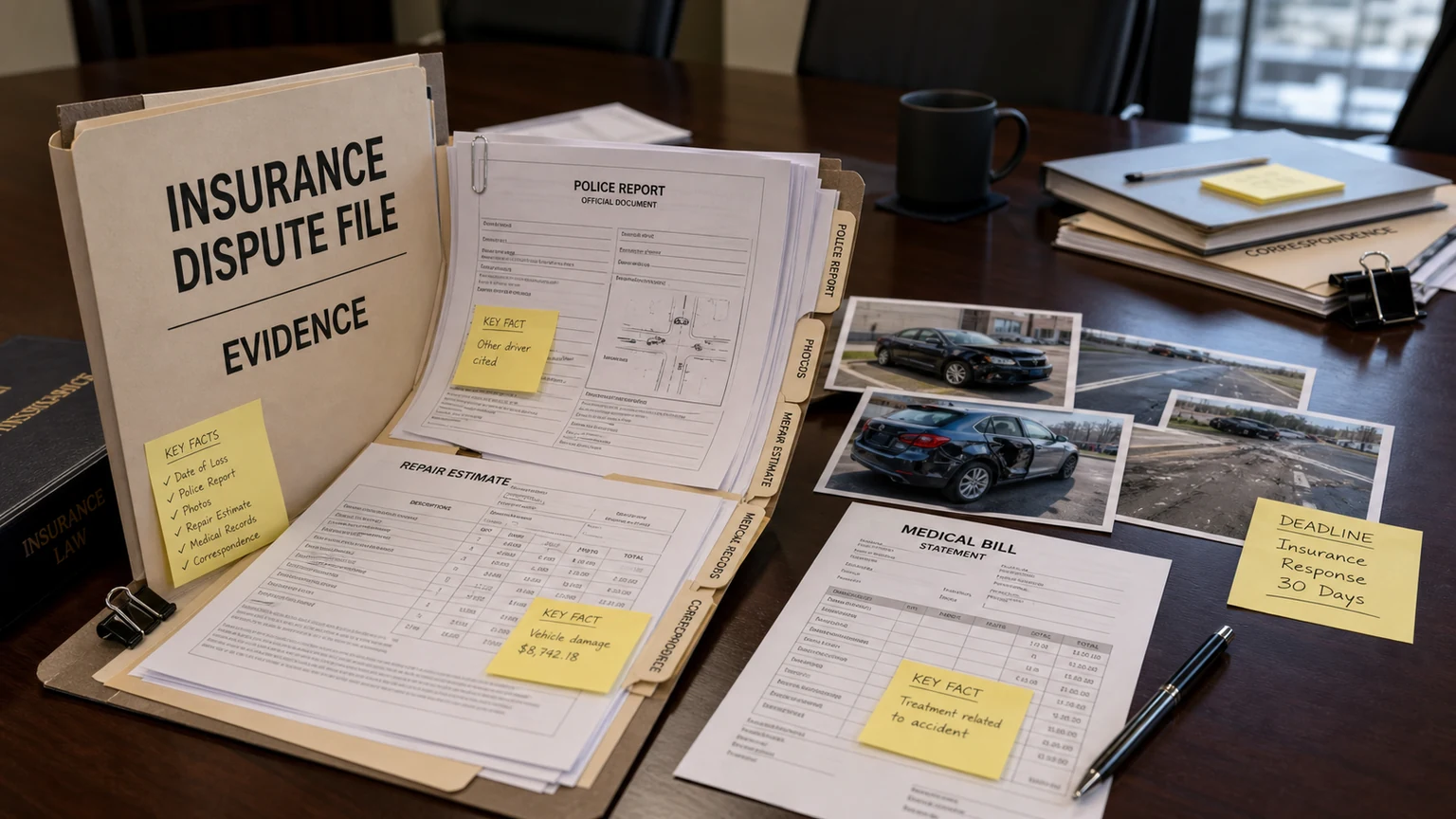
How to think about coverage, fault, and medical disputes
Coverage disputes
A coverage denial may involve cancellation, excluded drivers, business use, late notice, permission to drive, rideshare activity, or policy limits. If the at-fault driver has minimum limits, another Delventhal guide explains what happens when the other driver only has Indiana minimum insurance. Your own UM/UIM or MedPay coverage may also matter.
Fault disputes
Fault denials should be tested against the evidence. The police report matters, but it is not always the whole case. Photos, vehicle positions, skid marks, video, witness statements, phone records, roadway design, construction-zone facts, and crash reconstruction may matter. Indiana comparative fault can reduce or bar recovery in many claims under Indiana Code chapter 34-51-2[3]. Delventhal’s related guide covers police-report fault disputes.
Medical causation disputes
Insurers often argue that pain is from degeneration, a prior injury, delayed treatment, or minor vehicle damage. The response may require complete records, prior medical context, consistent symptom history, treating-provider opinions, imaging, therapy notes, and a clear timeline. Delventhal’s article on treatment gaps explains one common insurer argument.

Insurance complaint, lawsuit, or both?
The Indiana Department of Insurance[4] accepts consumer complaints about insurance issues. IDOI addresses regulatory and claim-handling conduct; it does not determine tort fault, adjudicate damages or claim value, award compensation, replace a lawsuit, or toll any deadline.
If the issue is that the other driver’s insurer simply refuses to accept liability or offer fair value, the practical remedy may be legal negotiation, a demand package, mediation, or lawsuit. Lawsuit strategy depends on liability evidence, damages, coverage, deadlines, venue, and whether litigation costs make sense for the claim.

When a lawyer should review a denied or stalled claim
Legal review matters when the insurer blames you, denies coverage, claims your injuries are unrelated, refuses to disclose limits, offers far less than the medical and wage evidence suggests, asks for broad authorizations, or the deadline is approaching. A denial does not mean the case is strong, but it does mean the next move should be deliberate.
Delventhal Law Office reviews car accident claims for people in Fort Wayne, Allen County, DeKalb County, Auburn, and northeast Indiana. The first step is usually to identify the denial reason, collect the missing evidence, and decide whether the claim can be fixed through documentation or needs legal pressure. Call 260-484-6655 or use the free case evaluation form.

For an overview of Indiana car accident claims, including deadlines and insurance coverage, see our Fort Wayne car accident attorney page.
FAQ: insurance company will not pay after an Indiana car accident
What should I do if the insurance company will not pay after an Indiana crash?
Ask for the reason in writing, gather missing proof, avoid signing a release, preserve deadlines, and consider legal review if liability, damages, or coverage is disputed.
Can an insurer deny a claim because it says I was partly at fault?
Yes, insurers often use comparative fault arguments to reduce or deny payment. The argument should be tested against the crash evidence, not accepted at face value.
Can I complain to the Indiana Department of Insurance?
You may file a consumer complaint about regulatory or claim-handling conduct. IDOI does not decide tort fault, damages or claim value, award compensation, replace a lawsuit, or toll deadlines.
Does a denial mean my case is over?
No. A denial may reflect missing documentation, a coverage dispute, a fault dispute, or negotiation posture. The next step depends on the reason given and the evidence available.