

This guide starts after a Board award. It explains how to organize disputed findings, locate supporting testimony, and prepare for a conversation about Full Board or court review. For the earlier stages, use our Indiana workers’ compensation hearing guide or Application for Adjustment of Claim guide. Our Fort Wayne workers’ compensation practice helps workers evaluate disputed awards in context.
Key takeaways
- Start with the complete written award, not a summary of the result.
- Separate a disagreement about what happened from a disagreement about the rule applied.
- Build an index connecting each disputed finding to a particular exhibit or transcript passage.
- Do not assume Full Board review and Court of Appeals review offer the same opportunity to present material.
- Bring the award, filing receipts, exhibit list, and transcript information to a case-specific consultation.
Two review stages after an Indiana Board award
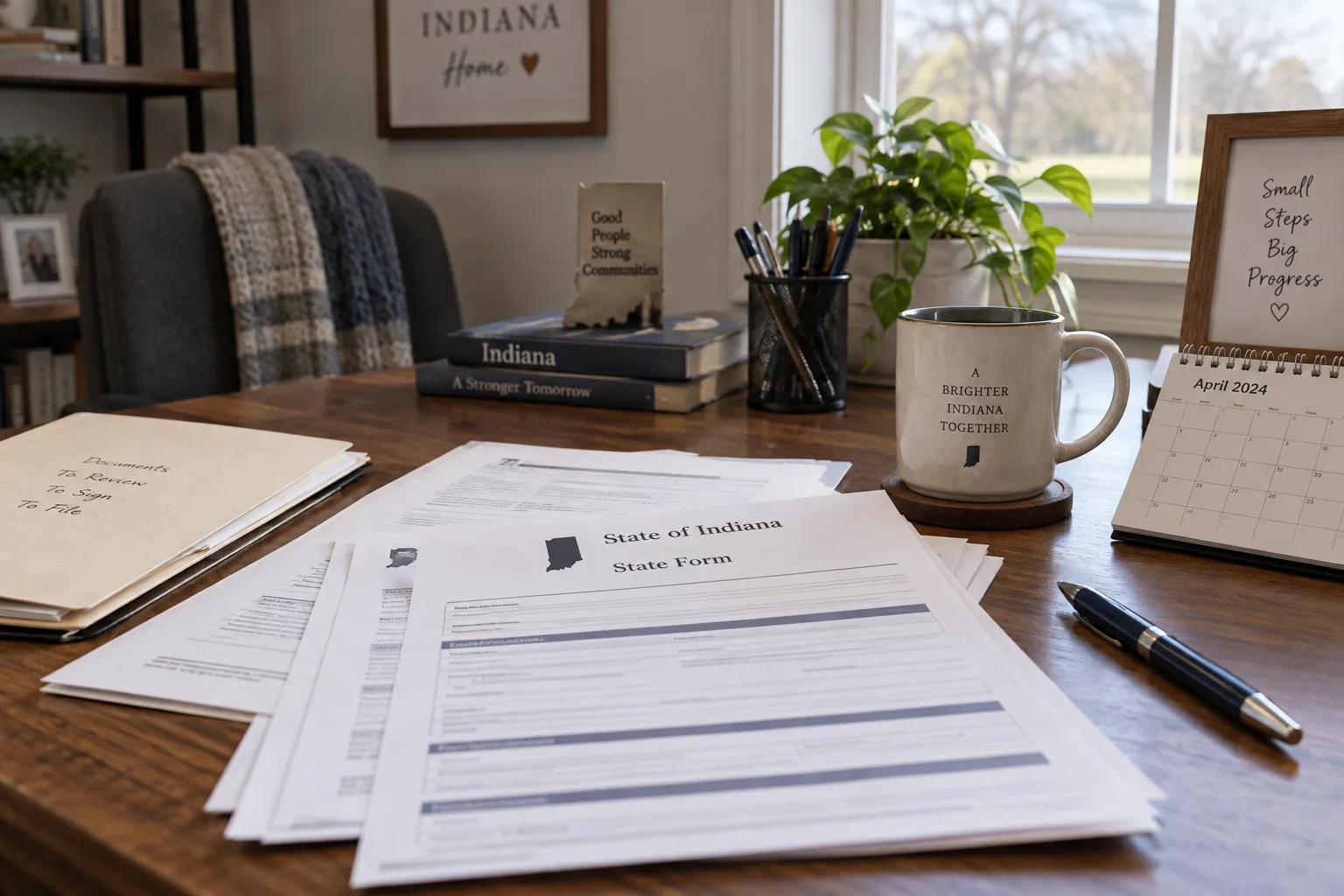
The Board’s disputed-claims guidance[3] identifies State Form 1042 as the Application for Review by Full Board. The official forms directory[4] links to the current form. For an appeal from a Full Board award to the Court of Appeals, Appellate Rule 9[2] instead governs the Notice of Appeal.
| Award received | Review route and starting document |
|---|---|
| Single Hearing Member | Full Board review: Application for Review by Full Board (SF 1042). |
| Full Board | Court of Appeals: Notice of Appeal under Appellate Rule 9. |
The 30-day Full Board period runs from the award date under IC 22-3-4-7[1]; the court-review period runs from the agency decision date under Rule 9(A)(3)[2]. Preserve the envelope or electronic notice, but do not substitute its arrival date for the trigger stated in the governing provision. Ask counsel to calculate the actual filing date and confirm the applicable filing and service requirements.

Read the findings, conclusions, and order separately
The Board explains[3] that a Single Hearing Member’s award contains stipulations, findings of fact, and conclusions of law. Reading those parts separately helps identify what the decision actually resolved.
- Stipulations: Identify the points the parties agreed on.
- Findings: Mark the numbered factual statements you question.
- Conclusions: Identify the rule or reasoning connecting those facts to the result.
- Order: Note exactly what the Board directed or rejected.
Practical example: Suppose an award describes a document as dated March 4, but your copy shows March 14. Instead of writing only “the decision is wrong,” note the finding number, exhibit label, and page containing the date. Then ask whether the difference matters to the result. This is a hypothetical organization example, not a prediction that the award would change.
A useful working sheet has four entries for each concern: the award passage, the record location, your question about the reasoning, and the change you want considered. Keep observations separate from unanswered questions.
Full Board review: work from the record, with a careful evidence distinction
The Board’s public guidance[3] describes Full Board appeals as legal arguments rather than new hearings. But IC 22-3-4-7[1] says the Full Board shall review the evidence or, if it deems advisable, hear the parties, their representatives, and witnesses. It would be too absolute to say the Full Board can never hear additional testimony. It is equally unsafe to assume you automatically get to start over.
For preparation, use the existing hearing materials as your starting point. Flag missing material for your attorney rather than silently inserting it into a folder labeled “hearing exhibits.” Ask what request would be needed and whether the Board could consider it in your case.
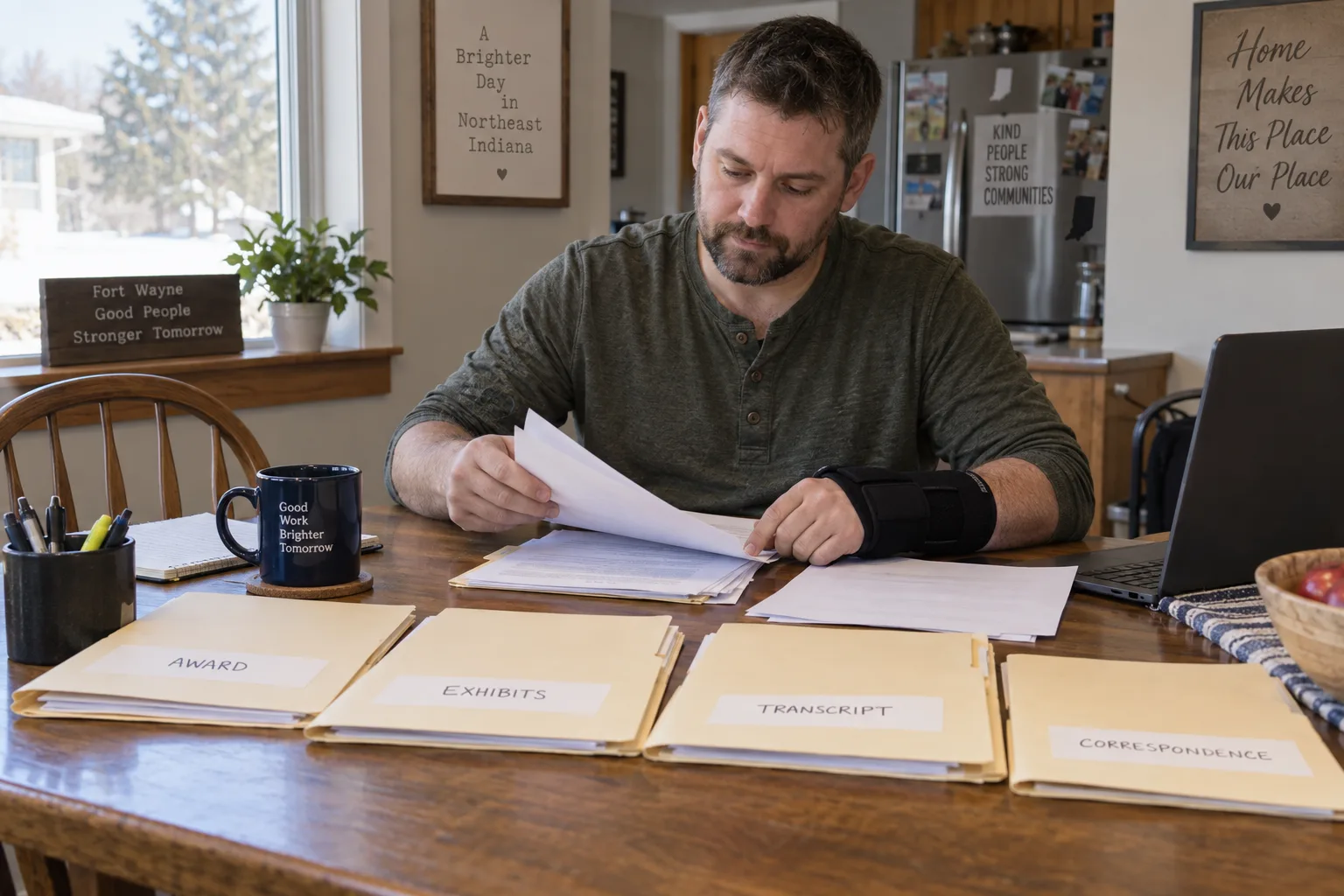
- Keep exhibit labels intact. Store the version used at the hearing, including attachments.
- Identify the record status. Distinguish material submitted at the hearing from material merely discussed or obtained afterward.
- Locate testimony. Make a list of speakers and passages relevant to each disputed finding.
- Preserve filing proof. Save the review application and its receipt together.
If you need a Single Hearing Member hearing transcript, the Board directs parties to the court reporter for that district[3]. Confirm arrangements with the reporter; a personal summary is useful for orientation but is not the transcript.
Court of Appeals review is a different kind of review
Under IC 22-3-4-8(b)[1], a Full Board award is conclusive and binding as to questions of fact, and either party may appeal for errors of law. Section 8(d) also addresses review of the sufficiency of findings and evidence. Those provisions make the legal issue and the applicable review standard important; they do not describe a fresh evidentiary hearing in court.
For the modern filing procedure, follow Appellate Rule 9(A)(3) and (I)[2]: an administrative appeal starts with a Notice of Appeal, and assignments of error are not required. This matters because the statute still contains older “assignment of errors” wording. Reading the statute alone does not supply the current filing instructions.
Rule 9(A)(5)[2] states that an untimely Notice of Appeal forfeits the right to appeal, subject to the rule’s stated exception. The exception named in Rule 9(A)(5) is P.C.R. 2, not a stated workers’ compensation extension. A case-specific review should address timeliness and whether the particular order is reviewable before moving to the merits.
Connect the transcript and brief to the actual appellate issues
Rule 9(F)(5)[2] requires designation of the transcript portions necessary to fairly present and decide the issues. If the appeal argues that a factual finding or a conclusion based on it is unsupported by or contrary to the evidence, the Notice of Appeal must request a transcript of all the evidence. Selecting a few favorable excerpts is not the rule’s instruction for that challenge.
Appellate Rule 46(A)(6)–(9)[5] gives a useful picture of what a court appeal needs: record citations for relevant facts, reasoned argument supported by authority, a standard of review for each issue, an explanation of how the issue was raised and resolved, and a precise statement of the requested relief.
A preparation outline—not a filing template:
- Issue: What specific part of the award is disputed?
- Record: Where is the relevant testimony or exhibit?
- Review standard: What rule governs how the court examines that issue?
- Prior presentation: Where was the point raised and how did the Board address it?
- Requested result: What exactly are you asking the court to do?
Bring this outline to counsel with the underlying materials. A brief is not simply a new narrative of the injury or a collection of documents; Rule 46 calls for a structured explanation tied to the record and governing authority.

A focused consultation packet for a Fort Wayne worker
These are practical organization suggestions, not additional filing requirements:
- The complete Single Hearing Member and Full Board awards, if both exist.
- Envelopes, electronic notices, filed review papers, and filing receipts.
- The exhibit list and copies carrying the hearing labels.
- Transcript orders, reporter correspondence, and the transcript if available.
- Your issue-by-issue working sheet, with page references instead of loose highlights.
- A separate list of documents obtained after the hearing.
Useful questions include: Which award is being reviewed? What issue could change the result? Is the necessary record available? Is a fact-based challenge being confused with an interpretation question? What is the scope of the proposed representation? For nearby workers, our Allen County workers’ compensation page explains our local practice.
Questions about appealing a Board award
Does Full Board review always exclude additional testimony?
No. Although the Board describes appeals as legal arguments rather than new hearings, IC 22-3-4-7[1] permits it to hear parties, representatives, and witnesses if it deems that advisable. Whether and how to seek that consideration is case-specific; do not assume a new hearing is automatic.
Can I order only the testimony that supports my argument?
For a court appeal challenging a finding as unsupported by or contrary to the evidence, Rule 9(F)(5)[2] requires a transcript of all the evidence. Other issues require the portions necessary to fairly present and decide them.
Why does the statute mention assignments of error?
The statutory language and current appellate filing rules use different terminology. Rule 9(I)[2] expressly says assignments of error are not required in administrative-agency appeals; the Notice of Appeal is the initiating document.
What should I bring if I cannot tell whether the problem is factual or legal?
Bring the whole award and mark the passage you question. Add the exhibit or transcript reference that prompted your concern. You do not need to guess at legal labels to organize a useful consultation packet.
Discuss the award and the available review route
If you have received a Board award and want to understand your options, request a free case evaluation. Delventhal Law Office can discuss the written decision, the existing record, and the next questions to investigate. Please arrange a secure method with the firm before sending detailed case materials.
This article is general information about Indiana law and is not legal advice. Reading it does not create an attorney-client relationship, and neither does contacting us.