Delventhal Law Office — Personal Injury Attorneys
Car Accidents

Hit-Skip Accidents in Fort Wayne and Allen County: What Injured Drivers Should Know

By Chad E. Delventhal15 min read
Two Allen County hit-skip accident calls on the same afternoon are a good reminder of something injured drivers learn the hard way: when the other driver leaves, the case does not become simpler. It becomes more urgent.

On June 8, 2026, public Allen County Sheriff activity-log entries included a hit-skip accident at 22xx Main Street in Huntertown, incident number 26A019238, and another hit-skip accident in the Dupont / Chapel Creek area, incident number 26A019260. Those entries are not final crash reports, and they do not tell us who was hurt or who was at fault. But they do show the local problem clearly. In Fort Wayne and Allen County, a driver who flees can leave an injured person trying to prove the crash, locate coverage, preserve evidence, and deal with their own insurance company all at once.

If a driver fled after hitting you or your vehicle, the first question is not just “who did it?” It is also: what proof can we preserve before it disappears, and what insurance coverage can pay if the fleeing driver is never found?

Delventhal Law Office represents injured people in Fort Wayne hit-and-run accident claims, car accident cases, uninsured and underinsured motorist claims, and injury cases involving back and neck injuries, brain injuries, and serious medical treatment after crashes.

What counts as a hit-skip accident in Indiana?

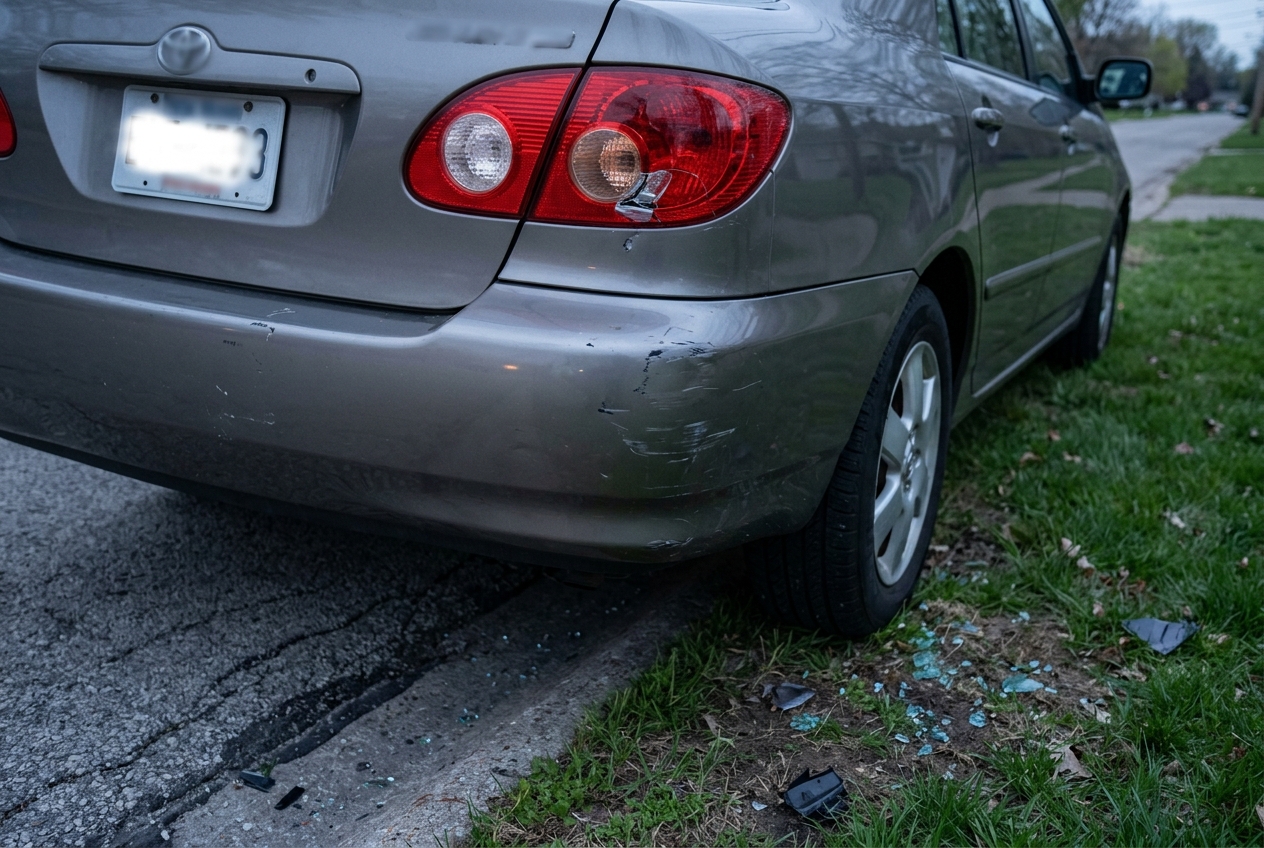
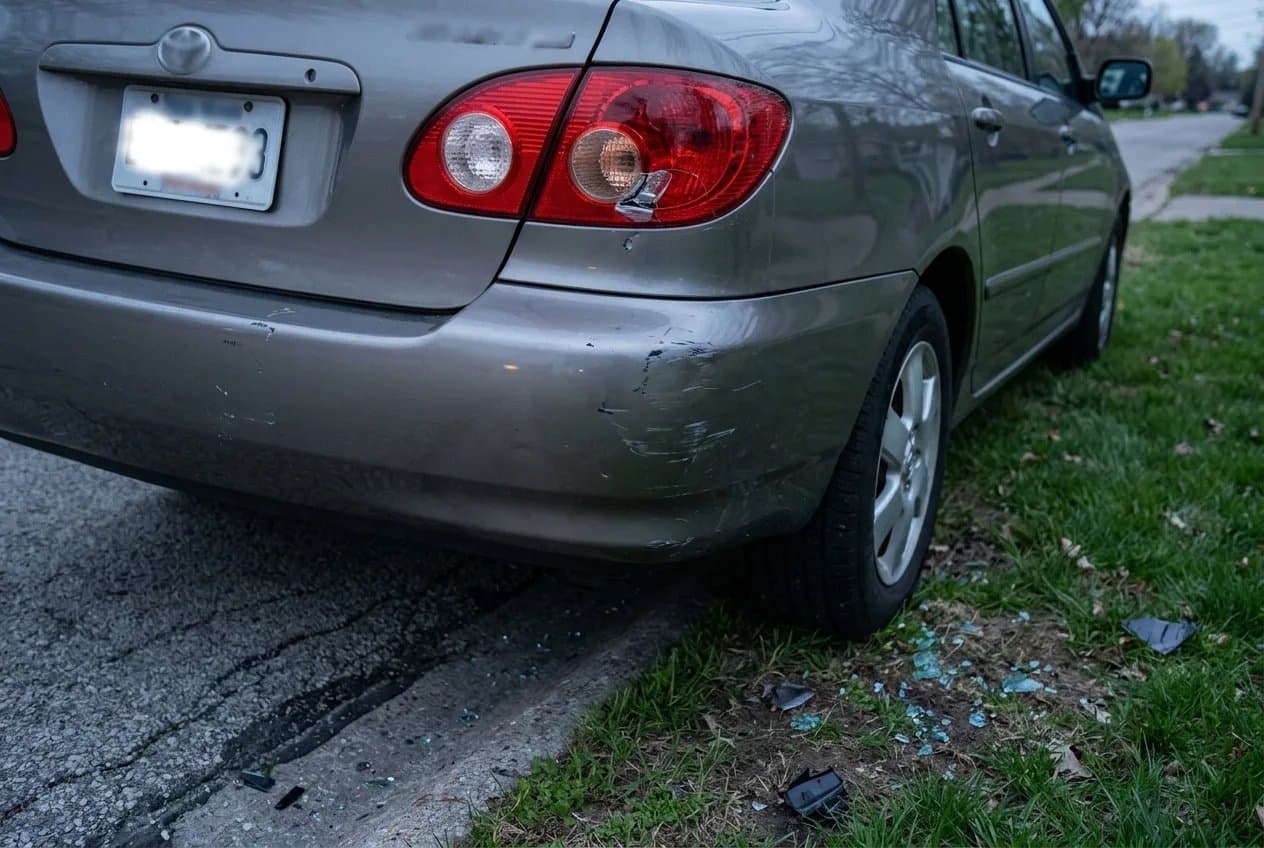
Damaged vehicle on the roadside after a Fort Wayne hit-skip accident
A hit-skip is not just rude driving. It can create serious legal, insurance, and evidence problems for the injured person.

Indiana drivers involved in a crash generally have duties to stop, remain at the scene, provide identifying information, and give reasonable assistance when someone is injured. Those duties appear in Indiana’s accident-scene statutes, including Indiana Code § 9-26-1-1.1[2]. In plain English, a driver should not hit someone and simply leave.

People use different phrases for the same problem. You may hear “hit-skip,” “hit and run,” “phantom vehicle,” “fleeing driver,” or “unknown motorist.” The wording can matter to the police, the insurance company, and the policy language, but the practical issue is the same: the driver who caused or contributed to the crash is not available at the scene to identify themselves, explain what happened, or provide insurance information.

Hit-skip accidents can include:

  • a driver who rear-ends your vehicle and leaves before police arrive;
  • a sideswipe where the other vehicle continues down Lima Road, Dupont Road, Coliseum Boulevard, Clinton Street, Jefferson Boulevard, or another Fort Wayne corridor;
  • a parking-lot impact where the driver leaves no note or false information;
  • a crash caused by a vehicle that forces you off the road and disappears;
  • a pedestrian, bicycle, or motorcycle crash where the driver flees;
  • a commercial vehicle, delivery van, rideshare vehicle, or work truck that leaves before the crash is documented.

Do not assume a hit-skip is unwinnable because the other driver left. The case may still have insurance coverage, camera evidence, witnesses, paint transfer, debris, vehicle data, dispatch records, app data, or later police identification. The key is moving quickly enough to preserve it.

Why you should report the crash and preserve the incident number

If another driver leaves, report the crash. In an injury crash, call 911. If the crash is already over and no emergency response is needed, contact the appropriate law-enforcement agency and your insurance company. In Fort Wayne and Allen County, the responding agency may be Fort Wayne Police, Allen County Sheriff, Indiana State Police, New Haven Police, Huntertown Police, or another local agency depending on where the crash happened.

The incident number matters because it becomes the anchor for the investigation and the insurance claim. It helps connect later evidence to the right event: body-camera footage, dispatch notes, officer narrative, supplemental reports, crash diagrams, witness names, insurance correspondence, repair estimates, medical visits, and UM/UIM claim notices.

Save the following as soon as you can:

  • incident number or crash report number;
  • date and exact time of the crash;
  • location, including nearest cross streets, address range, parking lot, business, or landmark;
  • responding agency and officer name, if known;
  • photos of police cards, report exchange forms, tow paperwork, and claim numbers;
  • the name and phone number of any witness who stopped;
  • any partial license plate, vehicle color, make, model, damage location, stickers, company markings, or direction of travel.

Indiana crash reports may later be available through official reporting channels or police records processes. The report helps, but you should not wait for it before preserving evidence. Video may disappear before a report is ready.

Do not chase the fleeing driver

It is understandable to want to follow the driver. Do not turn a hit-skip into a second crash. Chasing can put you, passengers, pedestrians, and other drivers at risk. It can also create insurance arguments about your own conduct.

Instead, get safe, call police, and document what you saw. A partial plate plus vehicle color, damage location, and flight direction may be enough to help police or an investigator find the vehicle later. Even without a plate, nearby cameras may show the vehicle entering or leaving the area.

Using UM/UIM coverage after a hit-skip

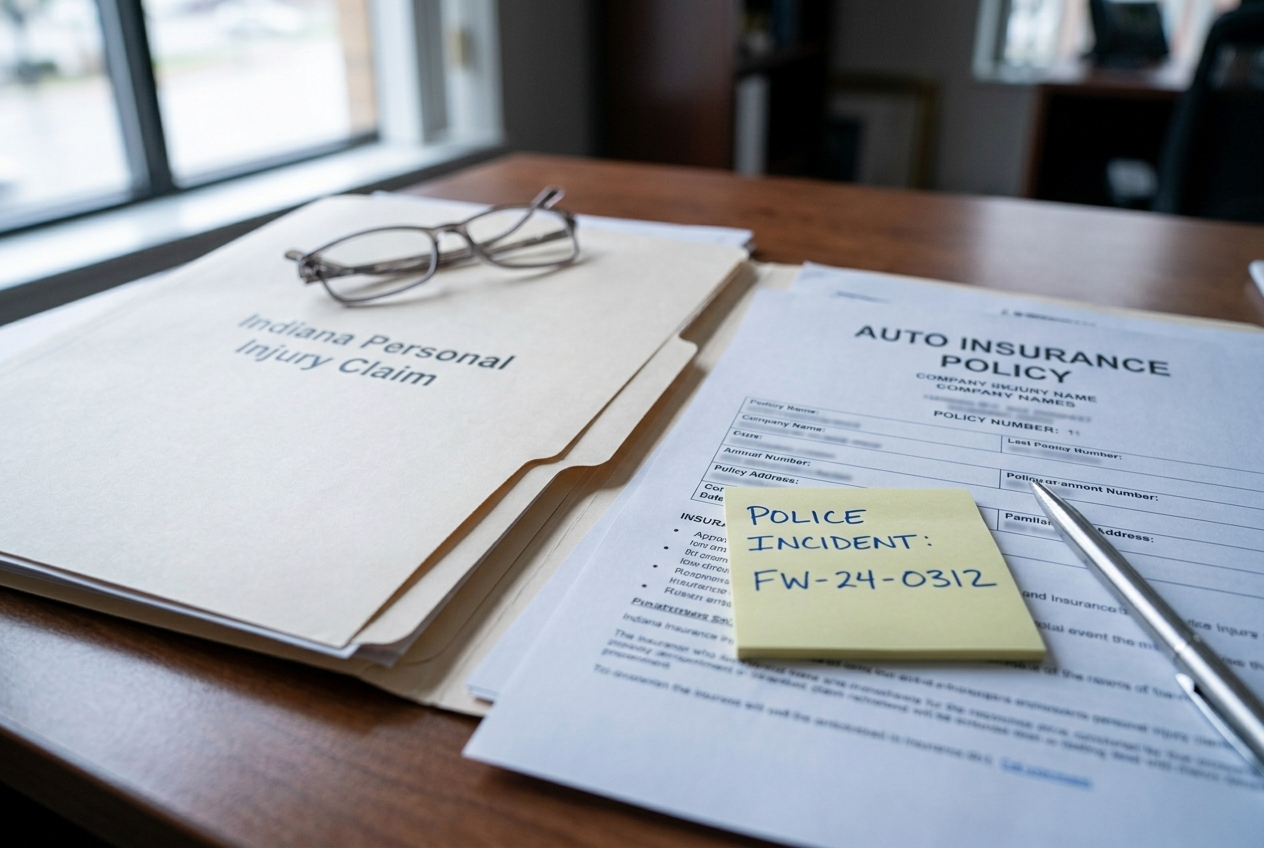
Indiana uninsured motorist claim file with police incident number and auto insurance documents
In many hit-skip cases, the injured person’s own UM coverage becomes the first serious coverage question.

When the fleeing driver is not identified, your own auto insurance policy may become the primary path to recovery. That is where uninsured motorist coverage, often called UM coverage, comes in. Indiana’s UM/UIM statute is Indiana Code § 27-7-5-2[1]. The details depend on your policy, the vehicles involved, whether coverage was rejected in writing, the type of claim, and the proof available.

UM coverage can matter when the at-fault driver is unknown, has no insurance, or cannot be located. Underinsured motorist coverage, called UIM coverage, can matter if the fleeing driver is later found but has too little insurance to cover the injuries. In a serious crash, we look beyond the obvious policy and search for every available layer.

Coverage questions may include:

  • Does your own policy include UM/UIM coverage?
  • Did anyone in your household have a policy that may apply?
  • Were you driving your own vehicle, a borrowed vehicle, a work vehicle, or a company vehicle?
  • Were you a passenger, pedestrian, cyclist, motorcyclist, delivery driver, or rideshare passenger?
  • Does MedPay apply to early medical bills?
  • Can multiple policies or vehicles affect the available limits?
  • Does the policy require prompt notice of a hit-skip, phantom vehicle, or UM claim?
  • Does the policy require proof of physical contact or independent corroboration?

This is the frustrating part for many clients: a UM claim is made against your own insurance company, but that does not mean the company is automatically on your side. Once money is at issue, your insurer may question how the crash happened, whether there was contact, whether your injuries are related, whether treatment was reasonable, and whether another coverage source should pay first.

That is why Delventhal Law Office treats a hit-skip claim as both an investigation and a coverage case. The goal is not simply to say “a driver left.” The goal is to prove the event, preserve the damages evidence, and force the correct carrier to evaluate the claim under the actual policy language.

Video, witness, and scene evidence to preserve quickly

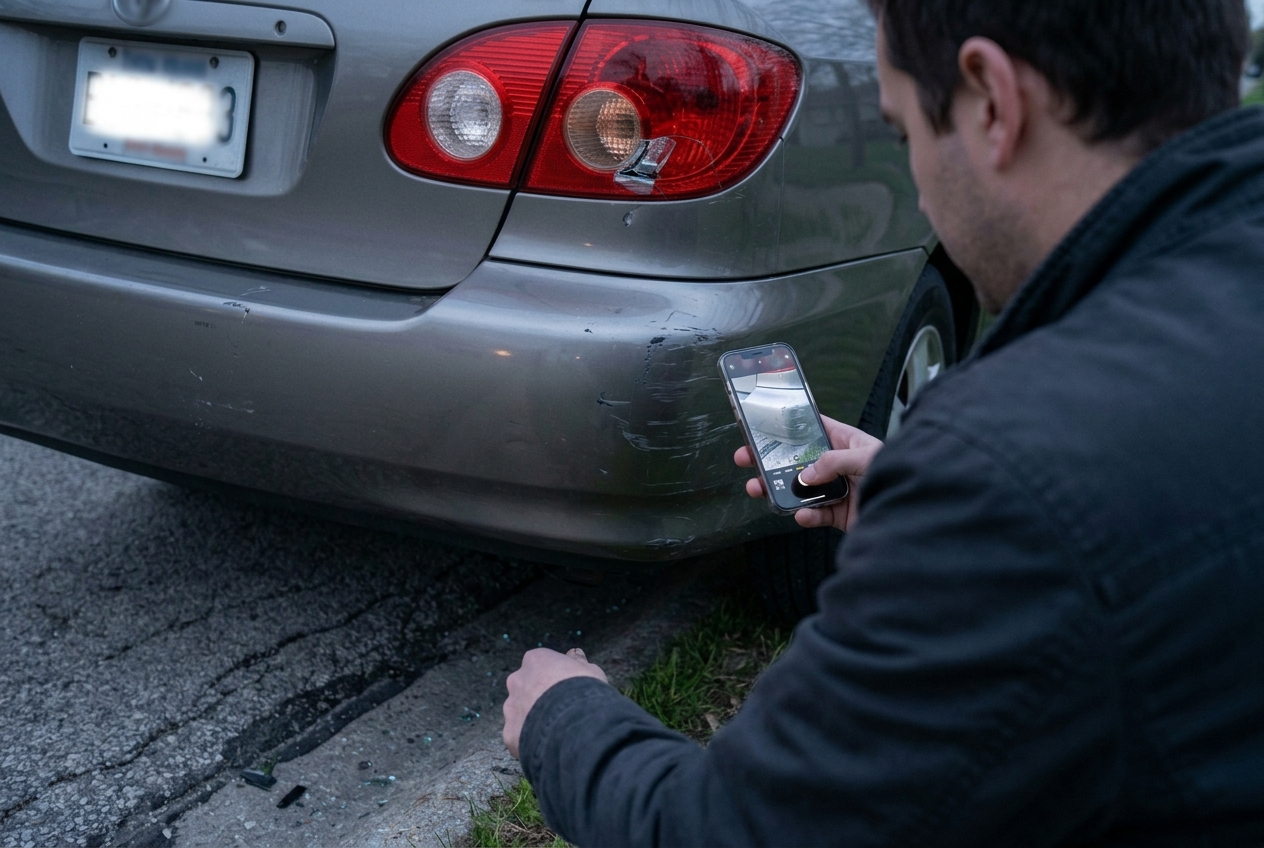
Driver photographing vehicle damage and debris after an Allen County hit-and-run accident
Photos taken before repairs, cleanup, or vehicle disposal can become the proof that separates a documented UM claim from a disputed one.

Hit-skip cases are won or lost on evidence that disappears early. The fleeing driver may be found through one small detail: a partial plate, a broken mirror, a paint-transfer color, a camera angle, a witness who saw the direction of travel, or a repair shop that later sees matching damage.

Start with your vehicle. Before repairs, photograph:

  • all sides of your vehicle, not just the worst damage;
  • close-ups of dents, paint transfer, broken lights, mirrors, bumpers, trim, and tire marks;
  • the height and location of impact;
  • debris inside or near the vehicle;
  • airbag deployment, seatbelt marks, interior damage, and child-seat involvement;
  • odometer, dashboard warnings, and tow/storage paperwork.

Then document the scene. Take wide photos that show lanes, signs, traffic signals, shoulders, parking spaces, driveways, lighting, weather, road defects, construction zones, and where the vehicles ended up. If the crash happened near Dupont, Lima, Coldwater, Carroll, Main Street, Coliseum, Jefferson, Illinois, Washington Center, or another busy corridor, assume there may be private cameras nearby.

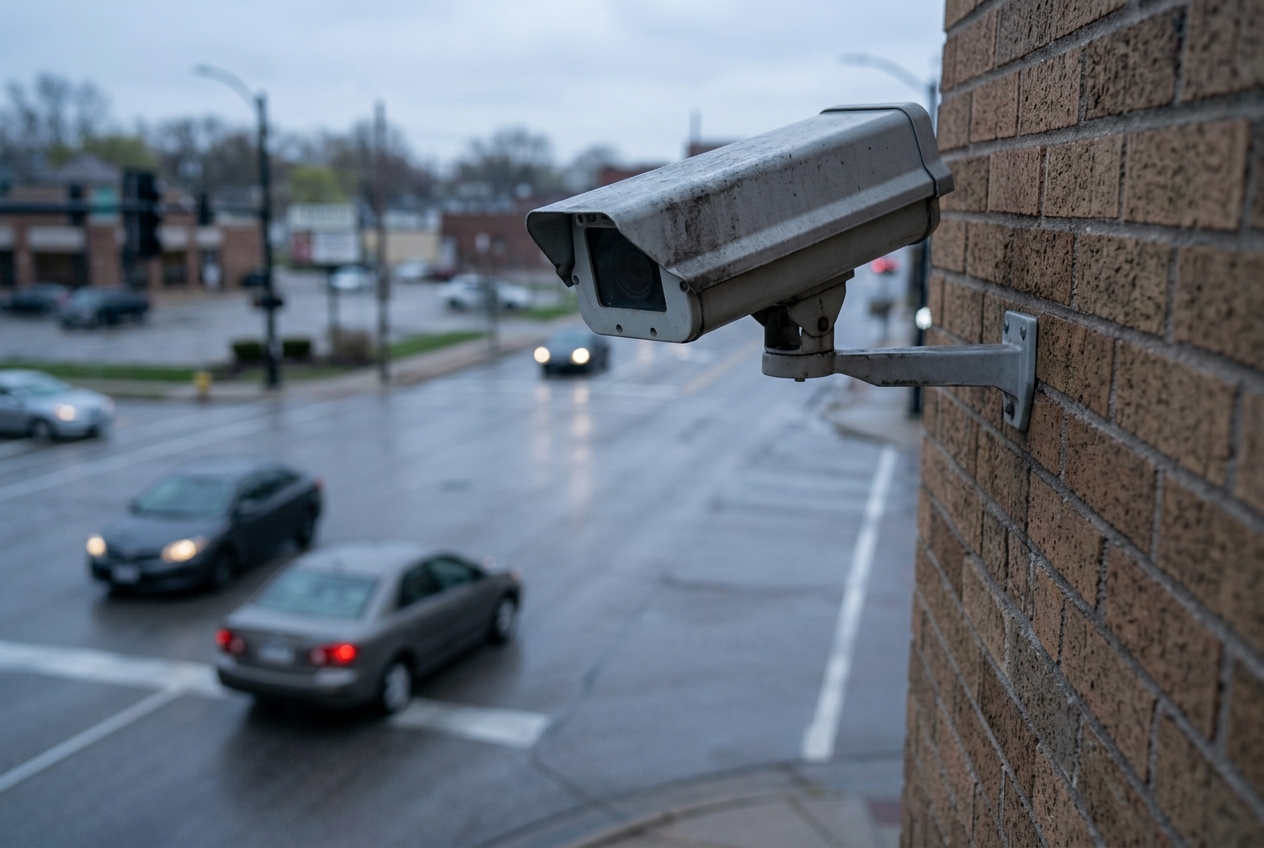
Business security camera near an Indiana intersection where hit-skip crash video may be overwritten
Business and doorbell cameras may overwrite quickly. Preservation requests should go out before the footage is gone.

Look for cameras at:

  • gas stations and convenience stores;
  • banks and ATMs;
  • restaurants, bars, and drive-thrus;
  • apartment complexes;
  • schools, churches, and municipal buildings;
  • warehouses, loading docks, and office parks;
  • homes with doorbell cameras;
  • delivery vehicles, rideshare vehicles, buses, and commercial trucks with dashcams.

Do not assume a business will save footage because police were called. Many systems overwrite automatically. A preservation letter should identify the date, time, location, and type of footage requested. In commercial-vehicle cases, additional evidence may include GPS, dispatch records, telematics, route data, app data, driver logs, maintenance records, and company communications.

What to tell witnesses and what to save

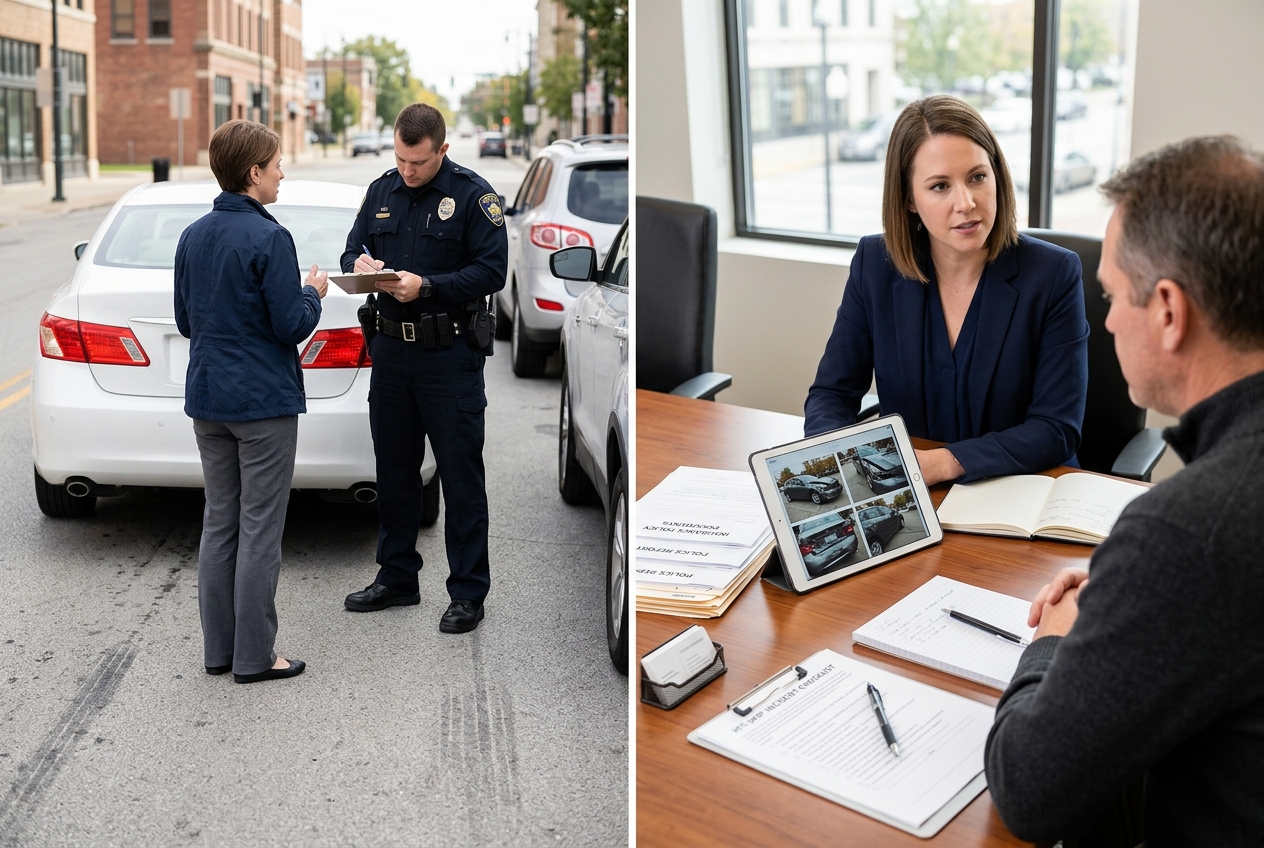
Witness speaking with police near a safe crash scene after a hit-skip accident
A witness who saw the fleeing vehicle, the direction of travel, or the moment of impact may be the most important person in the case.

If a witness stops, get their name and phone number if you can do so safely. Do not rely only on the police report. A witness may leave before the officer arrives, may not be fully listed, or may have more detail than the report captures.

Useful witness details include:

  • what the fleeing vehicle looked like;
  • where it was damaged;
  • whether the driver slowed down, stopped briefly, or continued immediately;
  • whether the driver appeared distracted, impaired, speeding, or aggressive;
  • which direction the vehicle went;
  • whether the witness has dashcam video;
  • whether the witness gave a statement to police.

If a witness texts you photos or video, save the original file if possible. Screenshots are better than nothing, but original photos and video usually preserve more metadata and quality.

Medical treatment still matters when the other driver fled

Do not let anger about the driver distract from medical care. If you are hurt, get checked. Neck pain, back pain, concussion symptoms, shoulder pain, knee pain, numbness, tingling, headaches, dizziness, and worsening soreness can develop after the adrenaline fades.

Medical records help prove injury, timing, causation, restrictions, referrals, imaging, therapy, lost work, and future treatment. If you wait too long, the insurance company may argue you were not really hurt or that something else caused the symptoms.

Indiana’s general personal-injury statute of limitations is often two years under Indiana Code § 34-11-2-4[3], but that deadline should not give anyone comfort in a hit-skip case. Evidence disappears in days. Policy notice duties may be much shorter. Medical documentation starts now.

Be careful with your own insurance company too

You should notify your own insurer promptly, especially if UM/UIM, MedPay, collision, rental, or property-damage coverage may apply. The Indiana Department of Insurance advises consumers to know their policy, file claims as soon as possible, provide complete and correct information, keep copies of correspondence, ask questions, and avoid rushing into settlement. See the IDOI’s insurance claim tips[4].

But prompt notice does not mean guessing. If the insurer asks for a recorded statement, be accurate and careful. Say when you do not know. Do not speculate about speed, distance, timing, or medical prognosis. Do not minimize symptoms to be polite. Do not sign broad medical authorizations without understanding their scope.

This is especially true in a UM claim because your own insurer may later become adverse. For more detail, see our article on recorded statements and medical releases after an Indiana accident.

How Indiana comparative fault can enter a hit-skip claim

Even if the other driver fled, the insurance company may still look for ways to shift blame. Indiana’s Comparative Fault Act is found at Indiana Code Chapter 34-51-2[5]. In a disputed hit-skip case, carriers may argue you were speeding, failed to keep a proper lookout, changed lanes unsafely, did not avoid the crash, or caused a single-vehicle event yourself.

That is why physical evidence matters. Vehicle damage, paint transfer, debris, witness statements, camera footage, and the crash location can answer the carrier’s favorite question: “How do we know another vehicle actually hit you?”

How a lawyer can help find coverage and protect the claim

Fort Wayne personal injury lawyer reviewing crash photos and insurance coverage after a hit-skip
Hit-skip claims are investigation cases and insurance-coverage cases at the same time.

A lawyer’s job in a hit-skip case is not just to call the insurance adjuster. It is to build the proof the adjuster will not build for you.

At Delventhal Law Office, that may include:

  • obtaining the police report, incident report, supplements, photographs, and dispatch information;
  • sending preservation letters to businesses, property owners, government entities, rideshare companies, delivery companies, trucking companies, and insurers;
  • locating witnesses and confirming what they saw before memories fade;
  • documenting vehicle damage, paint transfer, debris, repairs, towing, storage, and total-loss issues;
  • reviewing your policy, household policies, vehicle policies, commercial policies, umbrella coverage, MedPay, collision, UM, and UIM;
  • checking whether the fleeing driver was later identified and whether liability coverage exists;
  • protecting you from broad recorded statements, medical releases, and early settlement pressure;
  • organizing medical records, bills, wage loss, restrictions, future care, and lien issues;
  • filing suit when the carrier refuses to evaluate the claim fairly.

Good hit-skip work is detail work. A missed camera, missed policy, missed witness, or missed notice deadline can change the value of the case. This is where our firm’s approach matters: we find what others miss because in a hit-skip case, what others miss may be the only path to recovery.

A practical hit-skip checklist for Fort Wayne and Allen County drivers

If you are hit and the driver leaves, use this checklist:

  1. Get safe first. Move out of traffic if you can do so safely.
  2. Call 911 if anyone may be injured. Report that the other driver left.
  3. Do not chase the driver. Memorize or write down what you saw.
  4. Save the incident number. Photograph any police card, exchange form, tow document, or report information.
  5. Photograph everything. Vehicles, damage, debris, road conditions, traffic controls, nearby businesses, and your injuries.
  6. Identify cameras. Look for businesses, homes, dashcams, delivery vehicles, and parking-lot cameras.
  7. Get witness contact information. Do not assume it will appear in the report.
  8. Get medical care. Do not wait for the fleeing driver to be found.
  9. Notify your insurer. Ask for your declarations page and full policy if UM/UIM may apply.
  10. Do not give careless recorded statements. Be accurate, do not guess, and get advice if injuries are significant.
  11. Call a lawyer quickly if you were hurt. Evidence and video can disappear long before the claim is ready for settlement.

Frequently Asked Questions About Fort Wayne Hit-Skip Accidents

What is the difference between a hit-skip and a hit-and-run?

In everyday language, they usually mean the same thing: a driver left the scene after a crash. “Hit-skip” is a phrase often used in police activity logs and local reporting. “Hit-and-run” is the phrase many injured people and insurance companies use.

Can I still make an injury claim if the driver is never found?

Possibly, yes. Your own uninsured motorist coverage may apply if the facts and policy requirements are met. The details depend on your policy language, proof of the crash, physical contact or corroboration issues, notice requirements, and available damages evidence.

Should I report a hit-skip if the damage looks minor?

Yes. Property damage can look minor while injuries develop later, and the report may be important for insurance. A documented incident number also helps connect later medical treatment, repair estimates, and UM/UIM claim notices to the crash.

What if I only got part of the license plate?

Save it. A partial plate combined with vehicle color, make, model, damage location, time, direction of travel, and camera footage may still help identify the vehicle.

Will my own insurance company fight me on a UM claim?

It can. Your own insurer may question whether another vehicle caused the crash, whether the policy covers the event, whether notice was timely, whether your injuries are related, and what the claim is worth. A UM claim is still an insurance claim, and the carrier’s financial interests may conflict with yours.

How fast should I try to preserve video?

Immediately. Some systems overwrite quickly. A lawyer can send targeted preservation letters to nearby businesses, property owners, delivery companies, rideshare companies, or other entities that may have video or data.

What if the hit-skip driver is later identified?

Then the case may include a claim against the driver’s liability insurance, if any. If that coverage is too low, UIM coverage may still matter. If there is no insurance, UM coverage may remain the central issue.

Do I need a lawyer for every hit-skip?

Not every property-damage-only scrape requires a lawyer. But if you are hurt, need medical care, miss work, have disputed facts, lack clear video, face a UM/UIM claim, or get pressure from an adjuster, it is smart to talk to a lawyer quickly.

Bottom line

A hit-skip accident in Fort Wayne or Allen County is not just a crash with a missing driver. It is a race against disappearing evidence and a coverage problem that must be handled correctly from the beginning.

Report the crash. Preserve the incident number. Photograph the scene and damage. Identify witnesses and cameras. Get medical care. Review your UM/UIM coverage. And do not let an insurance company define the story before the facts are locked down.

If a driver fled after hitting you or your vehicle, call Delventhal Law Office at 260-484-6655 or request a free case evaluation. We help injured people in Fort Wayne, Allen County, Huntertown, New Haven, Auburn, Columbia City, Huntington, and across Indiana find the evidence and coverage others miss.

Sources and further reading

[1] Indiana General Assembly: Indiana Code § 9-26-1-1.1 — Duties after an accident[2]

[2] Indiana General Assembly: Indiana Code § 27-7-5-2 — Uninsured and underinsured motorist coverage[1]

[3] Indiana General Assembly: Indiana Code § 34-11-2-4 — Injury to person or character; injury to personal property[3]

[4] Indiana General Assembly: Indiana Code Chapter 34-51-2 — Comparative Fault[5]

[5] Indiana Department of Insurance: Insurance Claim Tips[4]

[6] Delventhal Law Office: Fort Wayne Hit & Run Accident Lawyer

[7] Delventhal Law Office: Fort Wayne Underinsured / Uninsured Accident Attorney

Sources

  1. Indiana Code § 27-7-5-2 (iga.in.gov)
  2. Indiana Code § 9-26-1-1.1 (iga.in.gov)
  3. Indiana Code § 34-11-2-4 (iga.in.gov)
  4. insurance claim tips (in.gov)
  5. Indiana Code Chapter 34-51-2 (iga.in.gov)

Frequently asked

The short version

Direct answers to the questions this article unpacks in full.

  1. What counts as a hit-skip accident in Indiana?

    Indiana drivers involved in a crash generally have duties to stop, remain at the scene, provide identifying information, and give reasonable assistance when someone is injured. Those duties appear in Indiana’s accident-scene statutes, including Indiana Code § 9-26-1-1.1 . In plain English, a driver should not hit someone and simply leave.

  2. What is the difference between a hit-skip and a hit-and-run?

    In everyday language, they usually mean the same thing: a driver left the scene after a crash. “Hit-skip” is a phrase often used in police activity logs and local reporting. “Hit-and-run” is the phrase many injured people and insurance companies use.

  3. Can I still make an injury claim if the driver is never found?

    Possibly, yes. Your own uninsured motorist coverage may apply if the facts and policy requirements are met. The details depend on your policy language, proof of the crash, physical contact or corroboration issues, notice requirements, and available damages evidence.

  4. Should I report a hit-skip if the damage looks minor?

    Yes. Property damage can look minor while injuries develop later, and the report may be important for insurance. A documented incident number also helps connect later medical treatment, repair estimates, and UM/UIM claim notices to the crash.

  5. What if I only got part of the license plate?

    Save it. A partial plate combined with vehicle color, make, model, damage location, time, direction of travel, and camera footage may still help identify the vehicle.

  6. Will my own insurance company fight me on a UM claim?

    It can. Your own insurer may question whether another vehicle caused the crash, whether the policy covers the event, whether notice was timely, whether your injuries are related, and what the claim is worth. A UM claim is still an insurance claim, and the carrier’s financial interests may conflict with yours.

  7. How fast should I try to preserve video?

    Immediately. Some systems overwrite quickly. A lawyer can send targeted preservation letters to nearby businesses, property owners, delivery companies, rideshare companies, or other entities that may have video or data.

  8. What if the hit-skip driver is later identified?

    Then the case may include a claim against the driver’s liability insurance, if any. If that coverage is too low, UIM coverage may still matter. If there is no insurance, UM coverage may remain the central issue.

  9. Do I need a lawyer for every hit-skip?

    Not every property-damage-only scrape requires a lawyer. But if you are hurt, need medical care, miss work, have disputed facts, lack clear video, face a UM/UIM claim, or get pressure from an adjuster, it is smart to talk to a lawyer quickly.

Working with Delventhal Law

Common questions

How fees work, deadlines that matter, and what to expect when you call.

  1. How much does it cost to hire Delventhal Law Office?

    There is no up-front cost. Personal-injury cases are handled on a contingency-fee basis: you pay nothing unless we recover compensation for you. The initial consultation is free and carries no obligation. Call (260) 484-6655 to talk through your situation.

  2. How long do I have to file a personal injury claim in Indiana?

    Indiana generally gives you two years from the date of injury to file a personal-injury lawsuit (Indiana Code § 34-11-2-4). Shorter deadlines can apply when a government entity is involved or in some workers' compensation matters. The sooner you call, the more options you have.

  3. What if I'm partly at fault for the accident?

    Indiana follows a modified comparative-fault rule (Indiana Code § 34-51-2-6). You can still recover compensation as long as you are not more than 50% at fault. Your recovery is reduced by your percentage of fault. Even if you think you share blame, call us — the insurance company's first assignment of fault is often wrong.

  4. Do I have to come into the office to meet with you?

    No. We meet clients by phone, video call, at their home, or at the hospital. The Delventhal Law Office is in downtown Fort Wayne, but most of our clients live across Indiana and we come to you when that's easier.

  5. How quickly should I call after an accident?

    As soon as you can. Evidence disappears fast — skid marks fade, surveillance video is overwritten, witnesses move on. Insurance adjusters also start calling within days. Talking to us before you give a recorded statement protects your claim.

  6. What kinds of cases does Delventhal Law handle?

    We represent injured plaintiffs in car, truck, motorcycle, bicycle, and pedestrian accidents; workers' compensation and on-the-job injuries; wrongful death; slip-and-fall and premises liability; birth injuries; burn injuries; and other personal-injury claims across Indiana.

INJURED? CONFUSED?

CALL US TODAY

(260) 484-6655
Call now260-484-6655Live Chat