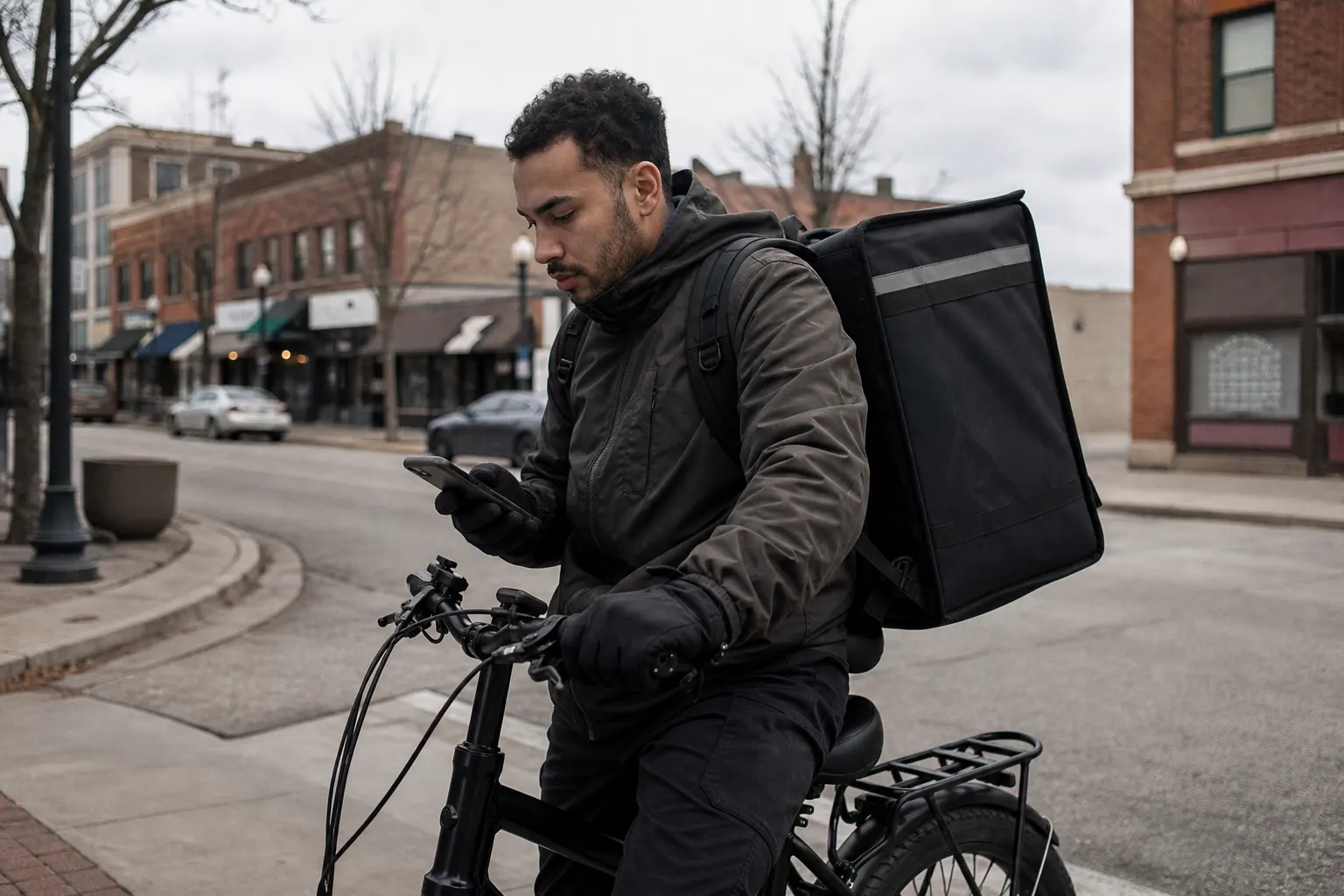
Making app-based, restaurant, courier, or package deliveries on an e-bike or e-scooter can put several businesses, motorists, and records into the same incident. Working out who employed whom and what happened is a factual question. Our Fort Wayne e-bike accident page and scooter accident page cover general roadway-fault and insurance questions for riders; this article focuses on the narrower situation of a rider hurt while working a delivery.
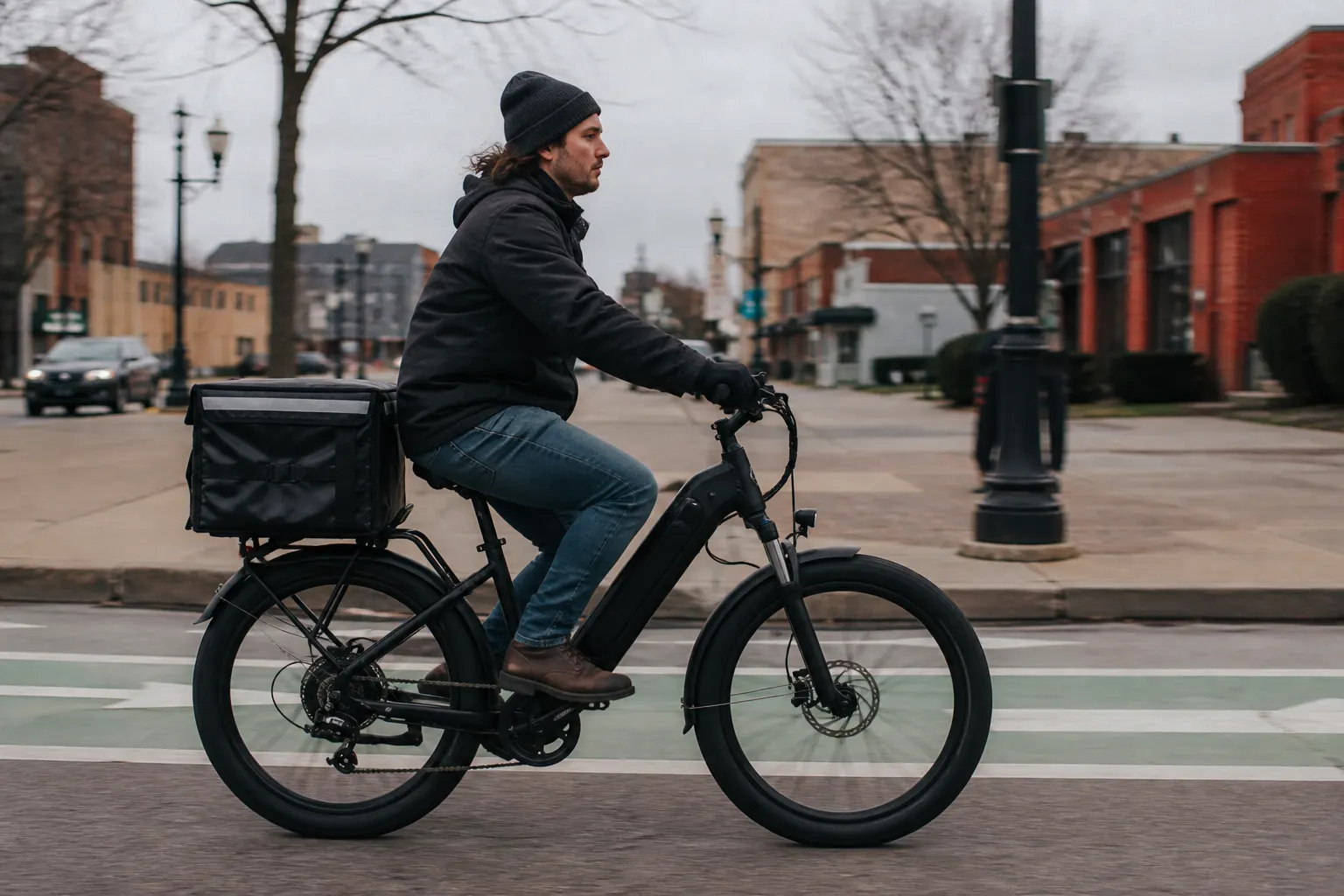
When Indiana workers' compensation may apply
Indiana's Act requires covered employers and employees to provide and accept compensation for personal injury or death by accident arising out of and in the course of employment (Ind. Code § 22-3-2-2[1]). The Act also lists defenses based on knowing self-injury, intoxication, commission of an offense, knowing failure to use a safety appliance, and knowing failure to obey a reasonable written or printed safety rule (Ind. Code § 22-3-2-8[3]).
For personal injury or death covered by the Act, its compensation rights and remedies exclude other rights and remedies of the employee, personal representatives, dependents, or next of kin at common law or otherwise on account of that injury or death (Ind. Code § 22-3-2-6[4]). That exclusivity is one reason the employment relationship matters so much in a delivery case.
Are delivery riders employees?
Delivery work is often arranged through an app or a staffing or courier company, and the paperwork may call the rider a contractor rather than a hired worker. Whether a rider is an "employee" for purposes of the Act depends on the facts, not just the label. The Act's definitions section addresses who is an "employee" and "employer" (Ind. Code § 22-3-6-1[5]). Since status turns on the facts, the written agreement, onboarding materials, pay records, and how the work was actually directed can all matter.

Four reference points
| Category | Narrow statutory point | Authority |
|---|---|---|
| Medical services | Subject to the section's terms, the employer must furnish a physician and surgical, hospital, and nursing services and supplies. | Ind. Code § 22-3-3-4[6] |
| Temporary total disability | The weekly compensation is 66 2/3% of average weekly wages during the disability, subject to the statutory maximum. | Ind. Code § 22-3-3-8[7] |
| Temporary partial disability | The weekly compensation is 66 2/3% of the difference between pre-injury average weekly wages and post-injury weekly earnings, subject to the section's maximum period. | Ind. Code § 22-3-3-9[8] |
| Permanent partial impairment | The section contains schedules and formulas for permanent partial impairment compensation. | Ind. Code § 22-3-3-10[9] |
Delivery riders are often paid per order or per trip, so figuring average earnings can be its own fact question. You can estimate the wage-replacement side with our Indiana disability-benefit calculator. See our related article on how pay is figured for Indiana workers' comp, and our Indiana workers' compensation overview.
When Section 22-3-2-13 matters
Many delivery crashes involve someone other than the employer — most often another driver, but sometimes a property owner, a product maker, or a road contractor. If an occupational injury or death occurs under circumstances creating legal liability in someone other than the employer or a person in the same employ, the injured employee or dependents may commence legal proceedings against that other person (Ind. Code § 22-3-2-13[2]). The section also addresses an employer's or carrier's lien on a settlement award, judgment, or fund from that other person and the allocation of collection costs and attorney fees (Ind. Code § 22-3-2-13[2]). Our article on workers' comp and a second injury claim explains how the two tracks interact, and our delivery accident page covers delivery-specific fact patterns.
Product-liability provision
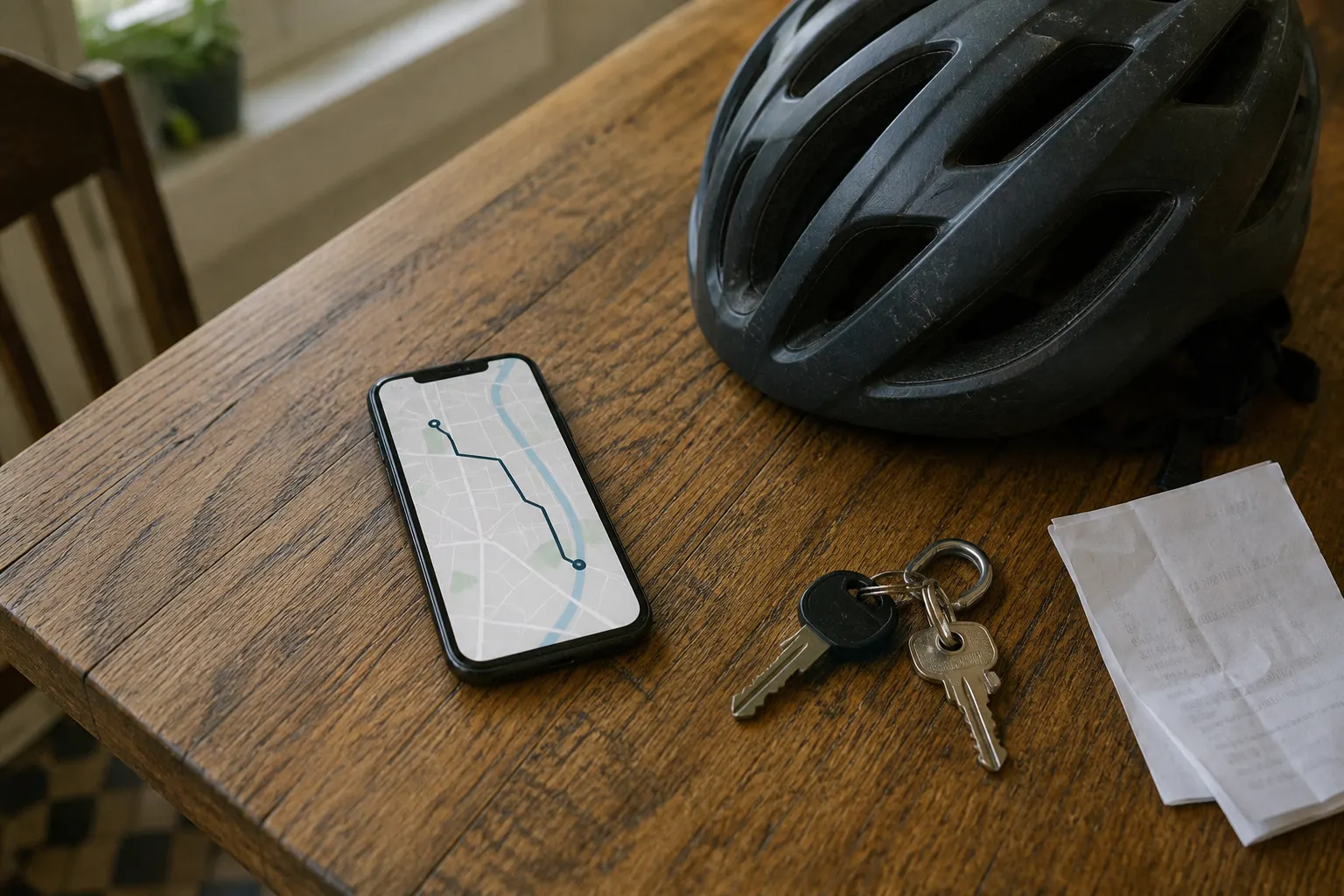
If a defect in the e-bike or e-scooter — a battery, brake, throttle, controller, or folding mechanism — is alleged to have contributed to the crash, a product claim may be a distinct track. For an action within Indiana's Product Liability Act, Section 34-20-2-1 states conditions for liability of a person who sells, leases, or otherwise puts into the stream of commerce a product in a defective condition unreasonably dangerous to an expected user or consumer (Ind. Code § 34-20-2-1[10]). Readers investigating an alleged defect can also review the firm's product-defect practice page.
How fault can affect the civil case
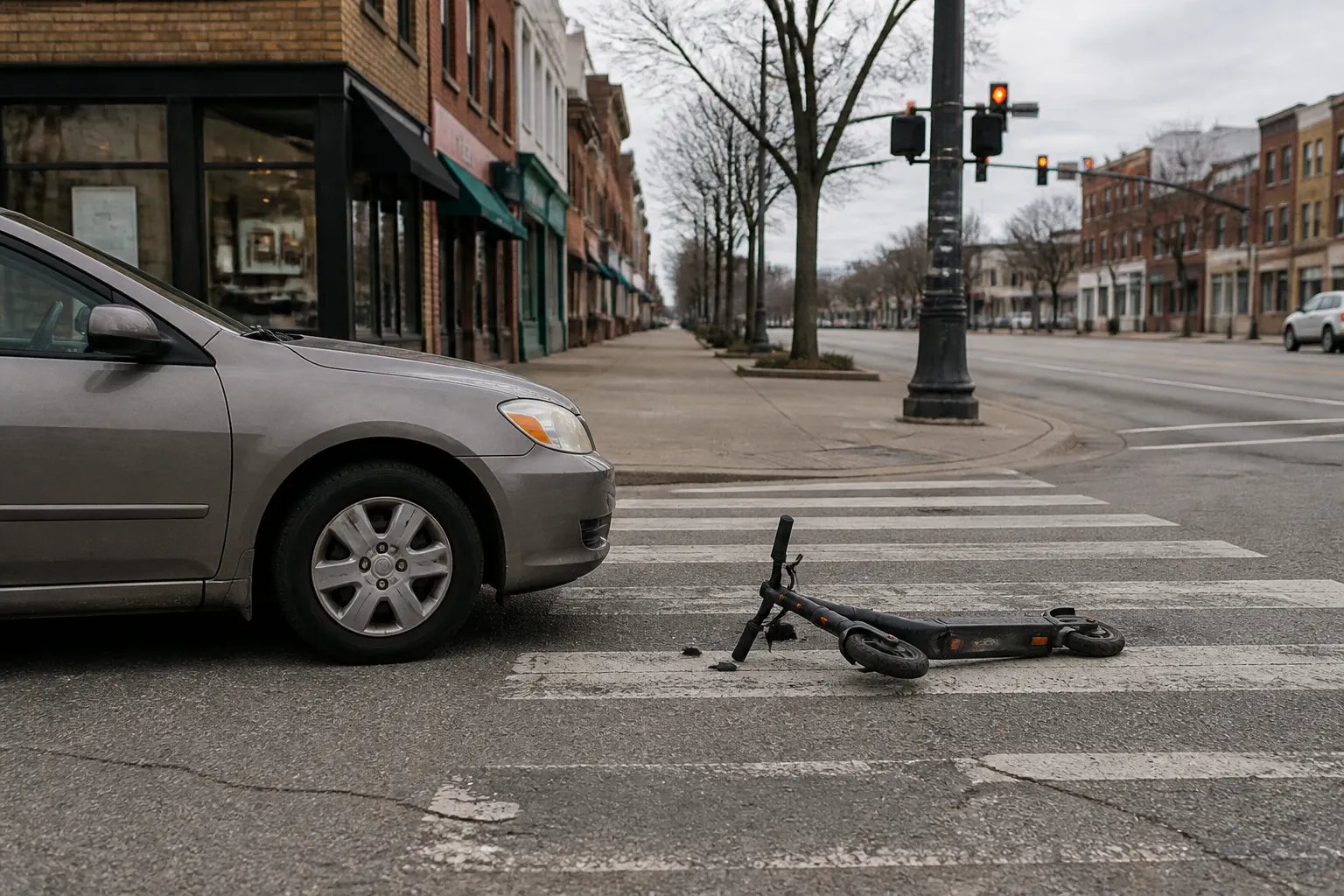
A civil claim against another party is not the same as workers' compensation. For an action governed by Section 34-51-2-6, a claimant is barred if the claimant's contributory fault is greater than the fault of all persons whose fault proximately contributed to the claimant's damages; otherwise, the claimant's damages are reduced in proportion to contributory fault (Ind. Code § 34-51-2-6[11]). In a delivery crash, questions about lane position, lighting, and right of way can affect how fault is allocated.
Records to identify and preserve
Delivery work produces evidence that ordinary crashes do not. Potentially useful factual sources include the delivery app's route, dispatch, order, and pay records; account and onboarding documents that bear on employment status; incident video and photographs; witness names; the device and its component identifiers; charging, maintenance, and repair records; and any contracts identifying the businesses involved. Preserve the e-bike or e-scooter and its battery before repair or disposal when a defect is suspected.

General Indiana timing rules
| Matter | Statutory text summarized | Authority |
|---|---|---|
| Notice to employer | Subject to the section's terms, written notice must be given as soon as practicable and no later than 30 days after the occurrence unless the employer or the employer's representative has knowledge of it. If timely notice or knowledge is absent, compensation is not paid until and from the date notice is given or knowledge is obtained. | Ind. Code § 22-3-3-1[12] |
| Compensation claim filing | Unless the section provides otherwise, the right to compensation is barred unless an application is filed with the Board within 2 years after the occurrence of the accident. | Ind. Code § 22-3-3-3[13] |
| Personal-injury action | An action for injury to person or character must generally be commenced within 2 years after the cause of action accrues. | Ind. Code § 34-11-2-4[14] |
These are statutory summaries, not a calculation for a particular claim; each linked section contains qualifications, and other rules may apply.
Frequently asked questions
Does it matter that my delivery app calls me a contractor?
The label is not automatically decisive. Whether a rider is an "employee" for purposes of the Act depends on the facts, and the Act's definitions section addresses who is an "employee" and "employer" (Ind. Code § 22-3-6-1[5]).
Can I have both a workers' comp claim and a claim against the driver who hit me?
Possibly. Section 22-3-2-13 preserves an action when an occupational injury occurs under circumstances creating legal liability in someone other than the employer or a person in the same employ, and it addresses the interaction with compensation, including a lien (Ind. Code § 22-3-2-13[2]).
What if a defective battery or brake led to the crash?
A product claim may be distinct. Section 34-20-2-1 states specific conditions for liability in an action within the Product Liability Act (Ind. Code § 34-20-2-1[10]). Preserving the device and its battery matters.
Which delivery records are useful?
App route, dispatch, order, and pay records; account and onboarding documents; and contracts among the app, restaurant, courier, or staffing company can help document the relationships and the work being performed.
What filing periods should be checked?
Subject to its terms, Indiana Code § 22-3-3-1[12] requires written notice as soon as practicable and no later than 30 days after the occurrence unless the employer or the employer's representative has knowledge; without timely notice or knowledge, compensation is not paid until and from the date notice is given or knowledge is obtained (Ind. Code § 22-3-3-1[12]). Indiana Code § 22-3-3-3[13] contains a 2-year compensation-application rule and qualifications (Ind. Code § 22-3-3-3[13]). Indiana Code § 34-11-2-4[14] contains a general 2-year limitation for an action for injury to person or character (Ind. Code § 34-11-2-4[14]).
If you were hurt while making deliveries on an e-bike or e-scooter in Indiana, attorney Chad Delventhal can review the facts and potential claim paths. Request a free case evaluation or call 260-484-6655.
Attorney advertising. General information; not legal advice.
Sources
- Ind. Code § 22-3-2-2 (iga.in.gov) ↩
- Ind. Code § 22-3-2-13 (iga.in.gov) ↩
- Ind. Code § 22-3-2-8 (iga.in.gov) ↩
- Ind. Code § 22-3-2-6 (iga.in.gov) ↩
- Ind. Code § 22-3-6-1 (iga.in.gov) ↩
- Ind. Code § 22-3-3-4 (iga.in.gov) ↩
- Ind. Code § 22-3-3-8 (iga.in.gov) ↩
- Ind. Code § 22-3-3-9 (iga.in.gov) ↩
- Ind. Code § 22-3-3-10 (iga.in.gov) ↩
- Ind. Code § 34-20-2-1 (iga.in.gov) ↩
- Ind. Code § 34-51-2-6 (iga.in.gov) ↩
- Ind. Code § 22-3-3-1 (iga.in.gov) ↩
- Ind. Code § 22-3-3-3 (iga.in.gov) ↩
- Ind. Code § 34-11-2-4 (iga.in.gov) ↩