What Happened
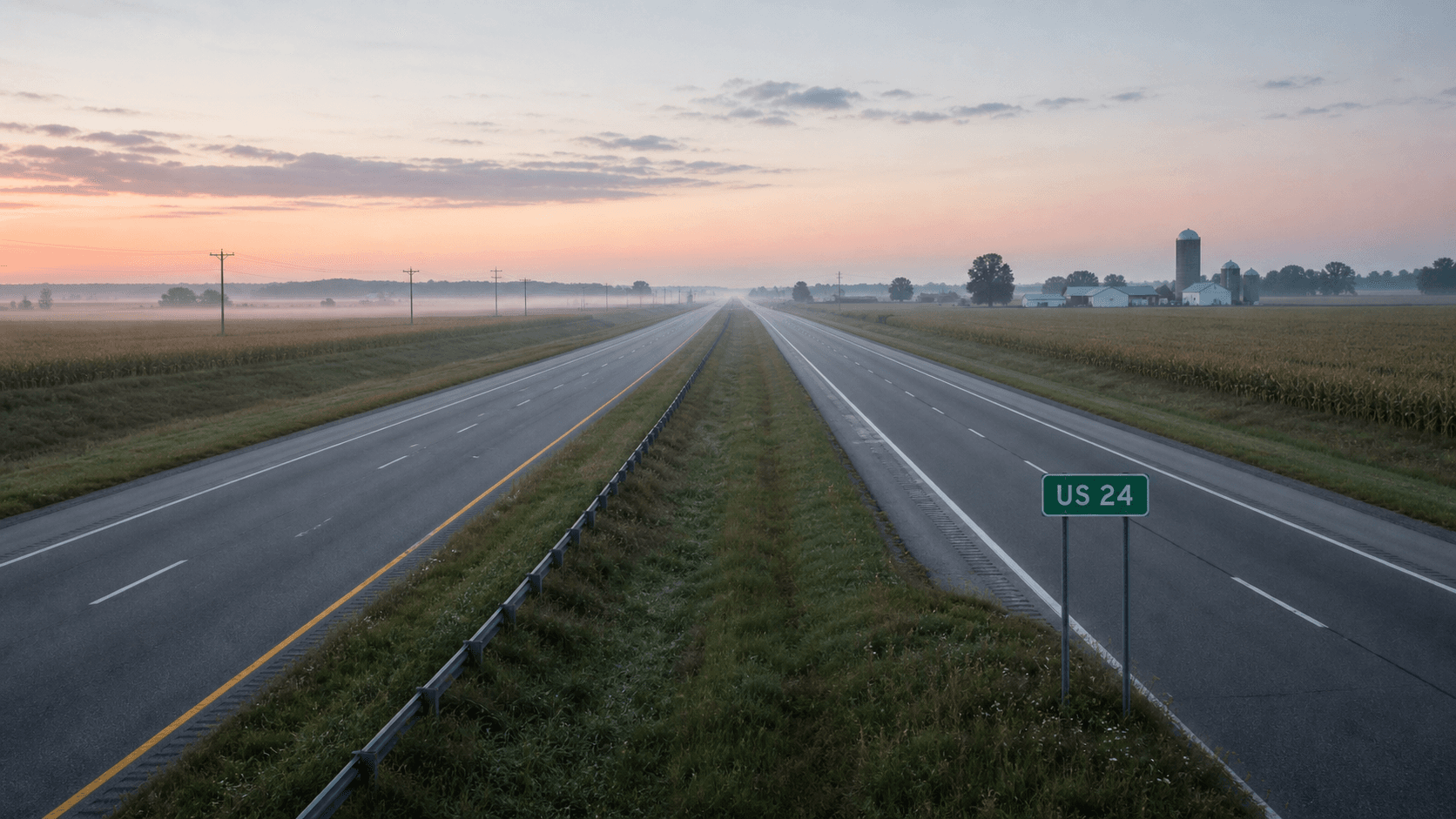
Three people were hurt, two of them seriously, in a three-vehicle crash on U.S. 24 east of Logansport Road in Cass County at about 5:23 a.m. Wednesday, Aug. 5, 2026, according to the Cass County Sheriff's Office. The sheriff's office said a 2011 Jeep Grand Cherokee driven by Rose Stambaugh, 57, of Peru was traveling eastbound in the westbound lanes of U.S. 24 when it struck an oncoming 2017 Dodge Ram driven by Matthew Kiefer, 51, of Peru.
The pickup rolled over, and Kiefer had to be extricated. A 2013 Dodge Dart driven by Zachary Ault, 35, of Peru then struck the overturned pickup. Stambaugh and Kiefer were flown by medical helicopter to a Fort Wayne trauma center with serious injuries; Ault was taken by ground ambulance to Parkview Logansport with injuries described as non-life-threatening. New Waverly Fire, Cass County EMS, Logansport Police, Indiana State Police, the Miami County Sheriff's Office, Cass County EMA, and INDOT assisted at the scene. Westbound U.S. 24 was closed between U.S. 31 and Logansport Road while crews worked. The sheriff's office said alcohol is not considered a factor and that the cause of the wrong-way travel remains under investigation. No citations or arrests were reported. The crash was reported by the Logansport Pharos-Tribune[1] and WLFI-18[2], both citing the sheriff's office release.
What Should Accident Victims Do Next?
After a high-energy highway collision, the first priority is medical care, including follow-up in the days that follow, because internal and spinal injuries do not always announce themselves at the scene. It also helps to gather what can be gathered while it is fresh: the crash report number, the responding agency, photographs, and the names of witnesses and first responders. Anyone unsure how to start that process can review the firm's practical checklist for what to do after an injury accident for the kinds of records worth preserving early.
Insurers often call quickly, and it is reasonable to decline a recorded statement until the official investigation has run its course and the physical evidence has been examined. Where an investigation is still open, early assumptions about what happened are worth far less than the reconstruction that follows. You can read more about whether to give a recorded statement after an Indiana car accident before speaking with any adjuster.
Proving Fault, and Finding Coverage, in a Wrong-Way Crash
A vehicle traveling the wrong direction on a divided highway is one of the clearer liability patterns in Indiana traffic law. A driver has a basic duty to keep to the proper lanes, and evidence of wrong-way travel (physical evidence, vehicle data, witness accounts, and the agency's reconstruction) tends to point in one direction. Even so, fault has not been officially assigned here, and the sheriff's office has said only that the cause of the wrong-way travel remains under investigation.
Why a driver ends up in the wrong lanes can matter. Police have excluded alcohol in this case. As a general matter, when impairment is ruled out, investigators look at other explanations, and one possibility in any wrong-way case is a sudden medical emergency. That principle carries legal weight: Indiana recognizes that a driver who suffers a genuinely sudden and unforeseeable medical event may not be negligent, though the defense is narrow and fact-intensive, and a known or foreseeable condition generally does not qualify. Nothing in the reporting establishes that any such issue occurred here.
Insurance capacity is the other practical question. When several people are seriously injured but the responsible driver carries a single policy, that policy can be exhausted long before the medical bills are. Uninsured and underinsured motorist coverage on an injured person's own auto policy exists for exactly that gap, and there may be more of it available than people realize across household vehicles; the firm's page on Indiana uninsured and underinsured motorist claims explains how that coverage stacks. Indiana also applies modified comparative fault: an injured person's recovery is reduced by their own share of fault and barred entirely if that share exceeds 50 percent, a rule discussed further in the firm's overview of Indiana's 51% fault rule. Most personal injury claims in Indiana must be filed within two years of the crash under Indiana Code 34-11-2-4[3].
How Delventhal Law Office Can Help
Delventhal Law Office represents people injured in Indiana highway collisions. Chad Delventhal handles wrong-way and multi-vehicle crash claims, including the coverage questions that arise when serious injuries outstrip a single insurance policy. Anyone with questions about a crash like this one, or about their own head-on collision claim, is welcome to request a free case evaluation.
This post is based on public reporting and a Cass County Sheriff's Office release as covered by the Logansport Pharos-Tribune and WLFI-18. The investigation into the cause of the wrong-way travel may still be ongoing, and facts may change as authorities release more information. Nothing in this post is legal advice, and reading it does not create an attorney-client relationship with Delventhal Law Office.