What Happened
One person was seriously injured in a crash involving a semi-tractor-trailer and a passenger car on US-30 at the Interstate 469 interchange in western Allen County. According to WANE 15[1], police responded on Monday to the crash in the westbound lanes of US-30 near the on-ramp to northbound I-469.
WANE 15 crews at the scene reported[1] seeing a passenger car partially crushed underneath the rear of the semi-trailer, which appeared to have been dragged along the roadway before coming to a stop, leaving a large debris field across US-30. One person was taken to a hospital in serious condition, and the roadway has since reopened.
As of the available reporting, no parties had been identified, no fault had been stated, and no responding agency had been named. The reporting indicates the crash occurred on a Monday, which most plausibly refers to July 20, 2026, though the exact date and time have not been independently confirmed.
This post is general Indiana legal information framed by the publicly reported facts above. It is not a comment on the conduct of any party, an opinion on civil liability, or legal advice on any particular claim, and it is not intended as solicitation of any individual. Nothing in the available reporting establishes who was at fault, and it should not be assumed that any particular driver caused the crash. The post will be updated as the parties' identities, the investigating agency, the injured person's condition, and any additional facts become part of the public record.
What Should Accident Victims Do Next?
A crash with a commercial semi-tractor-trailer is legally different from an ordinary car-versus-car collision, and several of the most important steps are time-sensitive because they involve evidence that a trucking company controls and can lawfully overwrite in the ordinary course of business.
The first step is to request the official crash report. Indiana crash reports generally become available through the State of Indiana's BuyCrash portal once the investigating agency uploads the report, and a formal request under the Indiana Access to Public Records Act (Indiana Code 5-14-3[2]) is the standard mechanism where a report does not become available through routine channels. On US-30 at the I-469 interchange, the Indiana State Police and the Allen County Sheriff's Department are the agencies most likely to have jurisdiction, so confirming which agency investigated is an early priority.
The second step, and the one most specific to a crash with a semi, is to move quickly to preserve the truck's data and the carrier's records. A commercial tractor-trailer typically carries an engine control module (ECM) and, in many fleets, telematics and event-data systems that can record speed, braking, and other operating data around the time of a crash. The motor carrier also maintains hours-of-service logs, driver qualification files, inspection and maintenance records, and dispatch records. These materials can be routinely purged or overwritten unless a spoliation (evidence-preservation) letter is sent to the carrier promptly. Acting early, before the truck is repaired or returned to service and before logs cycle out, is often the difference between having and not having the evidence that shows what happened. Anyone weighing these steps may want to consult a Fort Wayne truck accident attorney about how quickly a preservation letter should go out.
The third step is to document the scene and the vehicles while the physical evidence still exists. Photographs of the resting positions, the gouge and drag marks across the pavement, the debris field, and the damage to both the trailer and the car help reconstruct the sequence of events. Because the car was reported partially under and dragged by the trailer, the physical evidence on the roadway and on both vehicles may be especially important to any later reconstruction.
The fourth step is to identify every insurance policy that might respond. Interstate motor carriers are generally subject to federal financial-responsibility minimums under the Federal Motor Carrier Safety Administration (FMCSA) rules that are well above Indiana's minimum auto-liability limits, which means a commercial defendant is often more substantially insured than an ordinary at-fault driver. At the same time, an injured person should identify their own coverage, including medical-payments (MedPay) and uninsured/underinsured-motorist coverage and health insurance, and understand the notice and cooperation requirements each policy imposes.
The fifth step is to calendar the Indiana deadlines. Indiana imposes a two-year statute of limitations on personal-injury claims under Indiana Code 34-11-2-4[3], which for a July 20, 2026, date of incident would run to approximately July 20, 2028. That date should be confirmed once the exact crash date is established. Any first-party uninsured- or underinsured-motorist claim is governed by the deadlines and conditions in the policy in force.
Why Location Matters in Indiana Injury Claims
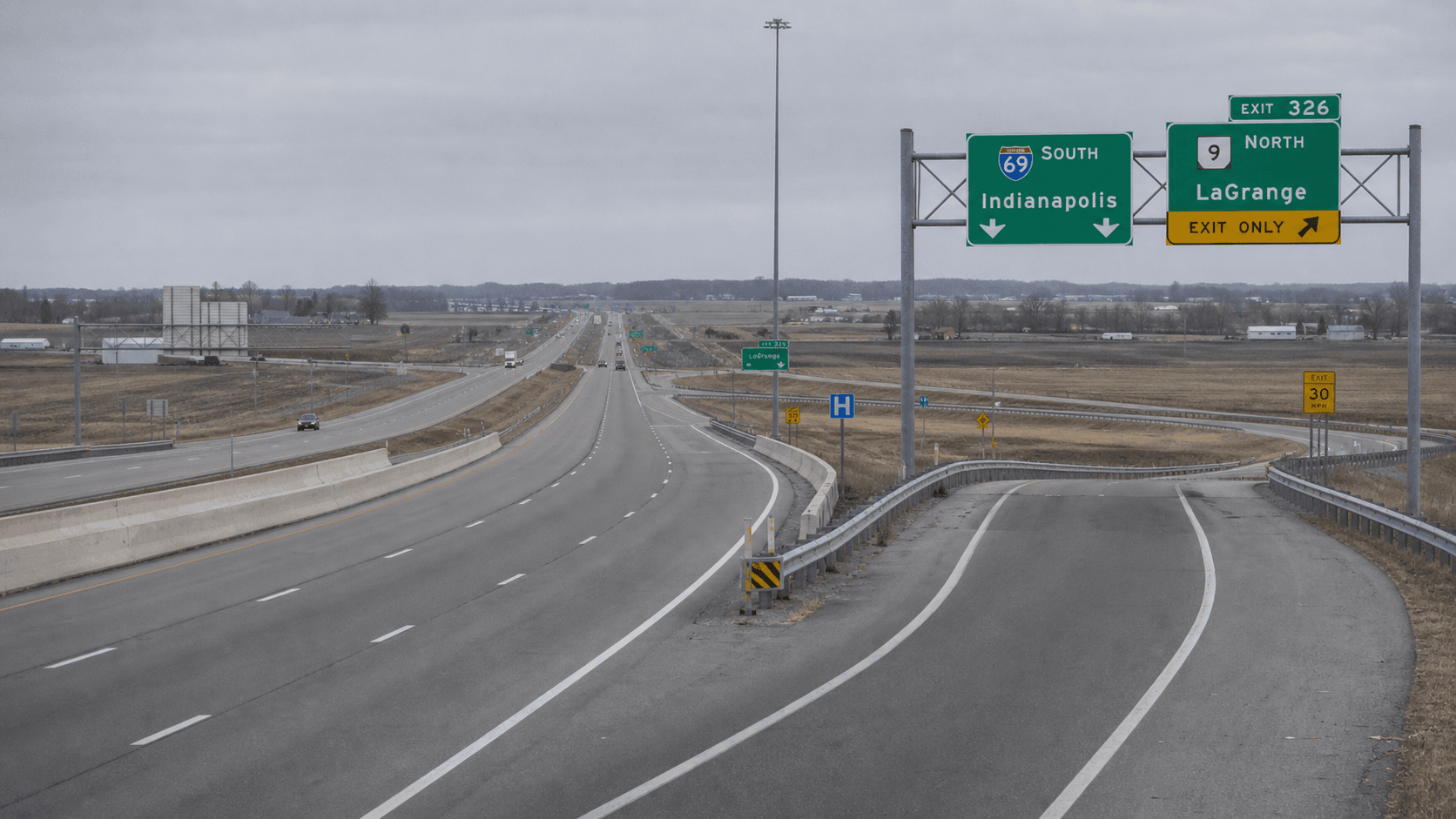
The crash occurred on US-30 in the westbound lanes near the on-ramp to northbound Interstate 469, in western Allen County, Indiana. The location shapes the claim in several ways.
US-30 is a major US highway, and its interchange with I-469 is a heavy commercial-truck corridor where cars and tractor-trailers share the road at highway speeds and where merging and lane-transition areas concentrate risk. This is a stretch that sees recurring heavy-truck crashes, and the presence of a commercial carrier changes the legal landscape: if the truck is found to be at fault, the potential defendants can include not only the driver but also the motor carrier that employs the driver, under theories such as respondeat superior and, where the facts support them, negligent hiring, training, supervision, or maintenance. Whether any of those theories applies depends entirely on facts that are not yet public, and fault here remains undetermined.

Because the crash lies in Allen County, the investigating agency is likely the Indiana State Police or the Allen County Sheriff's Department, and the civil-jurisdictional courts are the Allen Circuit and Superior Courts in Fort Wayne. Allen County is at the center of the Delventhal Law Office service area, and the US-30, I-469, and I-69 corridors and their interchanges are routes where serious commercial-truck crashes recur.
Fault will also be governed by Indiana's modified comparative-fault statute (Indiana Code 34-51-2[4]). Under that framework, an injured person whose share of the fault exceeds fifty percent is barred from recovering, and a lesser share reduces the recovery proportionally. Because no fault has been stated in the available reporting, how responsibility is ultimately allocated between the car and the truck will be a central question, and it is one reason the early preservation of the truck's data and the scene evidence matters so much. Readers can learn more about how this rule works generally at the firm's Indiana 51% fault rule explainer.
How Delventhal Law Office Can Help
Chad Delventhal and the Delventhal Law Office represent people injured in Northeast Indiana truck and car crashes, including collisions with commercial semi-tractor-trailers on US-30, I-469, and the region's other highway corridors. For a crash like the one at the US-30 / I-469 interchange, the firm handles the work this kind of case demands: prompt collection of the Indiana State Police or Allen County Sheriff's Department crash report; Indiana Access to Public Records Act requests where records do not become available through routine channels; early spoliation letters to preserve the truck's ECM and telematics data, the carrier's hours-of-service logs, and its maintenance and driver-qualification records before they can be overwritten; documentation of the scene and both vehicles; identification of every applicable insurance policy, including the higher federal commercial limits that can apply to an interstate motor carrier as well as the injured person's own MedPay, uninsured/underinsured-motorist, and health coverage; and calendar management on the two-year Indiana personal-injury deadline running to approximately July 20, 2028, once the exact crash date is confirmed. Injured people and their families in Allen County and across Northeast Indiana can reach the Delventhal Law Office in Fort Wayne for a free case evaluation about their rights and options.
This post is based on public reporting available at the time of publication. The investigation into this crash may still be ongoing, and facts including the parties' identities, fault, and the injured person's condition may change as more information becomes public. Nothing in this post is legal advice, and reading it does not create an attorney-client relationship with Delventhal Law Office.