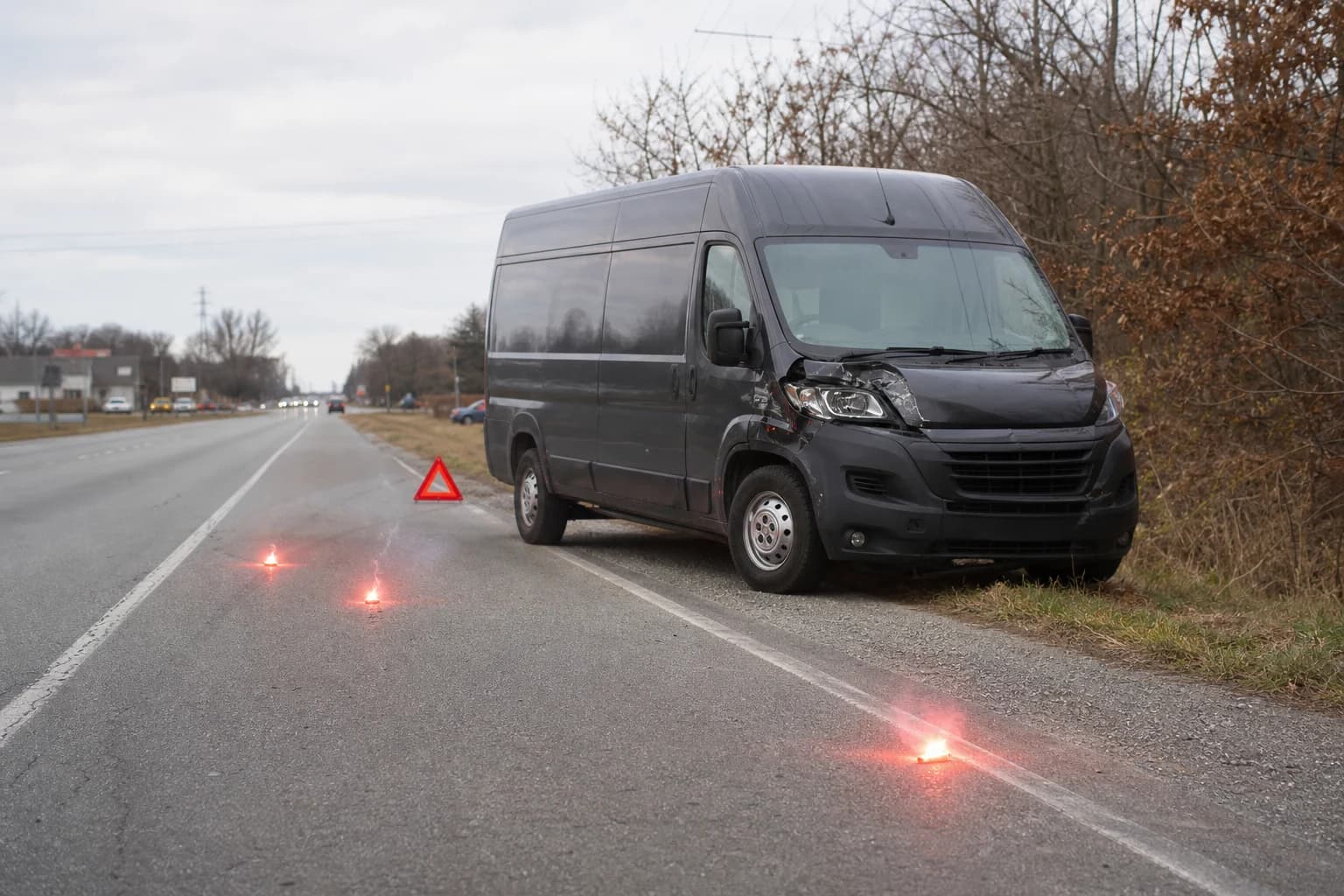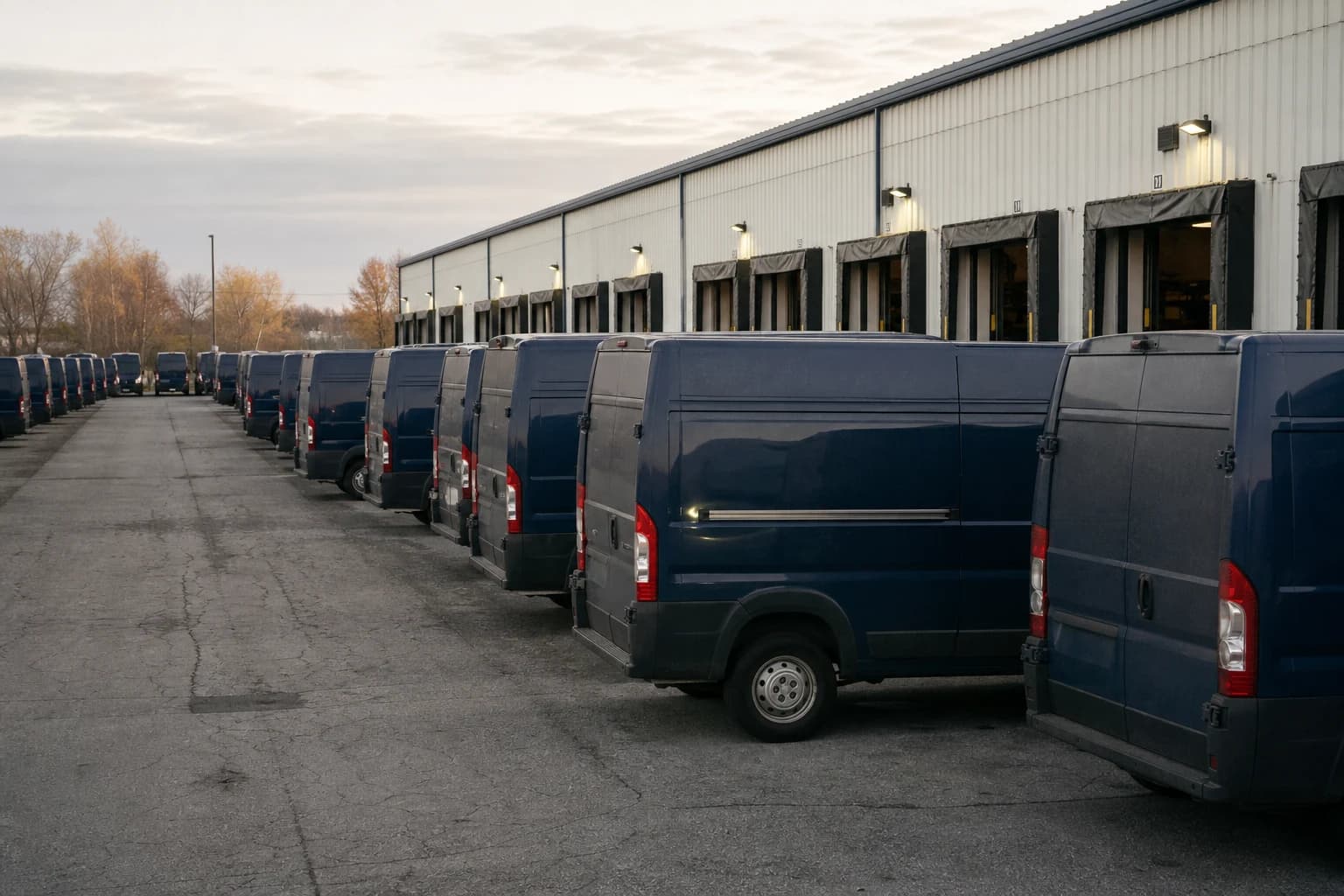
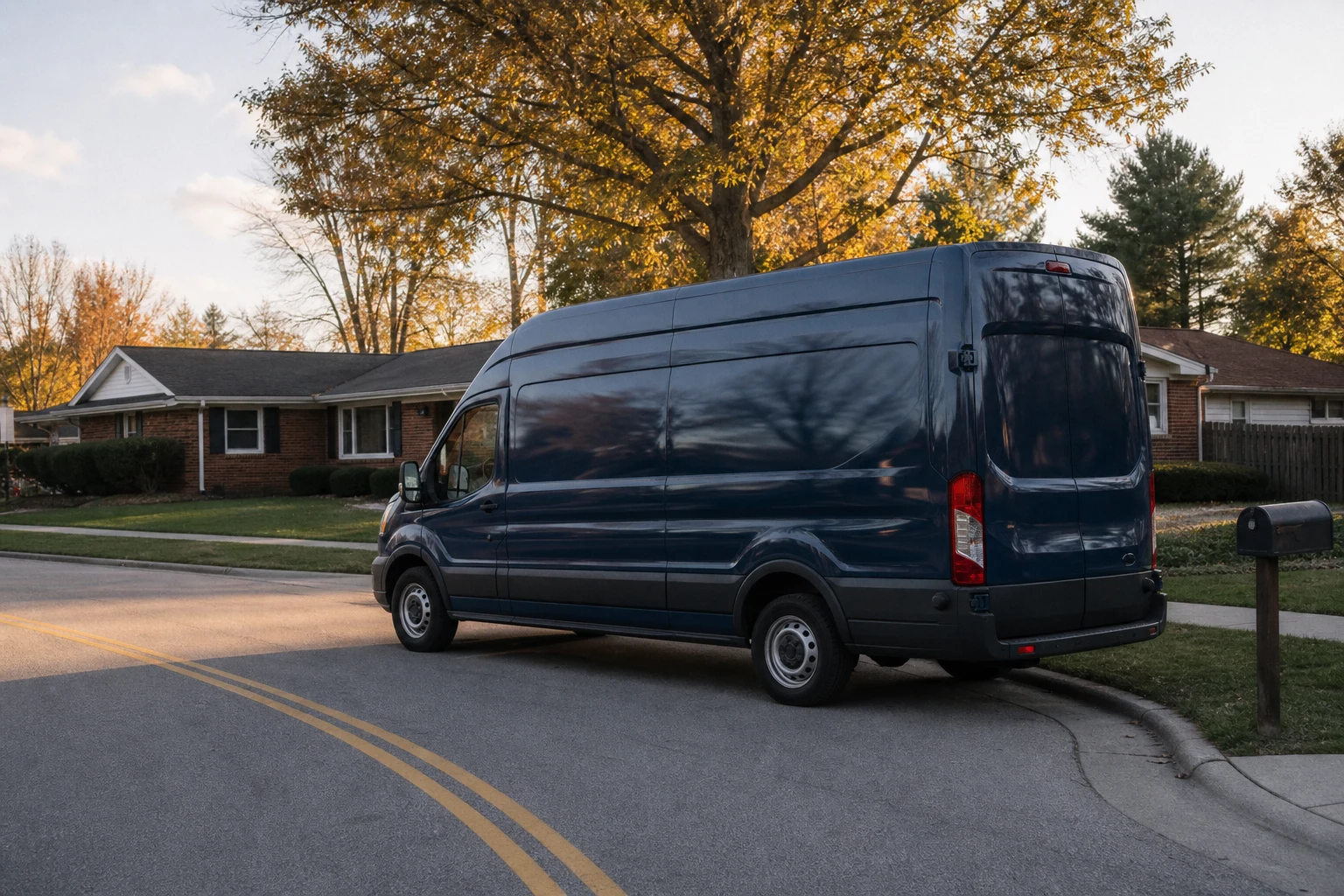
The blue delivery vans you see all over Fort Wayne — turning into cul-de-sacs in Aboite, double-parked on Calhoun Street downtown, sprinting through Huntertown and New Haven trying to hit a thirteen-hour route — aren't owned by Amazon. They're operated by Amazon Delivery Service Partners — independent contractors who Amazon hires, schedules, monitors, and (when something goes wrong) tries very hard to walk away from.
If you've been hit by one of those vans — as a pedestrian, a cyclist, a driver in another vehicle, or even as a delivery driver yourself — the case isn't a normal two-driver crash. There are three or four overlapping insurance policies, a contractor agreement designed to insulate Amazon from liability, and a 24-hour window before Amazon's lawyers start telling you it isn't their problem. The Fort Wayne Amazon delivery accident attorneys at Delventhal Law do this every week. Call 260-484-6655 for a free case evaluation, day or night.
What counts as an Amazon delivery accident case in Indiana?
Short answer: Any Indiana motor-vehicle incident involving an Amazon-branded or Amazon-routed delivery vehicle — driven by a Delivery Service Partner (DSP) employee, an Amazon Flex contractor, or an Amazon Logistics employee. Pedestrian impacts, cyclist crashes, multi-vehicle collisions, parking-lot incidents, and on-the-job injuries to delivery drivers themselves all qualify. The defining feature isn't the harm — it's the layered liability question behind it.

Amazon's last-mile delivery network in Fort Wayne and Allen County runs through three operating models, each with different liability rules:
- Delivery Service Partners (DSPs) — independent companies that lease branded Amazon vans (Rivian or Ford Transit / Mercedes Sprinter) and hire their own drivers as W-2 employees. Amazon dictates the routes, the timing, the technology, and the performance metrics — but contracts the relationship as arms-length.
- Amazon Flex — gig drivers in their own personal vehicles, scheduling delivery blocks through the Flex app. Treated as 1099 independent contractors.
- Amazon Logistics employees — direct Amazon W-2 drivers, mostly at sorting and fulfillment centers, with some last-mile coverage.
The vast majority of the dark-blue branded vans you see in Allen County neighborhoods are DSP vans. Which means when one of those vans hits you, the first question is whether Amazon — or only the DSP — is on the hook.
Who is actually liable — Amazon, the DSP, or the driver?
Short answer: In most Fort Wayne Amazon delivery accident cases, all three are potentially liable, but Amazon will spend the entire case trying to convince the court that only the DSP is responsible. Indiana law on respondeat superior, joint employment, and apparent agency gives us four distinct theories for putting Amazon back in the case — and we use all of them.

Amazon's contract with every DSP states explicitly that the DSP is an independent contractor and that Amazon has no employment relationship with the drivers. That contract is the centerpiece of Amazon's defense in every Indiana Amazon delivery accident claim. It's not the end of the analysis — it's the start.
The reality is that Amazon controls almost every aspect of how DSP drivers work. The route software, the delivery scanner, the in-cab driver-facing camera (Netradyne Driveri), the Mentor performance app, the daily debrief metrics, the Net Radius score, the package-handling protocols, the customer-rescue procedures — all Amazon. Under Indiana respondeat superior doctrine, the more control a principal exercises over a contractor's day-to-day work, the closer the relationship approaches employment. Indiana courts have repeatedly looked past the label on the contract to the operational facts. Our Fort Wayne Amazon delivery accident attorneys build the operational-control case from day one — through discovery, depositions, and the carefully preserved record of every algorithmic instruction Amazon sent the driver in the minutes before the crash.
Four theories we use to keep Amazon in every Allen County case:
- Respondeat superior / joint employment — Amazon's operational control over the driver, regardless of the contract label.
- Negligent hiring and retention — Amazon's responsibility for vetting DSPs and individual drivers it knows or should know are unsafe.
- Negligent route design — Amazon's algorithm assigns the route, the time pressure, and the stops; when those choices cause unsafe driving, Amazon's choices are causation.
- Apparent agency — Indiana law recognizes that when a company holds a contractor out to the public as its own (branded vans, branded uniforms, branded apps), it can be liable for that contractor's conduct.
Which insurance policies cover an Amazon delivery accident in Indiana?
Short answer: Three and sometimes four layers — the DSP's commercial auto policy (typically $1M primary), Amazon's $1M commercial auto liability program that wraps every DSP, the driver's personal auto policy (often relevant for pedestrian and bystander claims), and your own uninsured/underinsured motorist coverage if any of those fail. Most Fort Wayne Amazon delivery accident victims don't know about layers two and three. Finding every policy is half the case.

| Layer | Coverage Source | What It Pays | Typical Limits |
|---|---|---|---|
| 1 | DSP's commercial auto policy | Bodily injury and property damage caused by the DSP driver | $1M primary |
| 2 | Amazon Commercial Auto Insurance Program | Excess coverage wrapping every contracted DSP vehicle | $1M (often higher in catastrophic cases) |
| 3 | Driver's personal auto policy | Some claims when off-route or off-duty; bystander pedestrian claims | State minimums to $250K+ |
| 4 | Your UM/UIM coverage | Excess over at-fault driver's limits when their policy isn't enough | $25K to $500K |
Amazon's commercial program is the layer most often missed. It's a contractual wrapper Amazon maintains for every DSP, and it can dramatically expand the available recovery in a serious injury case. We trigger it by name in the demand letter, by policy number in discovery, and by deposition with the Amazon claims adjuster when the case escalates.
What evidence do we preserve in the first 48 hours of an Amazon delivery accident case?
Short answer: Amazon's evidence pipeline is digital, exhaustive, and overwrites itself fast. Driver-facing camera footage from Netradyne Driveri, route data from the Mentor app, GPS pings from the package scanner, dispatch communications, and the day's Net Radius performance scorecard all exist — but Amazon's data-retention policies wipe most of it within 30 to 90 days. The preservation letter goes out on day one.

What our Fort Wayne Amazon delivery accident attorneys subpoena and preserve in every case:
- Netradyne Driveri footage — the AI-powered driver-facing camera Amazon installs in every DSP van. Records distraction events, harsh braking, speeding, and the seconds before and after a collision.
- Mentor app data — the smartphone-based driver-behavior scoring app every DSP driver runs. Captures braking, acceleration, cornering, and phone-handling events down to the second.
- Route and dispatch data — the assigned route, the planned time per stop, the actual time per stop, and how badly behind the algorithm-imposed schedule the driver was at the moment of the crash.
- Rabbit and Flex app logs — package-scan timestamps, GPS coordinates per scan, and customer-rescue alerts.
- DSP daily debrief records — the post-route review every DSP driver completes, often capturing complaints about route feasibility before the incident.
- Vehicle telematics — the OEM data the van itself records: speed, braking, throttle, steering angle, and seatbelt status.
- Surveillance footage from third-party locations — Ring cameras, doorbell cameras, business security systems near the scene. Most overwrite within 7 to 30 days.
What are the most common Fort Wayne Amazon delivery accident injuries — and what do they cost?
Short answer: Pedestrian impact injuries dominate (head trauma, broken legs and pelvis, spine), followed by occupant injuries from rear-end collisions caused by route-pressured DSP drivers (whiplash, herniated discs, concussion), and a smaller pool of cyclist injuries on shared roadways. Treatment costs range from a few thousand dollars for soft-tissue cases to seven figures for catastrophic brain or spinal injury. The IIHS injury and fatality data[1] confirms the severity bell curve we see in Allen County.

| Injury Type | Treatment Cost Range | Settlement Range (clear liability) |
|---|---|---|
| Whiplash / cervical strain | $3K - $15K | $15K - $75K |
| Herniated disc (cervical or lumbar) | $25K - $150K | $75K - $400K |
| Concussion / mild TBI | $10K - $80K | $50K - $300K |
| Broken leg or hip (pedestrian impact) | $40K - $200K | $150K - $750K |
| Severe TBI | $200K - $1M+ | $750K - $5M+ |
| Spinal cord injury | $500K - $5M+ lifetime | $1M - $10M+ |
What tactics do Amazon's lawyers and insurance carriers use against accident victims?
Short answer: Four patterns we see in nearly every Fort Wayne Amazon delivery accident claim — the independent-contractor jurisdictional defense, the early lowball offer through the DSP's primary carrier, the recorded statement designed to lock the victim into an inconsistent story, and the gap-in-treatment argument when delays in medical care let the carrier argue causation. Knowing the playbook is the first step to dismantling it.
What we see Amazon and DSP carriers do, in order:
- The independent-contractor defense — Amazon's first letter will state that the DSP is solely responsible and Amazon has no involvement. This is theater. The Amazon Commercial Auto Insurance Program covers the loss regardless. We don't engage with the contractor defense; we go straight to the wrapper policy.
- The early lowball through the DSP carrier — within 14 to 30 days of the crash, the DSP's primary commercial carrier (often Progressive Commercial or State Farm Commercial) will offer a fast settlement well below value, often before the medical record is even complete. Accepting it closes Amazon's exposure too, by release.
- The recorded statement — adjusters request a recorded statement "to process the claim faster." The statement is then transcribed and used to argue inconsistency at trial. We never let a client give one without an attorney present.
- The gap-in-treatment argument — if there's any delay between the crash and the first medical visit, or any week-plus gap in physical therapy, the carrier argues the injury isn't really crash-related. Treatment continuity is part of the case strategy from day one.
What should you do in the first week after an Amazon delivery accident?
Short answer: Get medical treatment within 24 hours even if you feel okay, photograph the van and the scene (including the van's vehicle ID number on the rear and the driver-facing camera mount), get the names and contact info of every witness, report the incident to your own insurer only, and do not give the DSP's or Amazon's insurer a recorded statement or sign anything before a Fort Wayne Amazon delivery accident attorney reviews it. The decisions you make in the first seven days set the ceiling on the case.
Step-by-step, what to do:
- Get medical care immediately — Parkview Regional Medical Center, Lutheran Hospital, or a Fort Wayne urgent care if non-emergency. Adrenaline can mask serious injury for 24 to 72 hours; any gap in treatment is the first thing the carrier will use against you.
- Document the van — Photograph the van from all four sides. Capture the vehicle ID number stenciled on the rear panel (a five-character alphanumeric like A1B2C). That number identifies which DSP operates the van and connects to that day's specific route and driver.
- Photograph the scene — damage to all vehicles, debris field, skid marks, traffic signals, weather conditions, and your visible injuries as they evolve over the first week.
- Collect every witness name — officers typically list only one or two witnesses on the crash report. Get the names and contact info of everyone who saw what happened, including any nearby residents who may have Ring or doorbell camera footage.
- Report to your own insurer only — your policy requires you to report the crash to your own carrier. Do not give Amazon's or the DSP's carrier a recorded statement. You are not legally required to.
- Do not sign anything from Amazon or the DSP — quick-settlement checks contain a full release of your rights, including injuries that haven't been diagnosed yet. Have a Fort Wayne Amazon delivery accident attorney review every document before you sign.
Which Indiana statutes and federal regulations govern Amazon delivery accident claims?
Short answer: Indiana Code 34-11-2-4[2] sets a two-year statute of limitations on injury claims; IC 34-51-2[3] governs comparative fault; IC 22-3[4] applies if you're a DSP driver claiming workers' compensation. Federal Motor Carrier Safety Regulations under 49 CFR Part 395[5] govern driver hours-of-service for commercial drivers (relevant for some Amazon Logistics direct drivers and CDL DSP operations), and OSHA recordkeeping[6] under 29 CFR Part 1904 applies to DSP workplace injuries.
Indiana respondeat superior is the doctrine that keeps Amazon in the case. Indiana appellate courts[7] have consistently looked past contractual labels to the operational reality of the principal-agent relationship. The factors Indiana courts weigh — degree of control, source of the equipment, method of payment, length of the relationship, and the nature of the work — all point sharply toward Amazon, not against it, in DSP cases.
For DSP drivers injured on the job, Indiana Worker's Compensation Act (IC 22-3[4]) provides medical and wage-loss benefits regardless of fault, but the no-fault tradeoff means recovery is capped. The strategic question is whether a third-party claim (against the at-fault driver in another vehicle, against Amazon for negligent route design, against a vehicle manufacturer for a defect) lies alongside the comp claim. In most Fort Wayne DSP-driver cases we file, both proceed in parallel.
What does compensation cover in a Fort Wayne Amazon delivery accident claim?
Short answer: Indiana law allows recovery of every category of harm an Amazon delivery accident causes — economic and non-economic. Past and future medical expenses, past and future lost income (including diminished earning capacity), property damage, pain and suffering, loss of enjoyment of life, loss of consortium, and in catastrophic cases punitive damages where Amazon's or the DSP's conduct rises above ordinary negligence.
- Past medical bills — every dollar billed by every provider, even if covered by health insurance.
- Future medical care — projected by a life-care planner for catastrophic injuries.
- Past lost wages — including PTO and sick time burned recovering.
- Diminished earning capacity — what you can no longer earn going forward, calculated by a vocational expert.
- Property damage — full repair or replacement value of your vehicle, plus rental and diminished value.
- Pain and suffering — Indiana has no cap on non-economic damages in most personal injury cases.
- Loss of consortium — recoverable by spouses for the relational and household losses of the injury.
- Punitive damages — available where conduct is willful, wanton, or grossly negligent. Indiana caps punitives at the greater of three times compensatory damages or $50,000.
Why choose Delventhal Law for your Fort Wayne Amazon delivery accident case?
We find what others miss. Amazon's contract structure is designed to make these cases disappear. Most local firms see "independent contractor" and route the file to the DSP's primary carrier, where it settles for a fraction of its value. Our Fort Wayne Amazon delivery accident attorneys treat Amazon as a defendant from day one — preservation letter to Amazon Logistics, demand to the Amazon Commercial Auto Insurance Program, discovery requests aimed at the operational-control record, and deposition notices for the Amazon adjuster when the carriers stall.

Founded in 2009 by Chad Delventhal, our firm represents injured Hoosiers across Allen County and northeast Indiana. We've handled over 1,500 personal injury cases since opening, with 145+ five-star reviews on Google. There's no charge to talk. If we take your case, you pay nothing unless we recover. Call us at 260-484-6655 — we answer the phone 24 hours a day, 7 days a week.
Frequently Asked Questions
Is Amazon directly liable when an Amazon delivery van hits me?
Amazon's contract with every DSP states the DSP is an independent contractor. But Indiana law looks past the contract label to the operational reality. Because Amazon controls the route, the timing, the in-cab camera, the performance scoring, and the driver-facing technology, our Fort Wayne Amazon delivery accident attorneys keep Amazon in the case through respondeat superior, negligent hiring, negligent route design, and apparent agency theories. The Amazon Commercial Auto Insurance Program also wraps every DSP, so coverage exists regardless of the agency analysis.
How long do I have to file an Amazon delivery accident claim in Indiana?
Indiana Code 34-11-2-4[2] gives you two years from the date of the crash to file suit. The clock starts the day of the collision, not the day you finish treatment. If a government vehicle was involved or you're filing a wrongful death claim under IC 34-23-1[8], special Tort Claim Notice deadlines apply (180 days for local entities, 270 days for the State). Miss any of these and your case ends before it begins. Call our Fort Wayne Amazon delivery accident attorneys as soon as possible.
What if I'm an Amazon DSP driver and I was injured on the job?
You have two parallel paths in Indiana. Workers' compensation under IC 22-3[4] covers medical bills and a portion of lost wages regardless of who was at fault, paid by the DSP's comp carrier. Separately, if a third party (another driver, a defective vehicle, Amazon's negligent route design) contributed to your injury, you can pursue a third-party claim for the full range of damages — pain and suffering, future earning loss, the categories workers' comp doesn't cover. Our Fort Wayne Amazon delivery accident attorneys run both tracks in parallel.
What evidence is most important to preserve after an Amazon delivery accident?
The single most important piece is the van's vehicle ID number (a five-character code stenciled on the rear panel) — it identifies the DSP and the specific driver for that day. After that, the Netradyne Driveri in-cab camera footage, the Mentor app performance data, the route assignment and timing, and any nearby Ring or doorbell camera footage from the surrounding properties. Most of this data overwrites within 30 to 90 days. The preservation letter goes out on day one of our representation.
Do I have to give Amazon's insurance company a recorded statement?
No. You are not legally required to give a recorded statement to any insurance company that isn't your own. Amazon's and the DSP's adjusters request these statements specifically because they're used to lock in inconsistencies that get used against you later. Politely decline, and refer them to your Fort Wayne Amazon delivery accident attorney.
How much does it cost to hire a Fort Wayne Amazon delivery accident attorney?
Nothing upfront. Our firm takes Amazon delivery accident cases on contingency — you pay no attorney's fees unless we recover compensation for you. The initial consultation is free and there is no obligation to hire us. If we take your case and we don't recover, you owe us nothing.
What if the Amazon delivery driver fled the scene?
Hit-and-run cases involving Amazon delivery vans actually have a simpler evidence path than most, because Amazon's telematics, GPS, and dispatch records make it nearly impossible for a driver to truly disappear. Our Fort Wayne Amazon delivery accident attorneys subpoena the route data, the Mentor and Rabbit app logs, and the daily debrief records to identify the driver and the DSP within days. Your own uninsured motorist coverage also typically applies as a backstop.
What if Amazon claims the driver was off-route or off-the-clock?
This is a common Amazon defense — the driver was "between routes" or "on personal time" at the moment of the crash. We rebut it with the same dispatch and telematics evidence Amazon itself maintains. The Mentor app, the route scanner, and the in-cab camera together establish the driver's status to the second. If the driver truly was off-duty, the driver's personal auto policy is the primary coverage layer; the DSP's policy and the Amazon Commercial Auto Insurance Program may still apply depending on the circumstances.
Commercial vehicle or bus involved? If the crash involved a bus, shuttle, or public transit vehicle, different preservation and notice rules may apply. See our Fort Wayne bus accident attorney page.