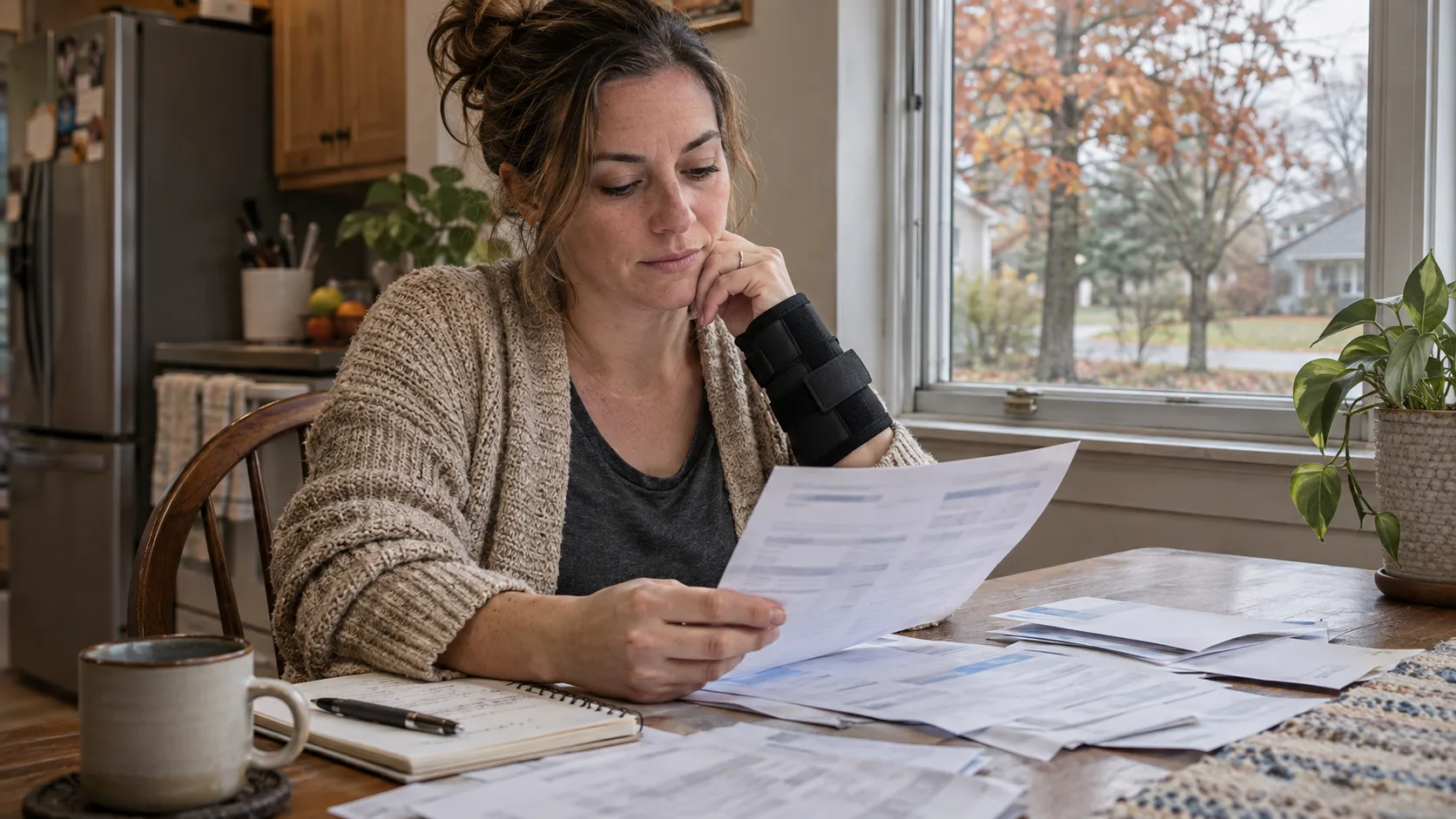
This checklist is for an Indiana patient receiving bills while an injury case remains open. It focuses on the next phone call, document, and follow-up task. For the broader payment-source overview, use our guide to medical bills after an Indiana car accident.
For example, the Indiana Department of Insurance advises checking whether a service is covered, following plan rules, confirming who submits the claim, and keeping a copy. Those steps help establish what has actually been submitted rather than what someone expects to be paid. IDOI claim-submission guidance[1].
Key takeaways
- Track each provider and date of service separately.
- Match the latest statement to the corresponding explanation and payment record.
- Ask for written terms before relying on a proposed account hold.
- Give every open task an owner and a follow-up date.
Identify the next task for each account
Use this worksheet as an organizational tool. It does not decide what you owe or promise that an account will be put on hold.
| Account status | Ask for | Record next |
|---|---|---|
| No submission located | Submission date, destination, and reference number | Who will send or resend the paperwork |
| Missing information | The exact document or answer requested | Who will supply it and how receipt will be confirmed |
| Paid but balance remains | Updated itemized statement and payment posting | Which line item still needs explanation |
| Denied | Written reason and instructions for review | Who will review the notice and its stated response date |
| Proposed account hold | Written terms, duration, and conditions | When the arrangement will be checked again |
| Collection notice received | Copy of the notice and account details | Who will review it promptly and contact the sender |
Add columns for provider, date of service, account number, original charge, adjustments, payments, stated balance, last contact, and next task. Keep a separate row when the same visit produces more than one account. Save originals rather than replacing them with your notes.

Confirm where the bill was sent
IDOI tells consumers to find out whether the provider submits the health claim or the patient must do so. Its guidance also says to review the policy or employee booklet, follow managed-care requirements, provide identifying information, and keep a copy of the submission. IDOI: submitting a health claim[1].
Practical questions: Which address or electronic destination was used? Is there a receipt or reference number? Has the recipient asked for an accident questionnaire or another document? If two offices give different answers, ask each to identify the specific account and submission being discussed.
For auto medical-payments coverage, IDOI describes payment of medical bills incurred by you and usually your passengers, up to the policy limit, for injuries while riding in, entering, or getting out of the car. IDOI: auto medical payments[2].
Ask the auto carrier whether that part of the policy applies, where to send the documents, and how to obtain an itemized payment history. This checklist does not set a universal order for submitting the same bill to different plans.

When a statement and explanation do not match
IDOI explains that an explanation of benefits states the health insurer’s decision. Its consumer guidance says a denial should state the reason, and directs consumers to the policy or employee booklet for the appeal procedure. IDOI: decisions and appeals[1].
Place the provider statement and the corresponding explanation side by side. Compare the patient, provider, service date, original charge, adjustment, payment, and stated patient portion. If a number differs, ask for the reason and a complete account history.
IDOI also explains that when benefits are assigned to the provider, the benefit check goes directly to the provider, with applicable deductibles and coinsurance left to the patient. IDOI: when a health claim is paid[1].
Ask whether a payment is still waiting to be posted, whether a corrected submission is pending, or whether the balance reflects a denial. Request an updated statement after a correction. For a formal denial, save the notice and its instructions; a routine billing call is not a substitute for following the applicable review process.

Keep Medicare and Indiana Medicaid notices separate
Medicare: CMS says Medicare may make a conditional payment when there is evidence that a primary plan does not pay promptly, conditioned on reimbursement when the primary plan pays. Its Benefits Coordination & Recovery Center handles recovery when there is a settlement, judgment, award, or other payment to the beneficiary. CMS conditional-payment guidance[3].
A Medicare Conditional Payment Letter includes an interim total and a payment summary. CMS says the total can change as additional payments are made while the claim is pending. It also describes how to submit documentation disputing unrelated items. CMS: interim totals and disputed items[3].
Practical step: keep the letter, payment summary, and any response together. Record its date and the specific items being questioned. This section addresses the BCRC process described by CMS, not the terms of every private Medicare-related plan.
Indiana Medicaid: The Indiana Health Coverage Programs provider manual says IHCP does not cost avoid claims based on liability insurance or available medical-payments coverage. For an accident-related account, it says the provider can bill IHCP or pursue payment from the liable party, and must identify accident-related services when billing IHCP. FSSA provider manual, printed page 4[4].
The same manual describes postpayment research and a lien against personal-injury settlement proceeds when IHCP identifies a responsible third party. Payment now and a later recovery inquiry are separate steps in that process. FSSA: accident-related claims and recovery[4].
Ask the billing office and your program contact which route is being used for your account. A generic “payer of last resort” description leaves out the accident-billing procedure explained above. The cited manual is version 7.2, published October 9, 2025, with policies stated as of August 1, 2024; it was retrieved from FSSA’s current provider site on November 16, 2026.
For the broader closing-account issues, see our Indiana repayment guide. This checklist does not calculate a program payoff or a settlement deduction.

Copyable questions for the billing office
You can adapt this request without sending unnecessary personal details through an unsecured channel:
Please send the current itemized statement and identify the submission date, destination, and reference number for this account. What documents are missing? Which payments or adjustments have been posted? If a pause or payment arrangement is available, please provide its terms in writing. Who should I contact next, and when should I follow up?
For a proposed arrangement, ask about its end date, any interest or fees, whether collection activity is included, and what happens if the case is still open at that time. These are questions to clarify an offer, not a promise that the office must accept it.
When a lawyer is already handling the matter, send the office copies of new statements and notices. Ask who is handling each unresolved account. Before an initial meeting, use our consultation document checklist.
Mistakes that leave accounts unresolved
- Relying on a telephone assurance without recording the person, date, and next step.
- Combining different provider accounts into a single unexplained total.
- Failing to check whether a requested document was received.
- Discarding an older statement after a new balance appears.
- Leaving a denial or collection notice unread while waiting for a callback.
Keep the file practical: one folder for statements, one for explanations and payments, one for notices, and one running contact log. Bring the unresolved items to the next discussion instead of starting the same search again.

Frequently asked questions
What should I ask when nobody can locate the bill?
Ask for the submission date, destination, reference number, and a copy of what was sent. Record who will resend it and who will confirm receipt.
Where should I look for the reason a health claim was denied?
IDOI says the reason should appear on the explanation of benefits. Check the policy or employee booklet for the appeal procedure, and preserve the notice and supporting documents. Official guidance[1].
What should I request before relying on an account hold?
Ask for written terms identifying the account, duration, conditions, any charges, and whether collection activity is included. Ask what happens if the case remains open when the arrangement ends.
Is the first Medicare conditional-payment total final?
Not necessarily. CMS describes the amount as interim because additional payments may be made while the claim is pending. Keep the payment summary and any dispute correspondence with the letter. Official guidance[3].
Must an Indiana accident provider always wait for settlement before billing IHCP?
No. The cited Indiana provider manual says IHCP does not cost avoid claims based on liability insurance or available medical-payments coverage, and describes the provider’s option to bill IHCP for accident-related services. Ask the provider and program contact how that guidance applies to the account. Official guidance[4].
If you want help reviewing unresolved accounts alongside an injury case, our Fort Wayne personal-injury team can discuss the records with you. You can use this checklist on your own or request a free consultation.
This article is general information about Indiana law and is not legal advice. Reading it does not create an attorney-client relationship, and neither does contacting us.