
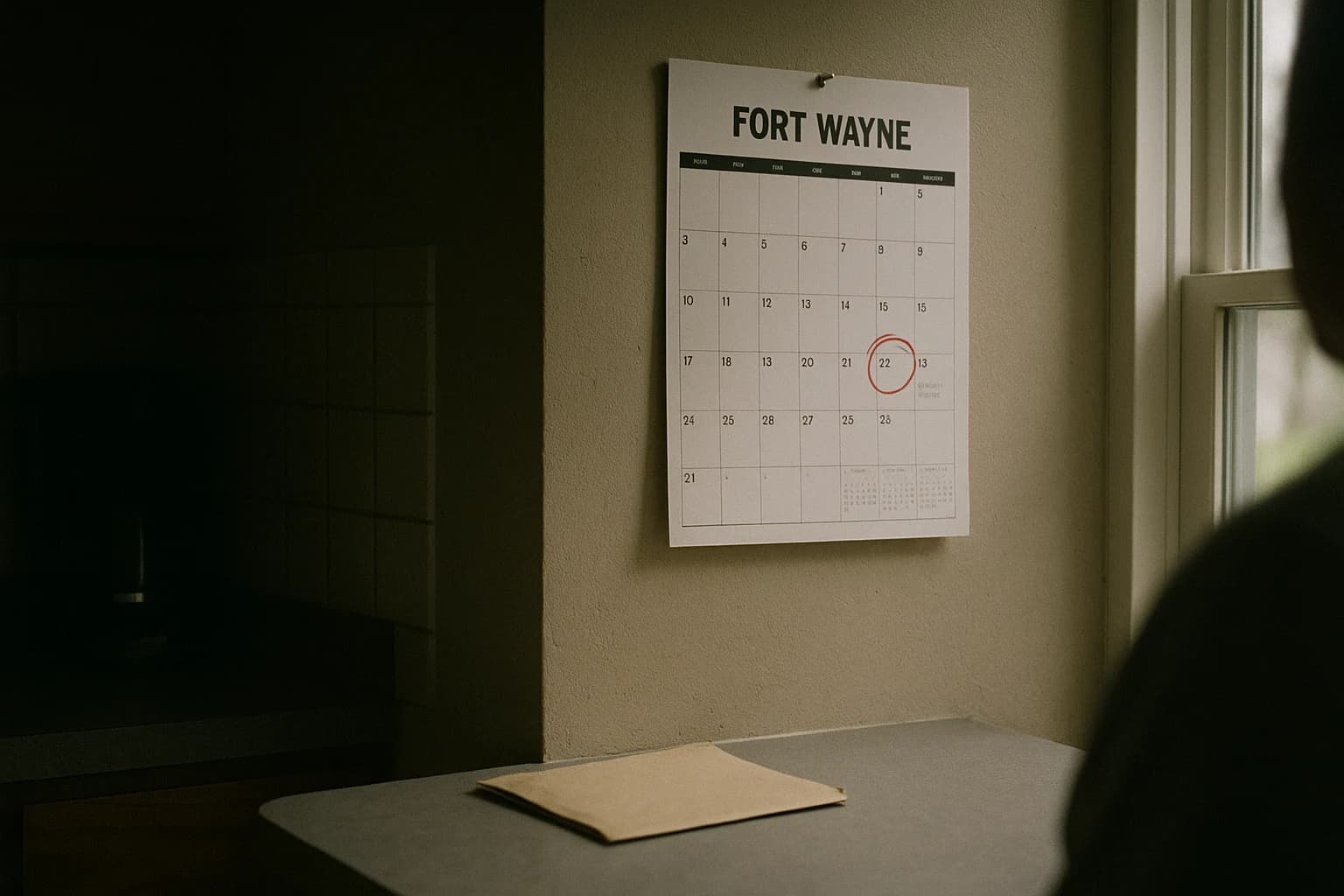
This article maps out the deadlines that govern when you can still file a claim, the traps that close cases before victims realize the clock has expired, and how to preserve your right to recover even when the injury came on slowly.
The Two-Year Rule and When the Clock Starts

Indiana's general statute of limitations for personal injury is two years. The clock starts on the date of the crash. Property damage to your vehicle also has a two-year limit under IC § 34-11-2-7[3]. Wrongful death actions, if a family member dies from crash injuries, run two years from the date of death under IC § 34-23-1-1[4].
Two years is the deadline for filing a lawsuit, not for filing an insurance claim. Filing a claim with the adjuster does not stop the statute. Mailing a demand letter does not stop the statute. Negotiating in good faith does not stop the statute. The only event that stops the clock is filing a complaint in court (or, for government defendants, properly serving a Notice of Tort Claim within the shorter notice window).
Why Two Years Disappears Faster Than You Think
Two years sounds generous. It is not, especially when the injury did not present for weeks. Here is how a typical Allen County serious-injury claim consumes the calendar:
- Weeks 1 to 6: Treatment begins. The crash report finalizes. You arrange physical therapy.
- Months 2 to 9: Symptoms either resolve or escalate. Imaging is ordered. Specialists weigh in. Sometimes surgery is recommended on a delay.
- Months 9 to 14: You reach maximum medical improvement, the point where doctors can put a long-term prognosis on paper. Only now can the claim be valued accurately.
- Months 14 to 20: A complete demand goes to the carrier. The carrier responds. Rounds of negotiation begin.
- Months 20 to 24: If the carrier will not pay fair value, suit must be filed before the two-year wall.
That is the optimistic timeline. Add a delayed surgery, a missed referral, or an adjuster who slow-walks responses, and the window collapses around you. Carriers know this. Their incentive on every disputed claim is to push the negotiation toward the deadline, betting the claimant will let it expire or panic into a lowball settlement. You can use our Indiana car accident settlement calculator to organize the factors that may affect a claim’s value; it is an educational tool, not a promise of any result.
The Discovery Rule for Delayed Injury

Indiana recognizes a discovery rule in personal-injury cases. The clock starts when you knew, or in the exercise of ordinary diligence should have known, that you were injured and that the injury was caused by another's wrongful act. In most car crashes the injury and the cause are obvious from day one and the discovery rule does not extend the deadline.
The exception matters when:
- A low-impact crash causes a soft tissue or disc injury that did not present for several weeks.
- A head injury was initially diagnosed as a concussion and only later identified as a more serious traumatic brain injury.
- An internal injury (slow splenic bleed, kidney injury, pancreatic injury) was not diagnosed at the scene and only manifested days or weeks later.
The discovery rule is fact-intensive. A judge will look at when a reasonable person in your position should have connected the symptoms to the crash. Do not assume your case fits the rule without an attorney evaluation.
Tolling for Minors and People Under Legal Disability
The two-year clock pauses (tolls) in two specific situations under IC § 34-11-6-1[2]:
Minor children
If the injured person was under eighteen on the date of the crash, the two-year clock does not start until the child's eighteenth birthday. A nine-year-old hurt as a passenger in a Fort Wayne crash has, in effect, until age twenty to file her own claim. This protects children whose parents may not have the resources or knowledge to pursue a claim while the child is a minor.
This does not mean parents should wait. Witnesses move. Memories fade. Police-report retention has limits. Evidence preservation matters even on a claim that will be filed in fifteen years.
Legal disability and mental incapacity
Indiana also tolls the statute for adults under a legal disability, including those who are mentally incapacitated. The two-year clock starts when the disability is removed, that is, when the person regains capacity to bring a claim. This exception is narrow. It does not cover short-term confusion, the stress of recovery, or the haze of pain medication. It applies to genuine inability to comprehend or pursue a legal claim.
Wrongful Death and the Estate's Deadline

When a crash victim does not survive, the claim becomes a wrongful death action under IC § 34-23-1-1[4]. The personal representative of the estate brings the claim on behalf of survivors. The deadline is two years from the date of death, not the date of the crash. The two dates can be the same. They can also be months apart, in cases where the injured person survives in critical condition before passing.
Wrongful death damages in Indiana include final medical expenses, funeral and burial costs, lost financial support, loss of love and companionship, and (in claims involving a minor child as decedent) statutory damages for the loss of the child's services and companionship.
The shorter notice clock for crashes involving public vehicles

The deadline that kills the most cases is not the two-year statute. It is the Indiana Tort Claims Act notice requirement. Our dedicated guide explains how an Indiana government tort claim notice works, who must receive it, and what it must contain. If a government employee or vehicle caused your crash, the regular two-year filing deadline is not the only clock. You must serve a written Notice of Tort Claim long before suit:
- 180 days from the incident, for political subdivisions (the City of Fort Wayne, Allen County, a township, a local school corporation), under IC § 34-13-3-8[5].
- 270 days from the incident, for the State of Indiana or a state agency (INDOT, Indiana State Police, a state university), under IC § 34-13-3-6[6].
Common scenarios where the notice clock closes: an Allen County sheriff's deputy rear-ends you on US-24, a Fort Wayne sanitation truck T-bones you at an intersection, an INDOT plow drifts into your lane on I-69 near Auburn, or a school bus runs a stop sign in Huntington County. In each case the notice clock starts ticking the moment the crash occurs, well before most victims have even thought about a lawsuit.
What Happens If You Miss the Deadline
If the statute of limitations expires before suit is filed, the defendant's attorney files a motion to dismiss under Indiana Trial Rule 12(B)(6) or for summary judgment under Rule 56. The court grants it. There is no appeal that fixes a missed statute. The case is over.
If the Tort Claims Act notice deadline expires without proper notice being served, the same outcome applies even though the two-year statute has not run. Failure to comply with the Tort Claims Act is itself a basis for dismissal.
The carrier knows the calendar. Adjusters track filing deadlines on every claim. A claim that has been negotiated past month twenty is a claim the carrier expects to settle for less, because the leverage has shifted.
How Delventhal Law Office Protects the Clock
The firm's internal target is to file or settle every case well before the statute of limitations expires. That means full evidence preservation in the first weeks, not the last months. It means filing the Notice of Tort Claim within thirty days whenever a government defendant is involved. It means setting the case up for filing at month twelve, not month twenty-three, so the carrier knows the deadline is not the firm's pressure point.
Every case is handled by Chad directly. Indiana State Bar. Hundreds of Fort Wayne, Allen, DeKalb, Whitley, Adams, Wells, Huntington, Noble, Elkhart, St. Joseph, and Kosciusko County crash claims. Direct phone access to your attorney. No screener.


FAQs About Indiana Auto Injury Claim Deadlines
How long do I have to file a personal injury claim in Indiana?
Two years from the date of the crash under IC § 34-11-2-4[1]. Filing means filing a complaint in court, not filing an insurance claim. Shorter deadlines apply when a government vehicle or employee is involved.
What if my injury did not show up until weeks after the crash?
The clock generally still starts on the date of the crash. Indiana's discovery rule can extend the clock in narrow cases where the injury was not reasonably discoverable, but most delayed-onset injuries (whiplash, soft tissue, mild TBI) are still tied back to the crash date. Talk to an attorney immediately.
My child was hurt in a car accident. How long do we have?
The two-year clock is tolled until the child turns eighteen. The child has until age twenty to file her own claim. Parents can also file a separate claim for the child's medical expenses on the standard two-year timeline. Do not wait. Evidence and witness availability deteriorate quickly.
What if a Fort Wayne city or Allen County vehicle hit me?
You must serve a Notice of Tort Claim within 180 days. State of Indiana defendants get 270 days. The notice has technical content and service requirements. Missing it ends the case even though the regular two-year statute has not run.
I am past two years. Is there anything I can do?
Probably not, but the analysis depends on whether tolling applied (minor, legal disability, discovery rule). A brief free consultation with a Fort Wayne car accident attorney can tell you quickly whether the case is closed or whether an exception might apply.
Call a Fort Wayne Car Accident Attorney Before the Clock Runs Out
Indiana's statute of limitations is unforgiving. The Tort Claims Act notice deadline is worse. The way to beat the clock is to start the case early, build the evidence while it is fresh, and force the carrier to deal with a complete file long before the calendar runs out. If you or a family member was hurt in a crash anywhere in Allen, DeKalb, Whitley, Adams, Wells, Huntington, Noble, Elkhart, St. Joseph, or Kosciusko County, talk to Delventhal Law Office. The consultation is free, no obligation, and you talk to Chad directly. Call (260) 484-6655 or contact us online to schedule a free case evaluation.