

DELVENTHAL LAW
BEEN INJURED BY A HEAD-ON COLLISION?
All car accidents have the potential to be terrifying, shocking, and even life-changing. But of all the various car accident types that occur, there is none more dangerous and deadly than the head-on collision. When a head-on crash occurs, drives and passengers in both vehicles are at serious risk of injury or death.
At the Delventhal Law Office, our Fort Wayne head-on collision accident attorneys are knowledgeable about the top causes of head-on collisions, the severe damages that can result from this accident type, and how to prove liability and recover compensation. If you have been injured in crash, please call our Fort Wayne lawyers today for your free consultation.
HOW HEAD-ON COLLISIONS HAPPEN
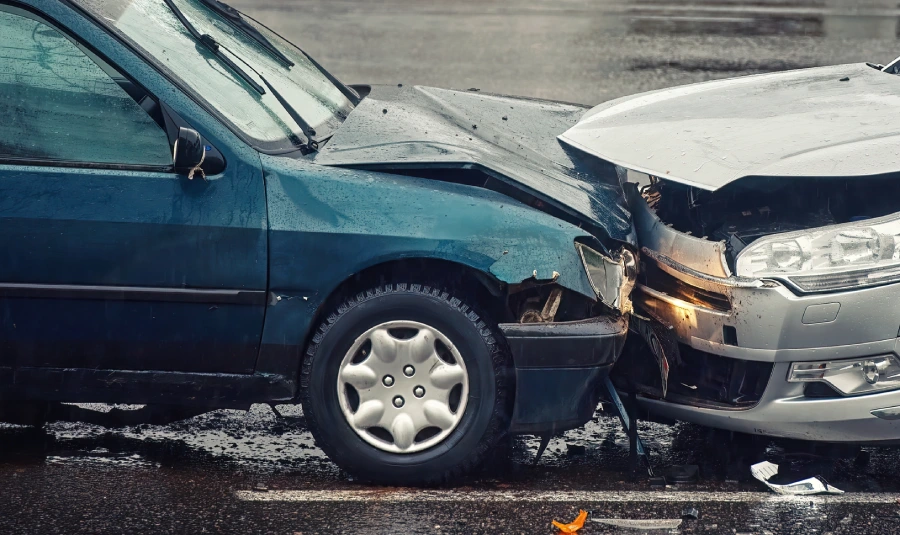
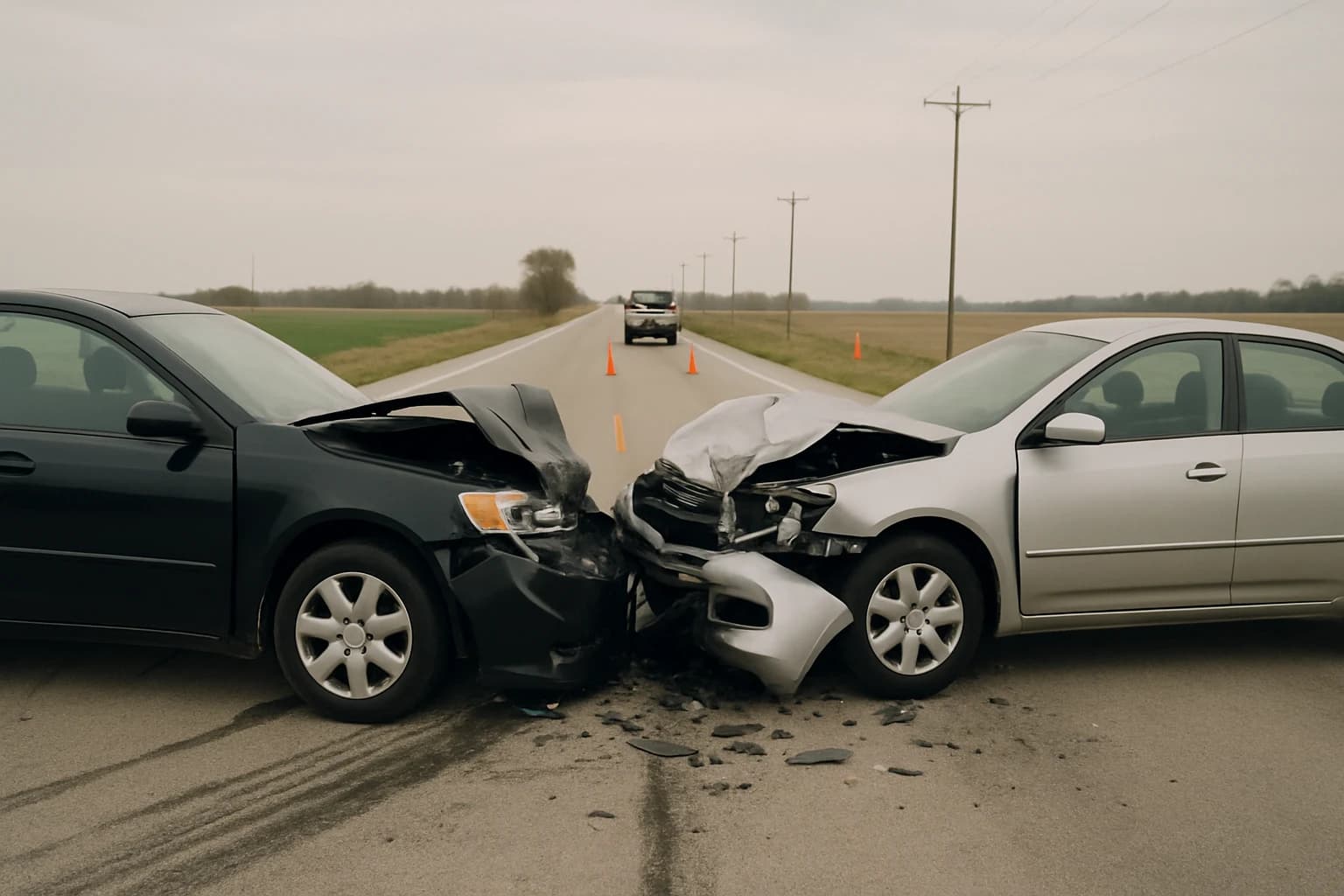
A head-on crash occurs when two motor vehicles run into each other straight on, with the front end of each vehicle making contact with the other. A head-on collision should never happen – two vehicles should never be traveling towards each other on the same line, especially at speed.
These accidents are almost always the result of the negligence or recklessness of one of the drivers involved in the crash. Top causes of head-on collisions include:
- Falling asleep at the wheel;
- Drowsy driving;
- Swerving into oncoming traffic;
- Excessively speeding;
- Drunk or impaired driving; and
Entering the roadway from the wrong direction (this could be a result of a driver impairment or negligence, or improper signage).
INJURIES RESULTING FROM HEAD-ON CRASHES
The type and severity of injury that can result from a head-on crash can be tragic. These accidents are especially devastating as the force involved in head-on collisions is amplified by the fact that both the vehicles are approaching one another with both mass (the weight of the vehicles themselves) and acceleration (the speed that the vehicles are traveling). As a result, the front ends of the vehicles may both completely crumple, leading to a variety of injuries for those within, including:
- Head, scalp, and facial injuries;
- Traumatic brain injuries;
- Amputation injuries;
- Burn injuries;
- Bone fracture injuries;
- Soft tissue injuries;
- Internal injuries;
- Object puncture injuries;
- Back and neck injuries; and
- Spinal cord injuries.
When a person suffers any of the injuries listed above, they may suffer long-term impairment and disability. Head-on collisions are, statistically, the most fatal accident type.[1]
DETERMINING LIABILITY FOR A HEAD-ON COLLISION & RECOVERING COMPENSATION
The losses that one suffers as a result of a head-on crash can be significant. Not only are serious injuries very likely, but these injuries may also result in an inability to work and earn an income, high medical bills and long-term healthcare expenses, emotional anguish and psychological harm, and physical pain and suffering. For these losses, and any other suffered by a victim or the surviving family members of a deceased victim, compensation is deserved.
Our Fort Wayne head-on collision accident attorneys can help you to recover the compensation that you’re owed by filing a car accident claim with the insurer of the at-fault party, or filing a lawsuit directly against the responsible person or entity. This process begins with identifying fault and proving liability; to do this, our lawyers open a thorough investigation into your case, hiring experts when necessary. From there, we build your case, valuate your damages, and issue a demand letter. When you receive a settlement offer, we fully review it, and can represent you in its rejection and negotiation. Our goal is to ensure that you get the full value of compensation that you deserve.
STATUTE OF LIMITATIONS IN INDIANA
While thinking about taking any legal action after being seriously injured can be challenging, it is important that you act quickly after being involved in a head-on collision, or losing a loved one in such a crash. This is because the statute of limitations in Indiana[2]–the amount of time that you have to bring forth a claim for damages–is two years from the date of accident. If more than two years from the time of the accident pass, you will be permanently barred from recovery.
CONTACT A FORT WAYNE HEAD-ON COLLISION ACCIDENT ATTORNEY TODAY
Our lawyers understand the trauma that you’re going through after a head-on crash, and we want to help. We have years of experience, and a reputation of excellence in our community and amongst our former clients. For a free consultation with our Fort Wayne head-on collision accident attorneys at the Delventhal Law Office, please reach us today by sending us a message or calling us directly. We work on a contingency fee basis and always put your needs first.
The Indiana law that applies to your head-on collision case
Indiana's two-year personal-injury statute of limitations at IC 34-11-2-4[3] governs Fort Wayne head-on collision claims, which are statistically the most lethal crash configuration on Indiana roads. Lane-departure causation typically traces to fatigue, intoxication under IC 9-30-5[4], distracted driving under IC 9-21-8-59[5], or reckless operation under IC 9-21-8-52[6]. The 51% modified comparative-fault rule at IC 34-51-2-6[7] controls allocation. When a vehicle defect contributes to the lane departure or the post-impact cabin failure, parallel product-liability theories run under IC 34-20[8].

How insurance carriers fight Fort Wayne head-on collision claims
Head-on carriers in Allen and surrounding counties run a defense built around four arguments. First is the sudden-emergency argument — the at-fault driver claims a deer, debris, or unexpected medical event forced the lane departure, attempting to convert clear negligence into a non-fault excuse. Second is the comparative-fault argument, where the carrier challenges the plaintiff's reaction time, approach speed, or lane position. Third is the crashworthiness-attribution argument, where the carrier blames the manufacturer to dilute its allocated share. Fourth is the medical-causation argument, attacking the link between the impact and the orthopedic, neurological, or chronic-pain diagnosis through aggressive defense-IME selection. We counter every layer with EDR data, scene reconstruction, witness statements, FMVSS crashworthiness analysis informed by Insurance Institute for Highway Safety crash testing[9], and current trauma-outcome medical-narrative literature.
Evidence we preserve in the first 48 hours
Head-on cases turn on lane-departure proof, vehicle-dynamics evidence, and crashworthiness documentation captured before storage release. From day one we lock down:
- Event Data Recorder downloads from both vehicles capturing pre-impact speed, throttle, braking, steering, and seatbelt status in the five seconds before impact.
- Scene photographs, drone overflight imagery, gouge marks, debris-field mapping, and centerline lane-departure documentation before INDOT crews clear the roadway.
- Witness statements taken within seventy-two hours, plus any dash-cam, ring-camera, or commercial-vehicle forward-facing camera footage in the corridor.
- Vehicle inspection by a qualified reconstructionist documenting crush profile, cabin intrusion, airbag deployment timing, and any pre-impact mechanical or tire failure.
- Toxicology results, cell-phone records, and employment hours-of-service logs from the at-fault driver to establish fatigue, distraction, or intoxication.

Damages categories in an Indiana head-on collision case
Head-on damages are typically catastrophic and divide into economic and non-economic categories. Economic damages cover trauma surgery, ICU stays, multiple staged orthopedic and reconstructive surgeries, long-term inpatient and outpatient rehabilitation, lost wages, and lost future earning capacity for survivors with permanent functional impairment. Future-care damages frequently reach into seven-figure life-care plans informed by Insurance Institute for Highway Safety crash testing[9] severity research. Non-economic damages capture pain, disfigurement, and loss of enjoyment, and wrongful-death recovery under IC 34-23-1[10] covers funeral expenses, lost services, and survivor loss of consortium.

What our head-on collision clients ask most
How much is a Fort Wayne head-on collision case worth?
Head-on configurations produce the highest median case values in motor-vehicle litigation because impact forces routinely cause polytrauma, traumatic brain injury, and fatalities. A documented serious-injury head-on with a single liability defendant, full policy limits, and UIM stacking regularly supports a high six- to seven-figure recovery when the reconstruction and life-care plan are built early.
What if the at-fault driver was killed in the crash?
The estate of a deceased at-fault driver remains liable to the same extent as a living defendant under Indiana law, and the driver's auto policy continues to provide coverage. The claim is filed against the estate, served through the personal representative, and tried on the same negligence and damages framework. Estate-defendant claims do not reduce available coverage.
Could a vehicle defect have caused the head-on crash?
Crashworthiness and lane-keeping defects appear in a meaningful minority of head-on cases — tire tread separations, stuck throttles, defective lane-departure warning systems, and steering failures all produce sudden lane crossings. The first inspection by a qualified reconstructionist documents the failure, and the IIHS crash-testing database frames the cabin-intrusion analysis.
How long do I have to file a head-on collision lawsuit?
Indiana's general two-year statute at IC 34-11-2-4[3] applies to surviving injury claims. Wrongful-death claims under IC 34-23-1[10] also carry a two-year clock from the date of death. Product-liability claims face IC 34-20-3-1[11]'s ten-year statute of repose. UIM claims may carry shorter contractual notice obligations under the policy, so early evaluation matters.
What if my family member died in the head-on crash?
Indiana's wrongful-death statute at IC 34-23-1[10] provides recovery for funeral and medical expenses, lost earnings, loss of consortium, and loss of love and companionship. The personal representative of the estate brings the claim. Adult-child and elderly-parent claims run under separate statutes with their own caps. Early estate-opening preserves the case.

What happens after you hire us
From the day we open the head-on file we retain a reconstructionist, dispatch an inspector to both vehicles before storage release, and preserve EDR data, dash-cam footage, and witness statements under written hold. We coordinate trauma and rehabilitation care, build a life-care plan with credentialed experts, and pursue every available coverage layer — at-fault liability, UM, UIM, and umbrella. A demand goes out at maximum medical improvement. If the carriers fall short, suit is filed in Allen Superior Court.
Sources
- Head-on collisions are, statistically, the most fatal accident type. (iihs.org) ↩
- statute of limitations in Indiana (iga.in.gov) ↩
- IC 34-11-2-4 (iga.in.gov) ↩
- IC 9-30-5 (iga.in.gov) ↩
- IC 9-21-8-59 (iga.in.gov) ↩
- IC 9-21-8-52 (iga.in.gov) ↩
- IC 34-51-2-6 (iga.in.gov) ↩
- IC 34-20 (iga.in.gov) ↩
- Insurance Institute for Highway Safety crash testing (iihs.org) ↩
- IC 34-23-1 (iga.in.gov) ↩
- IC 34-20-3-1 (iga.in.gov) ↩