This article maps out what a real Indiana car accident settlement looks like, stage by stage, so you know which delays are normal, which are tactical, and where you have leverage you may not realize. You can use our Indiana car accident settlement calculator to organize the factors that may affect a claim’s value; it is an educational tool, not a promise of any result.
Stage One: The First Forty-Eight Hours After the Crash
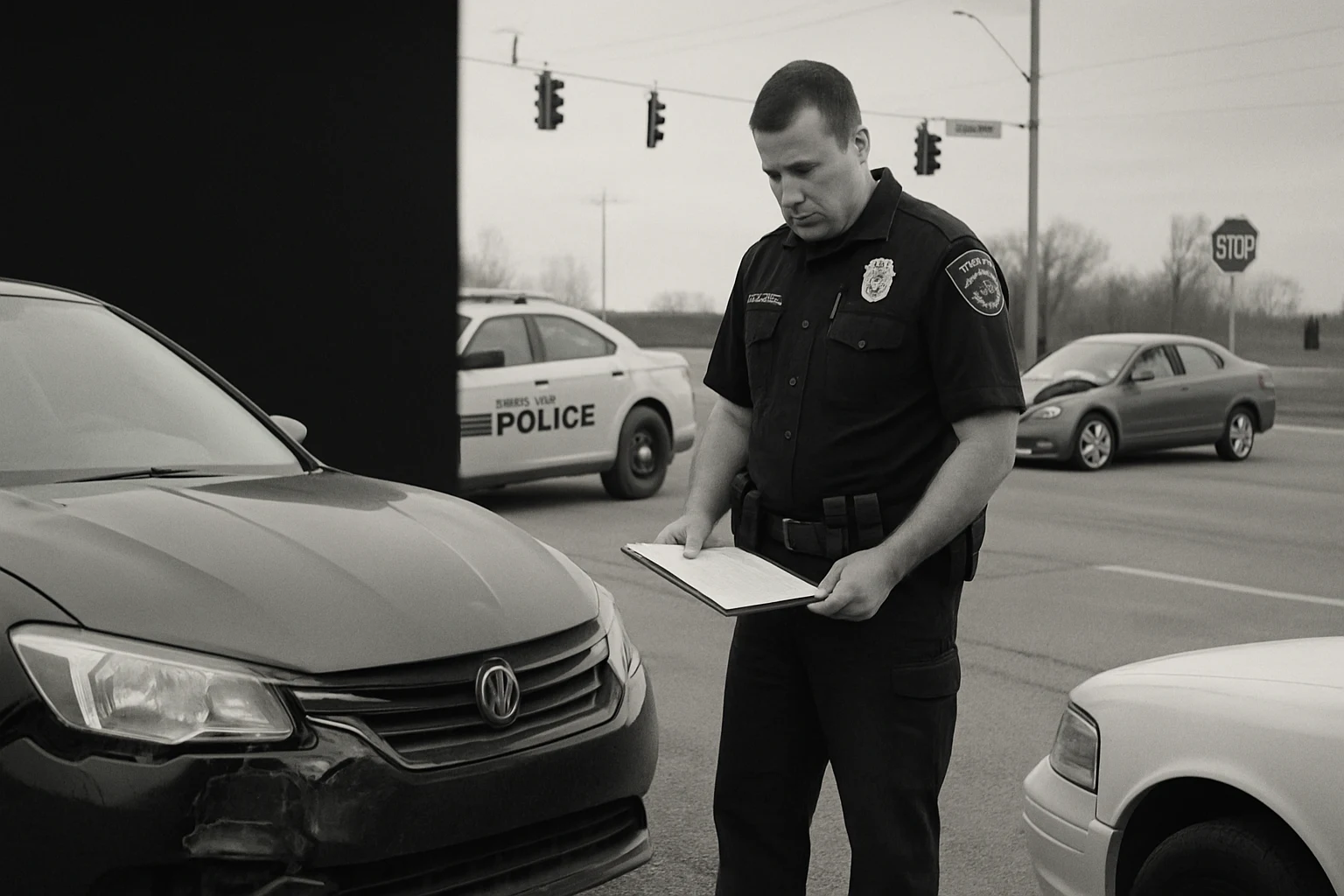
Everything downstream begins with what is captured at the scene. The Fort Wayne Police Department or Allen County Sheriff's deputy who responds writes a crash report under IC § 9-26-1[2]. That report assigns a preliminary fault determination, lists witness contacts, and records statements. Get the report number before you leave the scene. Photograph the vehicles in their resting positions, the surrounding roadway, any debris, and the weather. Photograph any visible injuries.
Do not give a recorded statement to the other driver's insurance carrier at the scene or on the phone in the days that follow. You are not required to. The adjuster's friendly request for your version of events is the first move in valuing your claim downward. The right answer is: I am still being treated, my attorney will be in touch.
Stage Two: Medical Treatment and Maximum Medical Improvement
The single biggest driver of settlement value is medical documentation. The single biggest driver of timeline is how long it takes your body to stabilize. Lawyers and doctors call this point maximum medical improvement, or MMI: the moment when your treating physician can state, in writing, what your long-term prognosis is. You cannot settle a serious claim before MMI without leaving money on the table, because nobody (including you) knows yet what your future medical costs and limitations will be.
MMI usually arrives three to nine months after the crash for moderate injuries, twelve to eighteen months for severe injuries. During this period:
- Go to every scheduled appointment. A two-month gap in treatment is what the adjuster waits for.
- Fill every prescription. Comply with every referral.
- Keep a short daily journal: pain level, activities you avoided, sleep quality.
- Save every bill, copay receipt, mileage log, and pharmacy printout.
If you stop treatment because you cannot afford it, the carrier will argue you stopped because you got better. Talk with an attorney early so that medical-payments coverage, health insurance, and treating providers willing to wait can be coordinated.
Stage Three: Notifying the Insurance Carriers

You notify your own carrier of the crash promptly. Your policy requires it. Be factual. Do not embellish, do not minimize. Stick to the basics: date, time, location, parties involved, that you are seeking medical treatment. The other driver's carrier will reach out as well, sometimes within twenty-four hours.
For the at-fault carrier, the standard is different. You are not contractually obligated to give them a recorded statement. You are not required to sign their medical-records release, which is typically broader than necessary and gives them access to your full medical history (which they will use to argue every ache you ever had is unrelated to their insured's negligence). Politely decline both until you have spoken with counsel.
If a government vehicle was involved (Fort Wayne sanitation, Allen County sheriff, INDOT, school bus, transit), the Indiana Tort Claims Act adds a notice deadline that runs separately and faster than the statute of limitations: 180 days for a political subdivision under IC § 34-13-3-8[3] and 270 days for the State of Indiana under IC § 34-13-3-6[4].
Stage Four: The Attorney Consultation and Investigation
A free consultation is exactly that. You sit down (in person, on the phone, or by video), walk through what happened, share what records you have, and the attorney tells you whether a claim is worth pursuing and what to expect. You are not committing to hire. You are getting information.
If you decide to retain counsel, the firm goes to work on a parallel investigation that is broader than what the police report contains. That includes:
- Pulling the crash report and 911 audio.
- Locating and interviewing every witness while memories are fresh.
- Subpoenaing surveillance footage from nearby businesses and traffic cameras.
- Sending preservation letters to the at-fault driver and the carrier to lock down vehicle data, cell phone records, and dash-cam files.
- Retaining a crash reconstructionist if liability is disputed.
- Coordinating with treating physicians on causation opinions and future-care projections.
This work happens during your treatment, in parallel. By the time you reach MMI, the case is ready to demand.
Stage Five: The Demand Letter and Negotiation

The demand letter is the centerpiece of pre-suit negotiation. A serious demand is not a one-page request. It is a bound presentation that includes the factual narrative, liability analysis with citations, the complete medical chronology, every bill and lien, wage-loss documentation, photographs, witness statements, the treating physician's prognosis, and the requested settlement figure. The package is usually fifty to two hundred pages.
The carrier has thirty to sixty days to respond. The first response is almost always a lowball. Negotiation then runs in rounds: counter, response, counter, response. Most cases that are going to settle pre-suit settle in two to four rounds, over sixty to one hundred twenty days. If the gap between the demand and the offer remains unbridgeable, the next step is suit.
Stage Six: Filing Suit, Discovery, and Mediation
Filing suit in Allen Superior Court (or the appropriate county court) does not mean trial. Most filed cases still settle, just at a higher value, because filing changes the carrier's posture. Suit must be filed within two years of the crash under IC § 34-11-2-4[1].
After suit is filed, the case moves into discovery, the formal exchange of evidence and testimony. Discovery in an Indiana auto-injury case typically includes:
- Interrogatories: written questions each side must answer under oath.
- Requests for production: documents, photos, medical records, employment records.
- Requests for admission: yes-or-no statements that, if admitted, become facts of the case.
- Depositions: sworn questioning of parties, witnesses, treating physicians, experts.
- Independent medical examination: a defense-selected physician evaluates you, on the record.
Discovery typically takes six to twelve months. Toward the end, the parties usually agree to mediation: a neutral retired judge or experienced attorney facilitates settlement discussion. The mediator cannot order anything. Most mediations either resolve the case that day or narrow the gap enough that resolution follows within weeks.

Stage Seven: Trial (Rare, but Real)
A small minority of Indiana auto-injury cases actually reach trial. The carrier's analysis is straightforward: if they can settle within their reserve, they settle. If the demand is higher than they want to pay and the case has weaknesses they think a jury will exploit, they roll the dice. Cases that go to trial in Allen County, DeKalb County, or surrounding counties usually involve disputed liability, large damages, or a carrier that has miscalculated jury value.
A trial-ready firm is a firm whose cases settle at the top of the range. Carriers track which lawyers actually try cases and which take whatever is offered. That reputation, built case by case, is the silent leverage at every negotiation. Indiana civil juries in northeastern counties tend to be fair but skeptical; they reward well-prepared cases with credible plaintiffs and clear medical evidence, and they punish overreach. Good trial preparation is also good settlement preparation, because the case is being built for the courtroom whether it ever gets there or not.
Common Mistakes That Cost You at Each Stage
Most underpaid claims trace back to choices made in the first two months, before an attorney was involved. The pattern repeats often enough that it is worth flagging:
- Giving a recorded statement to the at-fault driver's adjuster in the first week. Anything you say can be used to argue the injuries are minor or pre-existing.
- Signing the broad medical-records release the adjuster mails to you. The release usually covers your full history, not just the injuries from the crash. Limit the scope before signing.
- Posting on social media after the crash. Photos of you smiling at a cookout three weeks after a back injury show up in defense exhibits.
- Skipping appointments or stopping therapy when symptoms feel better. Gaps in treatment are the most common adjuster argument.
- Accepting a quick check for property damage with a release that also covers bodily injury. Read every release before signing.
- Waiting too long to call an attorney. Free consultations cost nothing. The information they provide is the difference between a case built right and one that gets discounted later.
How Delventhal Law Office Handles the Process
The approach is simple: do the work early, document everything, file when filing is warranted, and try the case if the carrier will not pay fair value. Most Fort Wayne firms wait until month twenty to send a real demand. By then evidence has decayed and witnesses have moved. The firm's internal target is to have a complete demand package ready within ninety days of MMI, which usually means six to twelve months after the crash.
Every case is handled by Chad directly. Indiana State Bar. Hundreds of crashes worked through this process in Fort Wayne, Allen County, DeKalb, Whitley, Adams, Wells, and Huntington counties. Clients reach Chad by phone, not a screener.

FAQs About the Indiana Car Accident Settlement Process
How long does the whole process take?
For moderate injuries that resolve pre-suit, nine to fifteen months. For serious injuries that require litigation, eighteen to thirty months. For trial cases, two to three years. The biggest variable is medical recovery time, not legal procedure.
Should I take the first offer the insurer makes?
Almost never. The first offer is calibrated to test whether you understand the value of your claim. Unrepresented claimants who accept the first offer typically receive a fraction of fair value. Talk to an attorney before signing anything, including any release.
Will I have to go to court?
Probably not. Most Indiana auto-injury cases settle before trial, either pre-suit or during discovery and mediation. If filing suit becomes necessary, it does not mean a courtroom is inevitable. It usually means the negotiation reset that brings the carrier to a fair number.
What does the attorney consultation cost?
Nothing. Reputable Indiana personal-injury firms work on contingency: no fee unless you recover, and free initial consultations. If a firm wants money up front to evaluate your case, look elsewhere.
What if I am partly at fault?
Indiana follows modified comparative fault under IC § 34-51-2-6[5]. If you are fifty percent or less at fault, you can recover damages reduced by your percentage. If you are fifty-one percent or more, you recover nothing. Even significant comparative-fault arguments by the carrier are negotiable when the evidence is well-developed.
Start the Process With a Free Case Evaluation
The settlement process is long. The work in the first sixty days is what makes it work in your favor. If you were hurt in a crash anywhere in Allen, DeKalb, Whitley, Adams, Wells, Huntington, Noble, or Elkhart County, talk to Delventhal Law Office before the carrier sets the pace. The consultation is free, no obligation, and you talk to Chad directly. Call (260) 484-6655 or contact us online to schedule a free case evaluation.
Talk to a Fort Wayne car accident attorney. The decisions you make in the first week after a Fort Wayne car accident set the ceiling on your case. Our Fort Wayne car accident attorneys can walk you through what to do next.