
Our Fort Wayne workers’ compensation practice helps injured workers understand the dispute in front of them. This guide focuses on preparing for a Board mediation—not a civil personal-injury lawsuit or a calculation of settlement value.
You may hear lawyers, adjusters, or Board staff use terms such as “mediation,” “settlement conference,” or “settlement discussion.” The name matters less than understanding the purpose of the meeting, who will participate, and whether anyone expects you to make a final decision that day.
Key takeaways
- The Indiana Worker’s Compensation Board offers mediation[1] for both formal and informal disputes.
- A mediator serves as a neutral facilitator and does not decide the dispute for the parties.
- The Board’s published mediation fee[2] is $350 for up to five hours and $50 for each additional hour; private mediators set their own fees.
- If an agreement is reached, the proposed workers’ compensation settlement is submitted to the Board for review and approval.
- Keep the meeting plan and the formal case paperwork separate; ask counsel what still needs to be filed or addressed.
What the meeting means
The Indiana Worker’s Compensation Board describes a mediator[2] as a trained and certified neutral who assists two conflicting sides with unresolved issues.
Indiana’s general mediation definition[3] describes mediation as an informal, nonadversarial process in which decision-making authority remains with the parties rather than the mediator.
That court-rule definition explains the mediator’s role; it does not mean every civil-court ADR rule automatically governs a Board proceeding. In practical terms, the meeting creates a structured setting for exchanging positions, identifying disagreements, and considering possible terms.
A “settlement conference” may be used as a practical label for a meeting focused on negotiated resolution. Before attending, ask who will conduct it, whether it is a Board mediation, what issues are on the agenda, and whether people with settlement authority will participate.
Mediation compared with other Indiana procedures
| Process | How it differs from the meeting |
|---|---|
| Informal assistance | State Form 45442[1] asks a Board case coordinator to investigate and try to resolve the dispute. |
| Mediation | A neutral helps the parties explore an agreement rather than imposing a decision. |
| Formal hearing | The Board’s disputed-claims process[4] uses an Application for Adjustment of Claim. A Single Hearing Member decides unresolved issues after evidence is presented. |
| Settlement review | Agreed terms are submitted for Board review. The mediator’s work and the Board’s approval are different steps. |
If your dispute remains unresolved, read about the Indiana Application for Adjustment of Claim and the separate Request for Assistance process. A discussion about settlement should not distract you from tracking the procedural status of your case.

Issues that may be discussed
The Board’s informal-dispute guidance[1] identifies unpaid medical bills, disagreements over compensability, delays or discrepancies in temporary disability payments, and premature termination of medical or disability benefits among the issues it handles.
Ask which unresolved issues are on the agenda and whether the goal is to resolve one disagreement or the entire claim. A scheduled meeting does not tell you the scope of a proposed agreement.
How to prepare
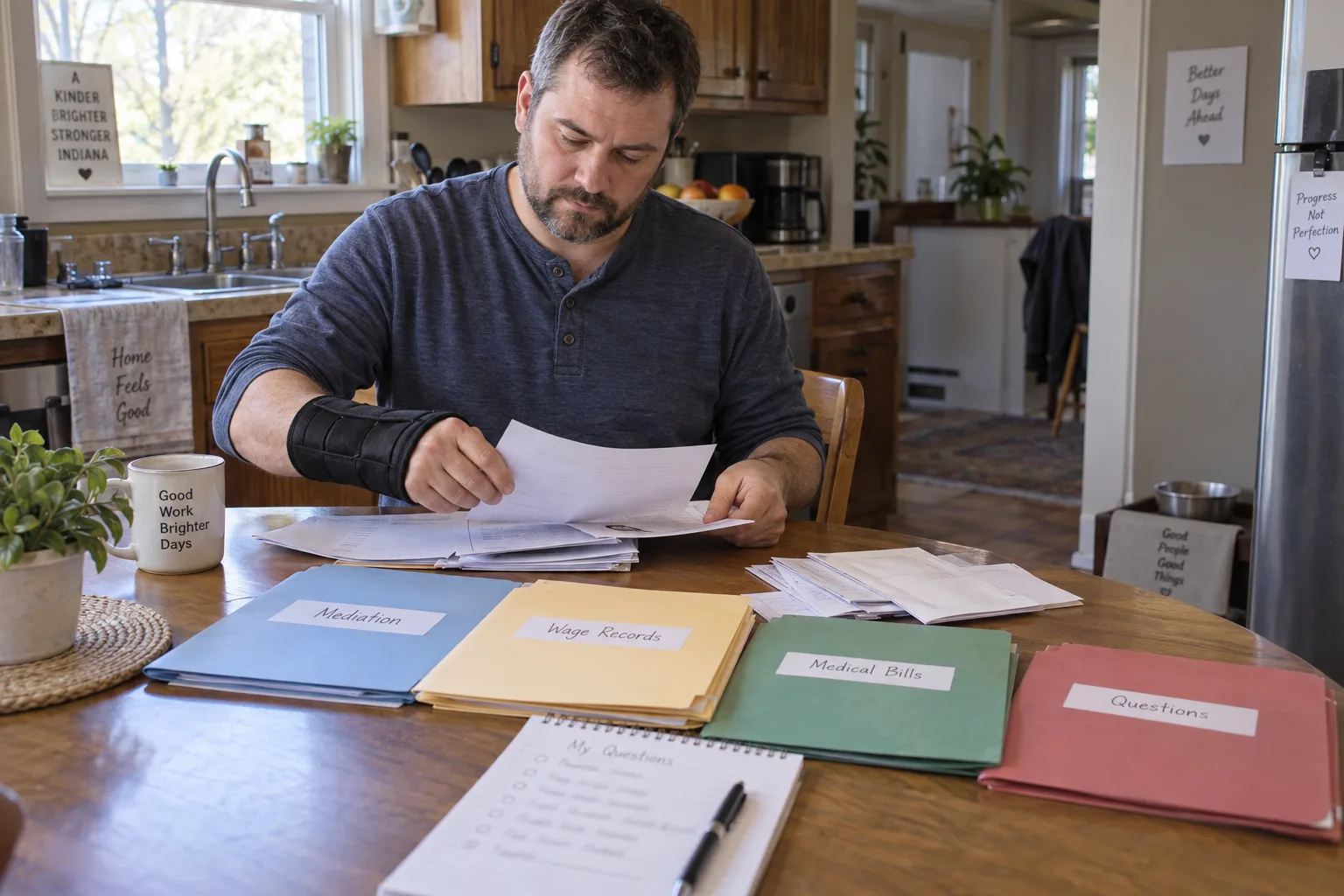
Start by writing down the decisions you need to make and the questions you want answered. The following is a suggested preparation list, not a separate Board filing requirement. Bring the actual documents alongside your notes.
- Bring the mediation notice, claim number, and a short timeline of the work injury and dispute.
- Make labeled folders for the documents you want to discuss, and ask your lawyer what else is needed.
- Which bills are still outstanding, and who currently has each one?
- What does the written proposal say about future medical care, outstanding bills, liens, and permanent impairment?
- Read the complete proposal and mark language you do not understand.
The Board’s August 27, 2026 settlement-document checklist[5] addresses temporary disability paid and average weekly wage, medical expenses, outstanding bills, future medical care, permanent impairment, restrictions, and existing liens. Its double-asterisk items are necessary when the worker is self-represented and advisable in complicated cases; the list is not exhaustive and varies with the case.
What happens during the meeting
Before the session, ask the organizer: Will we meet together, in separate rooms, or remotely? Who will participate? Who can approve an offer? Is a written summary requested? Can breaks or an interpreter be arranged? Confirm the actual format instead of assuming every conference follows the same script.
Expect questions about what remains disputed, what documents support each position, and what terms might resolve some or all of the disagreement. A useful answer can be “I need time to review that language” when you do not yet understand a proposal.
The Board’s Mediation Services page[2] identifies a $350 fee for up to five hours and $50 for each additional hour under 631 IAC 1-1-33. It also says the Board does not seek travel reimbursement from the parties. These are the Board service’s charges, not a price quotation for private mediation. Ask how the session fee will be allocated and whether any other charges apply.
Use the contact information on the Board’s Mediation Services page[2] to arrange a session, or ask about a private mediator. Confirm the appointment details before making travel plans.
Questions to ask before agreeing
- Which issues does the proposed agreement resolve?
- Which issues, if any, remain open?
- Who will be responsible for identified medical bills?
- What does the proposal say about future medical care?
- How were any impairment figures or payment amounts calculated?
- What documents must be signed and submitted to the Board?

What happens afterward
If no agreement is reached, identify what remains unresolved and confirm the next case event with your lawyer. The Board’s disputed-claims guidance[4] explains that a formal application is used to move unresolved disputes forward and that a Single Hearing Member determines unresolved issues. Do not assume the meeting itself completed a filing or changed an existing order.
An agreement at the meeting is not the same thing as an approved Board order. The settlement procedure currently linked by the Board[6] describes review and approval by a Single Hearing Member. The Board’s attorney resources page[7] is the starting point for the current checklist and submission guidance; confirm current submission details before sending a proposed agreement.
For a separate worksheet, open our Indiana PPI calculator and read its assumptions before entering figures. It does not calculate the full settlement value, future medical needs, or the effect of disputed issues. Review those separately with counsel.
A Single Hearing Member reviews the proposed settlement and, if approved, makes it an Order of the Board. Ask for a copy of the complete approved documents and compare them with the version discussed at the meeting.
Review the written terms against what you understood at the meeting. The Board’s current checklist[5] addresses responsibility for outstanding medical bills, future medical care, PPI calculations, and liens when applicable. A proposed dollar amount alone does not explain all of those terms.
If the proposal would close future medical care or resolve a disputed claim, you may also find it useful to review what to know before signing an Indiana workers’ compensation settlement.
Frequently Asked Questions
Do I have to accept an offer at mediation?
No. Mediation seeks a mutually acceptable agreement; the mediator does not impose a settlement. That is the distinction described in Indiana’s general definition of mediation[3]. Attendance obligations under a particular notice or order are a separate question to review with counsel.
Can the mediator decide who wins?
No. A mediator assists with resolution, while a Single Hearing Member decides unresolved issues in the Board’s formal hearing process.
How much does Board mediation cost?
The Board publishes a fee[2] of $350 for up to five hours and $50 for each additional hour. Confirm the fee arrangement for your session; a private mediator’s charges may differ.
Is a workers’ compensation settlement final as soon as everyone signs?
No. The proposed agreement must be submitted to the Worker’s Compensation Board, and a Single Hearing Member reviews it for approval before it becomes an Order of the Board.
What happens if mediation does not settle the case?
If a formal dispute remains unresolved, the Board’s hearing process allows a Single Hearing Member to determine the unresolved issues after evidence is presented.

If you are preparing for mediation or reviewing proposed settlement terms, Delventhal Law Office can listen to what happened, help you organize the questions that matter, and explain your options during a free consultation through our contact page.
Official source links checked September 26, 2026. The source list below links directly to the Indiana Worker’s Compensation Board and Indiana Judiciary materials discussed above.
This article is general information about Indiana law and is not legal advice. Reading it does not create an attorney-client relationship, and neither does contacting us.
Sources
- Indiana Worker’s Compensation Board offers mediation (in.gov) ↩
- published mediation fee (in.gov) ↩
- Indiana’s general mediation definition (rules.incourts.gov) ↩
- disputed-claims process (in.gov) ↩
- August 27, 2026 settlement-document checklist (in.gov) ↩
- settlement procedure currently linked by the Board (in.gov) ↩
- Board’s attorney resources page (in.gov) ↩