

- A work-related hernia is a covered injury. Indiana's Worker's Compensation Act covers a "personal injury by accident arising out of and in the course of the employment," and a hernia from lifting or straining at work can qualify.
- You carry the burden of proof. Indiana law puts the burden on the injured worker to show the hernia is work-related, so documentation matters.
- Report it fast. Tell your employer as soon as possible — Indiana law expects notice within 30 days of the injury.
- You generally have two years to file a claim with the Worker's Compensation Board.
- The employer or its insurer usually picks the treating doctor. If comp accepts your claim, authorized medical care — including hernia surgery when a doctor says it is needed — is paid at no cost to you.
- Pre-existing hernias are not an automatic denial. Indiana can cover a work event that aggravates or worsens an existing condition.

Is a work hernia covered by Indiana workers' comp?
In most cases, yes. A hernia caused by a work activity — lifting a heavy box, moving a patient, pushing a loaded cart, or straining on the job — is the kind of sudden, work-related injury Indiana workers' compensation is designed to cover. What matters is not the medical label "hernia" but whether the injury arose out of and in the course of your employment.
The practical rule: If your hernia can be tied to something you did or something that happened at work, and you report it and file on time, it is generally a compensable injury under Indiana law. If the insurer argues the hernia is unrelated to work or existed beforehand, the claim becomes a dispute you may need help proving.
Delventhal Law Office handles these cases across northeast Indiana. You can learn more about the firm's Indiana workers' compensation practice and how injured workers are represented.
What a hernia is and how work can cause one
A hernia happens when an organ or tissue pushes through a weak spot in the surrounding muscle or connective tissue — most often in the abdominal or groin wall. According to the Cleveland Clinic, hernias generally occur from a natural weakness in the abdominal wall or from excessive strain on it, such as the strain from heavy lifting, persistent coughing, or straining. The most common type is an inguinal hernia in the groin.
Common warning signs people notice include:
- A visible bulge in the groin or abdomen that grows with standing, coughing, or lifting and may shrink when lying down.
- A dragging, heavy, or aching sensation.
- Sharp pain when straining, lifting, or bending.
This is general medical information, not medical advice. A sudden, severe, painful bulge can signal an emergency, so seek prompt medical care and tell the provider it happened at work.
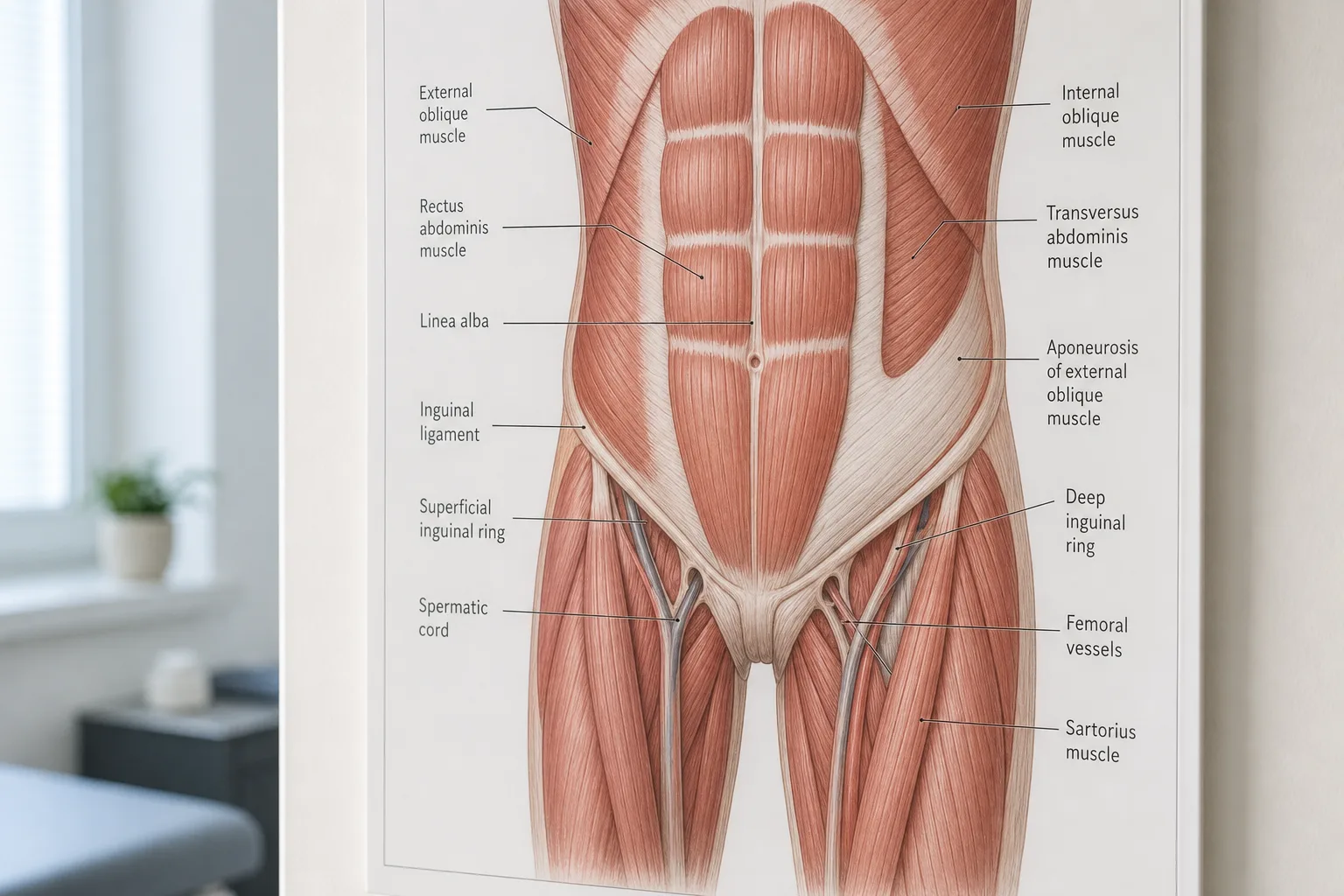
One important clarification: an abdominal or groin hernia is not the same thing as a herniated disc in your spine, even though people sometimes use "hernia" loosely. Both can be work injuries, but they are different conditions with different treatment. If your problem is really a spinal disc, see our overview for a Fort Wayne herniated disc workers' comp claim instead.
What Indiana law actually requires
Indiana's Worker's Compensation Act requires employers to pay compensation for a "personal injury or death by accident arising out of and in the course of the employment." A hernia that develops from a work task fits within that language.
Two legal points shape hernia claims specifically:
- "Injury" means injury by accident. Indiana law defines "injury" and "personal injury" as injury by accident arising out of and in the course of employment, and it does not include a disease except as it results from the injury. A hernia tied to a work strain is treated as an accidental injury, not a "disease."
- The employee has the burden of proof. Indiana law places the burden on the injured worker to prove each element of the claim, and proving one element does not create a presumption on another. In plain terms: it is on you to connect the hernia to work.
This is why a hernia claim can be straightforward when there is a clear on-the-job event and honest, prompt reporting — and why it gets harder when reporting is delayed or the cause is murky.

Reporting and deadlines that protect a hernia claim
In Indiana: Give your employer notice of the injury as soon as you can, and no later than 30 days. You generally have two years from the date of the accident to file a claim with the Worker's Compensation Board.
Two deadlines matter most:
- Notice to your employer. Indiana law expects notice of the injury within 30 days. If notice is not given in time, compensation may be delayed until notice or knowledge is provided. Report right away — even a hernia that seems minor can worsen.
- Filing with the Board. If the claim is disputed, you generally have two years from the date of the accident to file with the Indiana Worker's Compensation Board, or the right to compensation can be barred.
For repetitive-strain injuries that build over time rather than in one moment, timing can be measured differently. If your hernia developed gradually from repeated lifting, our guide to repetitive motion injuries and Indiana workers' compensation may help. When you are unsure which deadline applies, it is worth asking early.
What benefits can cover a hernia
If your hernia claim is accepted, Indiana workers' compensation can cover:
- Authorized medical care — doctor visits, imaging, and hernia repair surgery when the treating physician deems it necessary — at no cost to you.
- Temporary total disability (TTD) wage benefits if a doctor takes you off work while you recover from surgery or restricts you beyond what your employer can accommodate.
- Permanent partial impairment (PPI) if you are left with a lasting impairment after you reach maximum medical improvement.
To understand how the recovery timeline and impairment rating fit together, see our explainers on maximum medical improvement in Indiana workers' comp and what an Indiana PPI rating may be worth. Our Indiana workers’ compensation PPI calculator can help estimate how a rating may translate into statutory weeks and dollars, subject to the facts of the claim.

Who chooses the doctor and pays for surgery
Indiana is an employer-choice-of-medical state. Under Indiana law, after an injury the employer is responsible for the surgical, hospital, and nursing services the attending physician deems necessary — and because the employer or its insurer generally selects that physician, they usually direct your care. When care is authorized, you do not pay the provider for those services.
For a hernia, that means the authorized doctor typically decides whether surgery is appropriate, and workers' comp pays for it. Problems arise when care is delayed, denied, or when you feel the authorized doctor is rushing you back to heavy work. Our article on who chooses the doctor in an Indiana workers' comp claim explains your options in those situations.
Why some hernia claims get denied — and what to do
Insurers commonly dispute hernia claims by arguing one of the following:
- "It wasn't caused by work." Because hernias can also develop from everyday strain, the insurer may claim your bulge is unrelated to the job. Clear reporting and consistent medical records help counter this.
- "You had it before." A pre-existing hernia does not automatically end a claim. Indiana can cover a work event that aggravates a pre-existing condition and makes it worse or symptomatic.
- "You reported it too late." Late reporting invites suspicion, which is why prompt notice is so important.
A denial is not the end of the road. If your claim is denied, our guide on what to do when an Indiana workers' comp claim is denied walks through the next steps, and injured workers in this region can review the firm's Allen County workers' compensation resources.

Practical steps to protect a work-hernia claim
- Report it to your supervisor right away — in writing if possible — and describe exactly what you were doing when it happened.
- Get medical care promptly and tell every provider it started at work. Ask that the work connection be noted in the records.
- Use the authorized doctor the employer or insurer directs you to, and keep every appointment.
- Follow work restrictions. Do not push through heavy lifting against a doctor's orders.
- Keep copies of injury reports, medical notes, work restrictions, and any correspondence.
- Watch the deadlines — 30-day notice and the two-year filing window.
- Ask questions early if the claim is delayed, denied, or you are told surgery is not covered.
Frequently asked questions
Is a hernia considered a work injury in Indiana?
It can be. If the hernia arose out of and in the course of your employment — for example, from lifting or straining at work — it is treated as a compensable injury by accident under Indiana's Worker's Compensation Act. You carry the burden of showing the work connection.
Does workers' comp pay for hernia surgery?
If your claim is accepted, yes. Indiana comp covers the medical care the authorized treating physician deems necessary, which can include hernia repair surgery, at no cost to you.
What if my hernia was pre-existing?
A pre-existing hernia does not automatically bar a claim. Indiana can cover a work event that aggravates or worsens a pre-existing condition. The dispute usually becomes about how much the work activity contributed.
How long do I have to report and file?
Report the injury to your employer as soon as possible and within 30 days. If the claim is disputed, you generally have two years from the date of the accident to file with the Indiana Worker's Compensation Board.
Can I pick my own doctor for a work hernia?
Usually not. Indiana is an employer-choice-of-medical state, so the employer or its insurer generally directs your authorized care. There are limited exceptions, such as emergencies or when the employer fails to provide care.
What if the insurer says my hernia isn't work-related?
That is a common dispute. Prompt reporting, consistent medical records tying the hernia to a work event, and sometimes a supporting medical opinion can help. If the claim is denied, you can pursue it before the Worker's Compensation Board.
Talking with an attorney about a work hernia
Many hernia claims are approved and handled without a fight. Others turn into disputes over cause, pre-existing conditions, or whether surgery is covered. If you were hurt on the job and are not sure what to do next, a free consultation can help you understand your options and the deadlines that may apply. Delventhal Law Office can review what happened, explain how Indiana workers' compensation treats a hernia, and help you decide the next step. You can contact Delventhal Law Office or learn about attorney Chad Delventhal. You do not have to sort out the workers' comp process alone.
This article is general information about Indiana law and is not legal or medical advice. Reading it does not create an attorney-client relationship, and neither does contacting us. If you do contact us about a possible claim, Indiana Rule of Professional Conduct 1.18 requires us to keep what you tell us confidential whether or not we take the case — but please do not send documents or detailed facts until we have agreed in writing to represent you. For advice about your specific situation, speak with a qualified attorney or medical provider.