
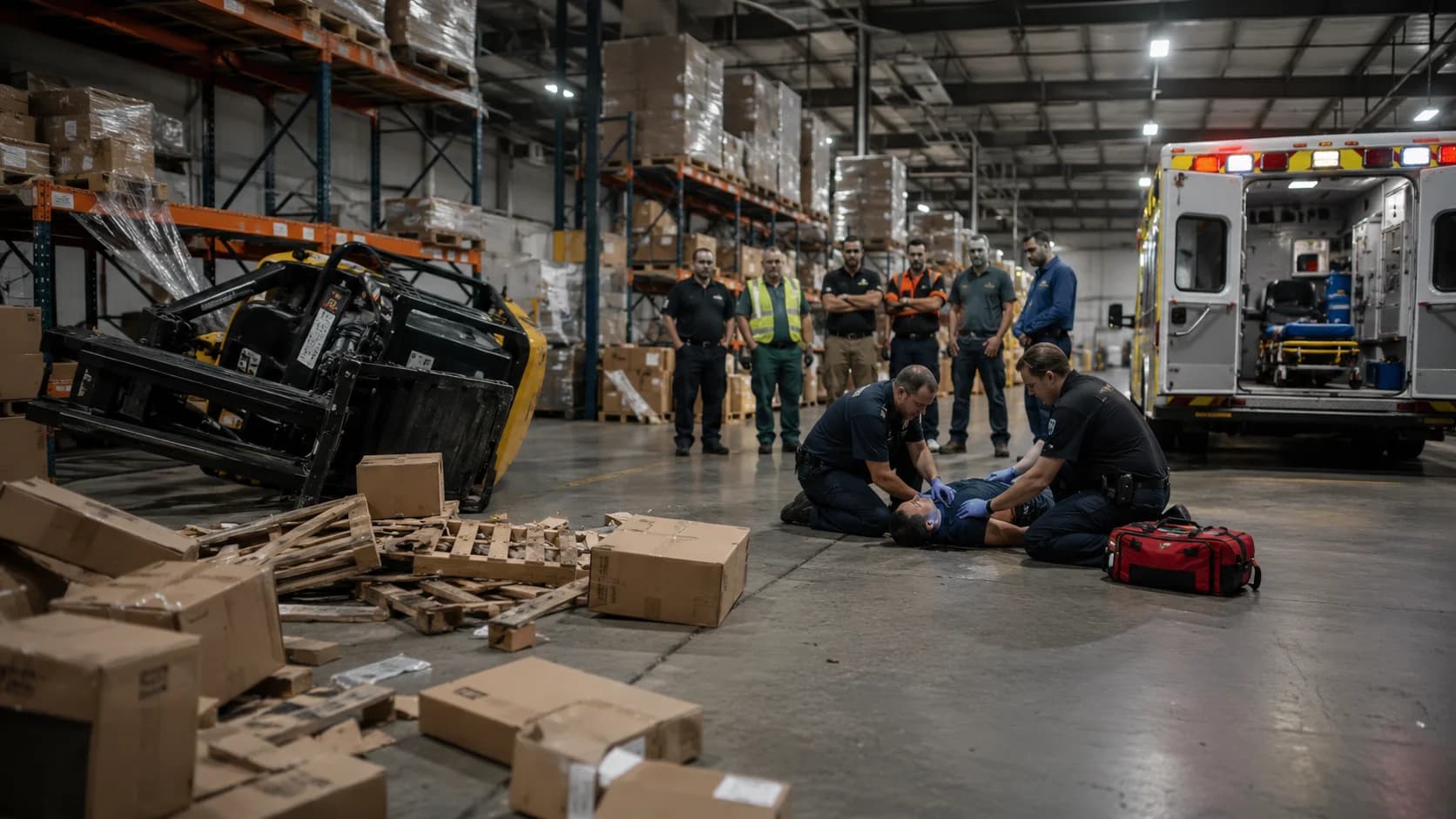

Fort Wayne Forklift Accident Attorneys
OSHA estimates there are 85 to 100 forklift fatalities and roughly 35,000 serious forklift injuries in the United States each year. In a warehouse town like Fort Wayne — with the General Motors Assembly Plant, the BAE Systems facility, Sweetwater's distribution operation, the dozens of logistics and manufacturing operations along I-69 and US-30, and the food and beverage warehouses that supply the region — those numbers are not abstract. Delventhal Law Office represents people seriously injured by forklifts in Fort Wayne, Allen County, and across Indiana. Most of these cases involve more than just workers' compensation, and finding the third-party defendants is where real recovery comes from.
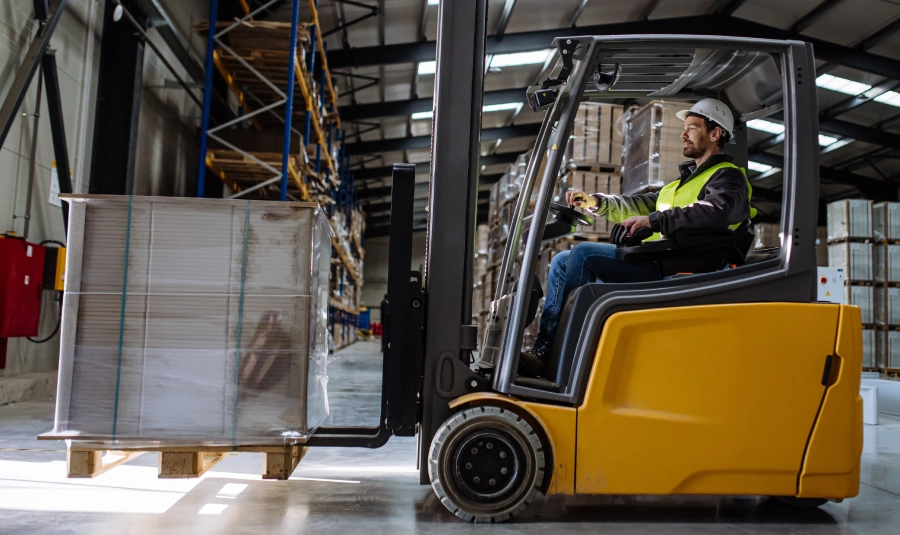
A forklift weighs three to five times as much as a passenger car and concentrates enormous force on a small tipping point. A typical 5,000-pound counterbalanced lift carrying a 3,000-pound load has the energy to crush a pedestrian, knock down racking, drop a pallet from height, or tip over with the operator inside. The injuries are accordingly severe — crush injuries, amputations, traumatic brain injuries, spinal cord injuries, and fatalities. Insurance and benefit analysis on a forklift case is rarely simple.
The OSHA Standard That Controls Forklift Operations
The federal OSHA standard for Powered Industrial Trucks is 29 C.F.R. § 1910.178. It governs equipment design, operator training and certification, daily inspections, refresher training, evaluation of operators, traveling and load-handling rules, maintenance, refueling, and pedestrian safety. Some of the most frequently violated provisions:
- 1910.178(l) — Training and certification. Every operator must be trained and evaluated by a competent person, certified in writing, retrained after any accident or near-miss, and re-evaluated every three years.
- 1910.178(q) — Maintenance. Forklifts must be inspected at the start of each shift and any defects removed from service.
- 1910.178(m) — Traveling and load-handling rules. Speed limits, horn use at intersections, prohibition on riders, prohibition on raising or lowering loads while traveling.
- 1910.178(n) — Stacking and loading. Stable loads, proper tilting, attention to capacity.
- 1910.178(p) — Removal from service for defects.
OSHA citations and the underlying investigation records are powerful evidence in a forklift case. The Indiana Department of Labor (IOSHA) investigates workplace incidents in this state and produces inspection reports we routinely use.
Why Workers' Comp Is Not the Whole Story
If you were injured at work, Indiana workers' compensation under IC 22-3[1] provides medical care and wage benefits regardless of fault. Workers' comp is generally your exclusive remedy against the employer. But the exclusive remedy only protects the employer — not other parties who contributed to the injury. Third-party civil claims are the path to full compensation in forklift cases, because they provide damages workers' comp does not: pain and suffering, full lost wages and earning capacity, loss of consortium, and (in qualifying cases) punitive damages.
The third-party defendants we routinely identify in forklift cases:
- The forklift manufacturer — for design defects (inadequate operator restraints, defective hydraulic systems, missing or defeated safety interlocks, poor visibility designs).
- The forklift dealer or rebuilder — for negligent maintenance, sale of a defective unit, or modifications that introduced hazards.
- A maintenance contractor — for negligent service or failure to identify a defect on inspection.
- A parts manufacturer — for defects in components like wheels, brakes, hydraulic lines, or safety interlocks.
- The owner of the premises when the injured worker was a non-employee on someone else's site (a truck driver delivering to a warehouse, a contractor working on a customer's premises).
- A staffing agency or general contractor with responsibility for safety on a multi-employer worksite.
- The driver of a different forklift employed by a separate company on a shared worksite.
Identifying these defendants — and the insurance that backs them — is half the work. We find what others miss by digging into the corporate structure of warehouses, the maintenance and service history of the equipment, and the multi-employer dynamics of a job site.
Common Forklift Accident Scenarios
- Tip-overs (lateral and longitudinal). The single largest category of forklift fatalities. Operators are crushed when the lift tips and they jump out (or are thrown) into the path of the falling overhead guard.
- Pedestrian strikes. Warehouse workers struck by a lift the operator did not see. Often related to inadequate horn use, missing pedestrian lanes, or operating in reverse without proper lookout.
- Falling loads. Loads improperly stacked, overloaded, or shifted during travel that fall onto workers nearby.
- Falls from elevated forks. A worker riding on the forks or on a non-OSHA-compliant platform falls when the platform shifts.
- Run-overs. Pedestrians backed over by a forklift, frequently a fatal scenario.
- Loading dock falls. A lift driven off a loading dock, often when the dock plate was missing or improperly secured.
- Carbon monoxide poisoning. Internal combustion forklifts operated in inadequately ventilated spaces produce dangerous CO levels.
- Collisions between forklifts and other equipment on busy warehouse floors.
- Battery and propane incidents. Hydrogen gas from charging, propane leaks during fueling, electrical burns.
Indiana Statutes of Limitations and Workers' Comp Coordination
The two-year personal injury statute of limitations in IC 34-11-2-4[2] applies to the third-party civil case. Wrongful death claims (IC 34-23-1[3]) carry the same two-year deadline. The workers' compensation claim against the employer is governed by IC 22-3[1] with its own filing deadlines and procedures. The two cases proceed in parallel: workers' comp pays medical and wage benefits while the third-party civil case is litigated, and the workers' compensation carrier has a statutory lien on the third-party recovery for benefits paid (IC 22-3-2-13[4]). We coordinate the two so the net recovery to the injured worker is maximized.
Comparative fault under IC 34-51-2[5] applies to the third-party civil case; recovery requires the worker to be 50% or less at fault. The employer's negligence does not get attributed to the worker in the third-party case (under the doctrine that limits this allocation in workers' comp cases), though defense lawyers will sometimes argue otherwise.
What Compensation Covers
| Damage Category | Workers' Comp Only | Third-Party Civil Case |
|---|---|---|
| Medical care | Yes (carrier-directed) | Yes (broader, including future) |
| Wage loss | Yes (2/3 of average weekly wage, capped) | Yes (full lost wages) |
| Permanent partial impairment | Yes (scheduled award) | Yes (full damages) |
| Pain and suffering | No | Yes |
| Mental anguish / loss of enjoyment | No | Yes |
| Disfigurement | Limited | Yes (full damages) |
| Loss of consortium (spouse) | No | Yes |
| Future lost earning capacity | Limited | Yes (full economic projection) |
| Punitive damages | No | Yes (qualifying cases) |
Typical Injuries and Cost Ranges
| Injury | Typical Medical Cost |
|---|---|
| Crush injury to extremity | $50,000 - $250,000 |
| Amputation (finger, hand, foot) | $100,000 - $500,000 |
| Major amputation (leg, arm) | $500,000 - $2,000,000+ |
| Spinal fracture, surgical | $150,000 - $500,000 |
| Spinal cord injury / paralysis | $1.5M - $5M+ lifetime |
| Traumatic brain injury (mod-severe) | $300,000 - $1,500,000+ lifetime |
| Multi-trauma in tip-over | $200,000 - $1,000,000+ |
| Wrongful death | Final medical + funeral |
The Investigation
Forklift cases require fast preservation of the equipment, the scene, and the records.
- The forklift itself must be preserved in its post-incident condition. If it is returned to service or repaired before inspection, key evidence is destroyed.
- Maintenance and inspection logs (pre-shift inspection sheets, formal maintenance records, the maintenance contractor's invoices) need to be obtained.
- The operator's training records, certification documents, and any prior disciplinary or accident history are critical.
- OSHA / IOSHA investigation files, when available, are formally requested.
- Surveillance video from the warehouse is often overwritten in 30 to 90 days and must be preserved immediately.
- Witness statements should be taken while memories are fresh.
- The product is inspected by qualified engineering experts — mechanical, hydraulic, controls, and human factors.
We send preservation letters within days of being retained, both to the employer and to potential third-party defendants. Spoliation of evidence after notice can support a spoliation instruction at trial telling the jury to assume the missing evidence would have hurt the responsible party.
Who Is Most Often at Risk
Many of the forklift cases we handle involve workers who were not the lift operator — a co-worker walking through the warehouse, a maintenance technician working on adjacent equipment, a truck driver delivering to a dock. These cases frequently support strong third-party claims because the injured worker is not the employee of the operator's employer in any meaningful sense relative to the third-party defendant's role. Cases involving rental forklifts also expand the universe of potential defendants to include the rental company and the maintenance vendor.
Allen County and Federal Court
Forklift cases against in-state defendants are filed in Allen Superior or Allen Circuit Court. Product liability cases against out-of-state manufacturers with damages exceeding $75,000 frequently land in the United States District Court for the Northern District of Indiana, Fort Wayne Division. We litigate in both. The carrier's evaluation of a case shifts substantially once their defense lawyer realizes the file is being worked seriously, with the right experts and the right preservation done early.
Frequently Asked Questions
How long do I have to file a forklift accident lawsuit in Indiana?
Two years from the date of injury under IC 34-11-2-4[2] for the third-party civil case. Wrongful death claims (IC 34-23-1[3]) carry the same two-year deadline. Product liability claims have a two-year limitations period and a ten-year statute of repose under IC 34-20-3[6]. The workers' compensation claim against the employer has separate deadlines under IC 22-3[1]. If a government entity owns or controls the premises, a Tort Claim Notice must be filed within 180 days for local entities and 270 days for the State under IC 34-13-3-8[7].
I am already getting workers' comp. Why would I need a lawyer for a third-party case?
Workers' comp pays medical care and a fraction of your lost wages. It does not pay for pain and suffering, full lost wages and earning capacity, loss of consortium, or any noneconomic damages. A third-party civil case against a non-employer responsible for the injury (the equipment manufacturer, the property owner, the maintenance company, a contractor) provides those damages. For serious injuries, the third-party recovery is typically many times larger than what workers' comp will pay over the life of the claim. We coordinate the two cases so the net recovery to you is the largest the law allows.
Who can I sue if the employer is protected by workers' comp exclusivity?
Workers' comp protects the employer, but it does not protect anyone else. Common third-party defendants include the forklift manufacturer (for design defects), the maintenance company (for negligent service), parts manufacturers (for defective components), the property owner if the work was being done on someone else's premises, a separate company operating on a shared worksite, and the operator of another piece of equipment from a different employer. Identifying the right defendants is the first major task of the case.
Was the operator's lack of certification a factor?
It can be — both for OSHA compliance and for civil liability. OSHA's powered industrial truck standard (29 C.F.R. § 1910.178(l)) requires that operators be trained, evaluated, certified in writing, and re-evaluated every three years (or after any accident, near-miss, or change in equipment or work conditions). An uncertified or improperly trained operator supports a negligence per se argument against the employer (in workers' comp terms) and against any non-employer with safety responsibility on the worksite.
What if the forklift tipped over and the operator was killed?
That is unfortunately one of the most common forklift fatality scenarios. The civil case typically involves a wrongful death claim under IC 34-23-1[3] brought by the personal representative of the decedent's estate, combined with workers' comp death benefits to the family. Tip-over cases frequently support product liability claims against the manufacturer for inadequate operator restraints, defective stability characteristics, or failure to warn — claims that survive workers' comp exclusivity because they target the manufacturer, not the employer.
The OSHA inspector said the company was cited. Does that prove our case?
It helps significantly. OSHA citations are admissible evidence in many cases and create powerful momentum at settlement. The citations do not automatically prove liability — civil cases have their own causation analysis — but they do shift the conversation. We routinely request the full OSHA / IOSHA investigation file and use it as a foundation for the civil case workup.
What does it cost to hire Delventhal Law Office for a forklift accident case?
Nothing up front. We handle forklift third-party cases on a contingency fee — our fee is a percentage of the recovery, payable only if we win. The firm advances all case expenses, including engineering experts, human factors experts, accident reconstructionists, and life-care planners. You owe nothing for those costs if we do not recover. Workers' compensation claims are handled separately under the schedule of fees set by the Indiana Workers' Compensation Board. Call us or use the free consultation form. See our other practice areas for related work.
The Indiana law that applies to your forklift accident case
Indiana's two-year personal-injury statute under IC 34-11-2-4[2] governs almost every Fort Wayne forklift-injury claim that proceeds as a third-party negligence or product-liability suit, and Indiana's modified comparative-fault rule under IC 34-51-2-6[8] controls apportionment. The parallel workers' compensation case runs through the Indiana Workers' Compensation Board[9]. Forklift operation is governed nationally by the OSHA[10] Powered Industrial Trucks standard at 29 CFR 1910.178, which sets the operator-training, daily-inspection, and load-handling requirements framing every causation argument in the case.

How insurance carriers fight Fort Wayne forklift accident claims
Forklift-defendant carriers in Allen County rely on a tight set of defenses. The first is the operator-error argument — the carrier blames the injured worker or a co-employee operator and invokes Indiana's workers' compensation exclusivity rule to wall off the employer. The second is the misuse defense in the product-liability track, where the manufacturer claims the lift was operated outside its design parameters. The third is the maintenance-history fight, where the defendant disputes whether pre-shift inspections under OSHA[10] 29 CFR 1910.178(q) were performed and documented. The fourth is the warning-adequacy defense in the design-defect case, where the manufacturer points to operator-cabin decals. We build the file around the training file, the inspection log, the manufacturer's service bulletins, and the load-chart capacity data that often shows the lift was overloaded before the failure.
Evidence we preserve in the first 48 hours
Forklift cases turn on the maintenance log, the training certification, and the physical condition of the lift before it is returned to service.
- Daily pre-shift inspection logs required under 29 CFR 1910.178(q), including the 30 days preceding the incident, often showing repeated unaddressed deficiencies
- Operator training certification records under 29 CFR 1910.178(l) for the injured worker and every co-employee operator who used the same lift during the relevant period
- Manufacturer service bulletins, recall notices, and the lift's full maintenance and repair history from the dealer or in-house shop
- Load-chart data sheets, capacity plates, and any rigging or attachment used at the time of the incident along with the load weight documentation
- Site photographs of the lift, the load, and the impact area within 24 hours before the equipment is repaired or returned to service

Damages categories in an Indiana forklift accident case
Forklift cases routinely combine a workers' compensation file with a product-liability suit against the manufacturer, dealer, or component supplier. The comp track produces statutory wage replacement and a permanent partial impairment award under the Indiana schedule. The parallel product-liability case captures full lost earning capacity, future medical care including reconstructive surgery, pain and suffering, and loss of consortium for the spouse. OSHA[10] incident data on forklift tip-overs, struck-by events, crush injuries, and pinch-point amputations grounds the long-term-impact arguments at mediation and trial.

What our forklift accident clients ask most
Can I sue the forklift manufacturer for a workplace injury in Indiana?
Product-liability claims against a forklift manufacturer, dealer, or component supplier run parallel to the workers' compensation file under Indiana's Product Liability Act at IC 34-20[11]. Design defects involving overhead-guard adequacy, operator-restraint systems, and tip-over warning systems are routinely litigated. The comp carrier holds a subrogation lien against any product-liability recovery.
What if the forklift had not been inspected before my accident?
Missing or incomplete pre-shift inspection records under 29 CFR 1910.178(q) create direct evidence of employer negligence and frequently expand the product-liability case against the manufacturer when a known defect was reported in service bulletins. Inspection gaps over the prior 30 days often reveal a pattern of unaddressed mechanical issues.
Who is liable if a co-worker was operating the forklift that hit me?
Indiana workers' compensation exclusivity under IC 22-3-2-6[12] typically bars suit against the co-employee operator and the employer. The viable third-party defendants in that scenario are the forklift manufacturer for any design defect, the maintenance contractor responsible for safety-critical repairs, and any non-employer property owner or contractor controlling the worksite.
How long do I have to file a forklift-accident lawsuit in Indiana?
Two years from the date of injury under IC 34-11-2-4[2] for the product-liability and third-party negligence claims. The parallel workers' compensation file has a 30-day employer-notice requirement under IC 22-3-3-1[13] and its own two-year limitations period under IC 22-3-3-3[14]. Indiana also imposes a 10-year statute of repose on most product-liability claims.
What if I was not properly trained to operate the forklift?
Missing operator-training certification under 29 CFR 1910.178(l) is direct evidence of employer regulatory violation and frequently supports a third-party negligence claim against any staffing company, host employer, or contractor that placed the worker on the lift. Training gaps are also relevant to the comparative-fault analysis in the parallel product-liability case.

What happens after you hire us
Our first move is a litigation-hold letter to the employer, the lift's manufacturer, and the maintenance vendor demanding preservation of the lift in its post-incident condition. We file the comp claim, coordinate medical care, and inspect the lift with a forensic mechanical engineer before any repairs occur. The product-liability suit is filed in Allen Superior Court or federal court when diversity exists. Discovery focuses on service bulletins, recall data, and prior-incident history. Representation is on a contingency-fee basis.
Sources
- IC 22-3 (iga.in.gov) ↩
- IC 34-11-2-4 (iga.in.gov) ↩
- IC 34-23-1 (iga.in.gov) ↩
- IC 22-3-2-13 (iga.in.gov) ↩
- IC 34-51-2 (iga.in.gov) ↩
- IC 34-20-3 (iga.in.gov) ↩
- IC 34-13-3-8 (iga.in.gov) ↩
- IC 34-51-2-6 (iga.in.gov) ↩
- Indiana Workers' Compensation Board (in.gov) ↩
- OSHA (osha.gov) ↩
- IC 34-20 (iga.in.gov) ↩
- IC 22-3-2-6 (iga.in.gov) ↩
- IC 22-3-3-1 (iga.in.gov) ↩
- IC 22-3-3-3 (iga.in.gov) ↩