
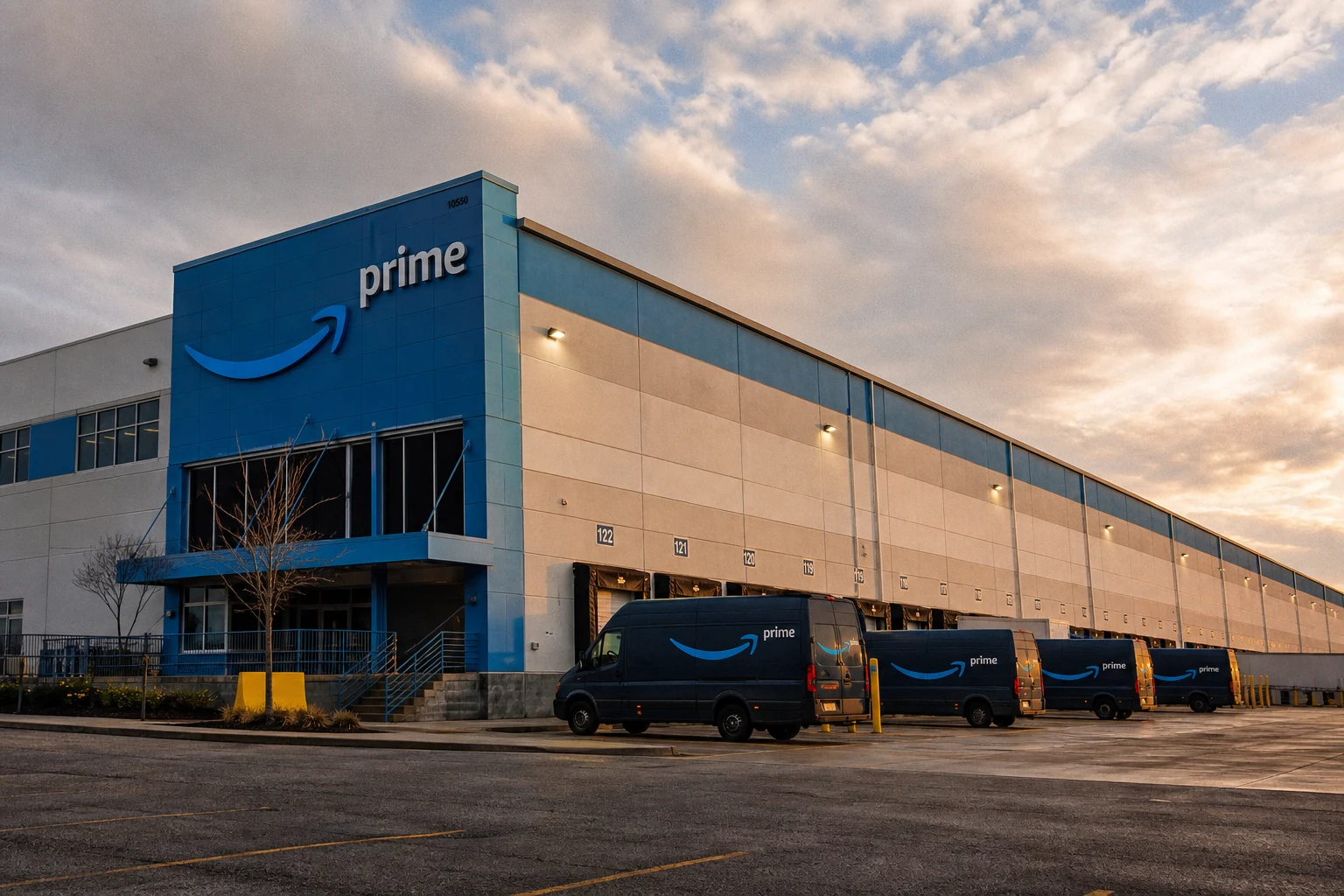

Amazon's Indiana fulfillment centers employ thousands of Hoosiers — and injure them at rates that run roughly twice the warehousing-industry average. The Strategic Organizing Center's "Injury Machine" report[1] documented Amazon's per-worker injury rate at nearly double the rest of the industry, and the OSHA National Emphasis Program on Warehousing and Distribution Centers (CPL 03-00-026)[2] has cited Amazon facilities repeatedly for the underlying causes: production-rate pressure, ergonomic exposure, struck-by hazards from robotics and conveyor systems, and forklift incidents.
If you've been hurt at an Indiana Amazon warehouse — IND2 in Whitestown, IND9 in Plainfield, the Greenwood, Indianapolis, Jeffersonville, Elkhart, or Franklin facilities, or a regional delivery station — your case has two parallel tracks: Indiana workers' compensation under Indiana Code 22-3[3], and a potential third-party claim against the equipment manufacturer (Amazon Robotics, Dematic, Honeywell Intelligrated). Amazon and its third-party administrator will try to keep you in the workers' comp track only — because it's cheaper for them. Our Fort Wayne Amazon warehouse injury attorneys run both tracks. Call 260-484-6655 for a free case evaluation.
What counts as an Amazon warehouse injury case in Indiana?
Short answer: Any work-related injury or occupational illness sustained by a worker at an Indiana Amazon facility — fulfillment center, sortation center, delivery station, AMXL warehouse, or AmCare clinic itself. Direct W-2 Amazon employees, agency-supplied associates, contracted DSP drivers loading at the dock, and visiting maintenance technicians all have potential claims under Indiana law, though the specific procedural path differs by employment classification.
The most common Amazon warehouse injury types we handle:
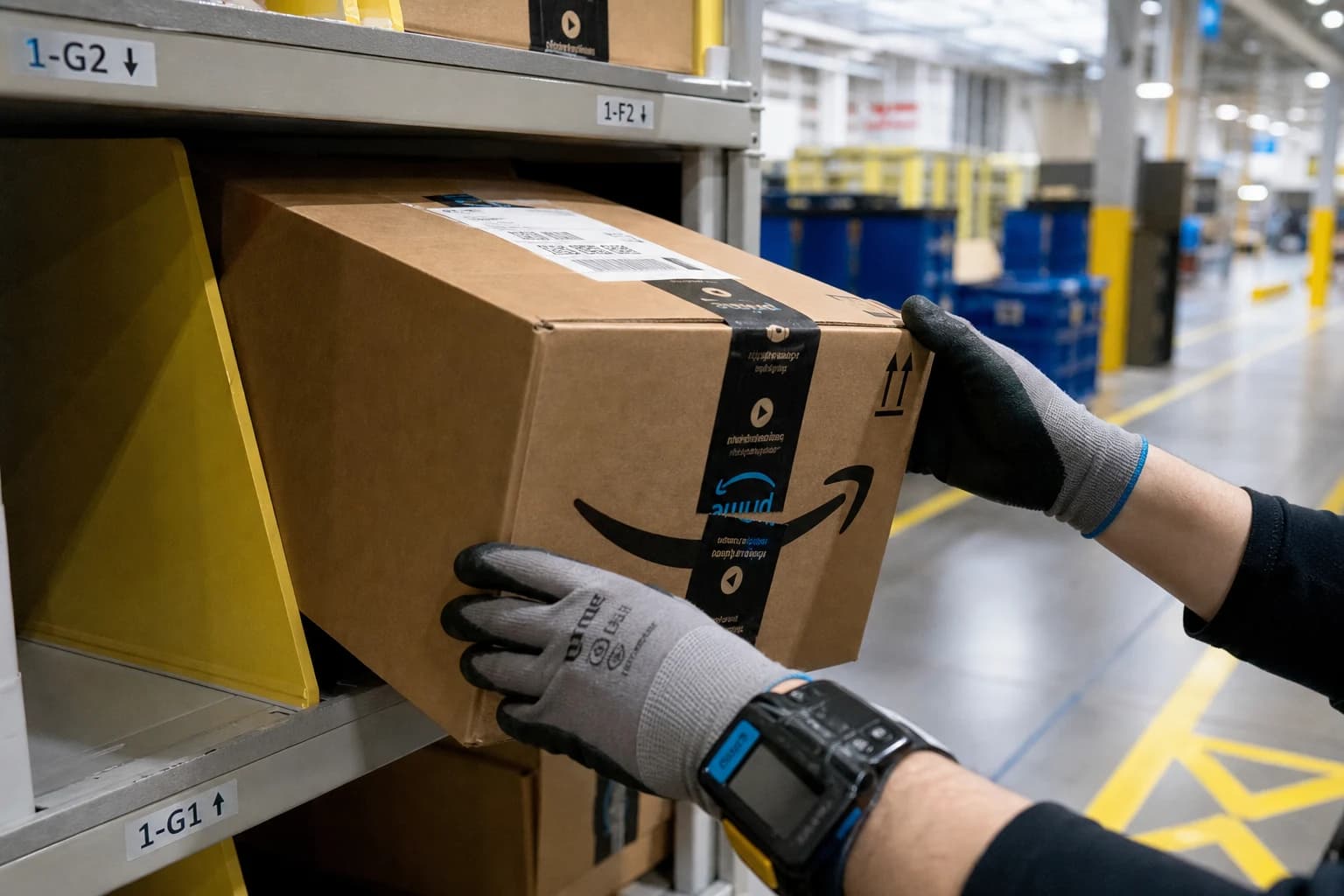
- Musculoskeletal injuries — sprains, strains, herniated discs from repetitive lifting at induct, stow, and pack stations, often driven by Amazon's "rate" expectations and Time Off Task tracking.
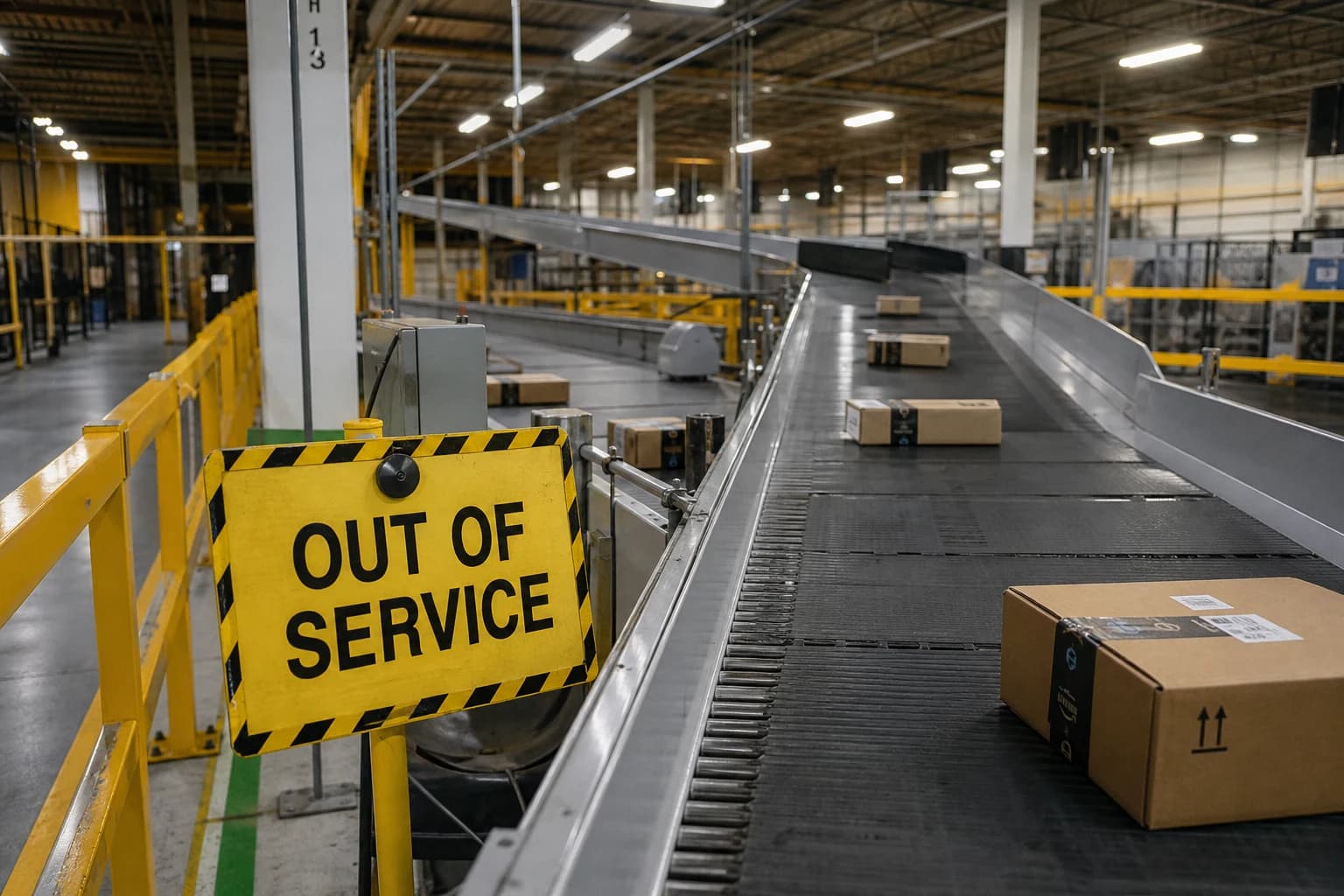
- Struck-by injuries — caught-in or struck by conveyor belts, sorter shoes, and autonomous mobile robots (Kiva drive units, Proteus, Sequoia).
- Falls — slip-trip-fall on polished concrete floors, from broken pallets, from elevated mezzanines, from improperly used ladders.
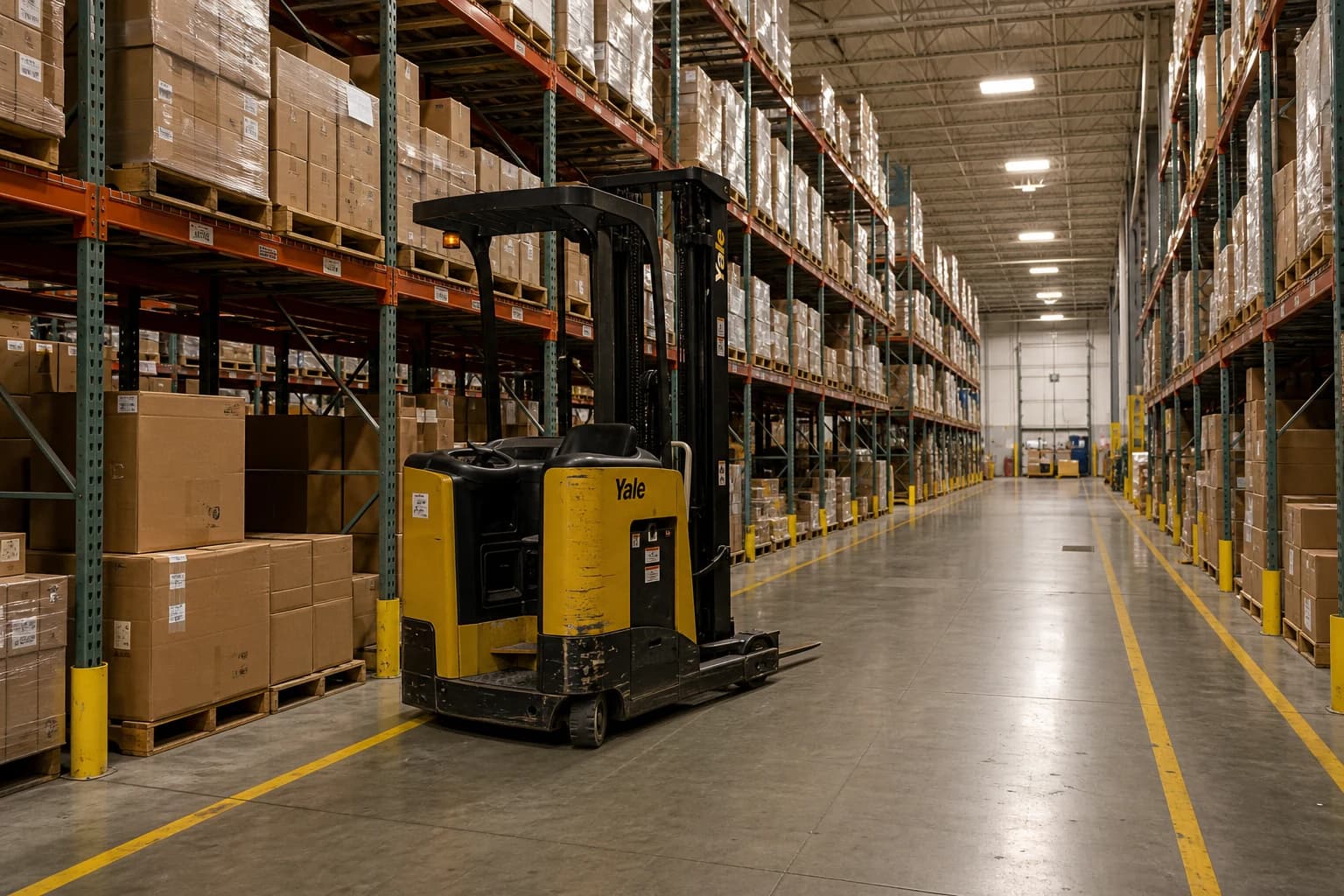
- Forklift and powered industrial truck (PIT) incidents — struck by lift trucks, crushed by reversing equipment, pinned against shelving.
- Heat-related illness — Indiana summers in non-climate-controlled warehouse zones, plus near-miss documentation of heat stress events.
- Repetitive strain injuries — carpal tunnel, tendinopathy, rotator cuff tears from sustained pick or scan cycles.
- Acute injuries from equipment failures — guard-rail bypass, pinch-points, conveyor maintenance during operation.
How does Amazon's Time Off Task system cause warehouse injuries?
Short answer: Time Off Task (TOT) is Amazon's algorithmic productivity-rate tracking system that monitors how long workers spend between scans. The system creates relentless pressure to skip ergonomic safe-lifting practices, to bypass micro-recovery breaks, and to work through pain — all of which translate directly into the injury patterns documented in GAO and federal investigations[4]. TOT is documentary evidence of foreseeable harm — and that matters in litigation.

How TOT becomes evidence in a Fort Wayne Amazon warehouse injury case:
- Pace-rate data — Amazon logs every worker's pace continuously. Pre-injury TOT records show the production pressure the worker was under.
- Safety-incident correlations — Internal Amazon documents have shown the company tracks the relationship between rate and injury and chose to maintain rates despite the correlation.
- Training contradictions — Amazon trains workers in safe-lifting and ergonomics, then disciplines them under TOT for working at that safer pace. The contradiction is documented.
- Subpoena targets — Pre-injury productivity records, manager-driven rate adjustments, the worker's individual rate trend in the weeks before injury.
Workers' comp vs. third-party claim — which should an injured Amazon warehouse worker file?
Short answer: Both, if the facts allow. Indiana workers' compensation under IC 22-3[5] is a no-fault benefit that covers medical care and wage loss regardless of who caused the injury — but it's a strictly limited recovery. A third-party claim against the maker of the equipment that caused the injury (Amazon Robotics, Dematic, Honeywell Intelligrated, Daifuku Wynright) is a full personal-injury claim with pain and suffering, lost earning capacity, and uncapped non-economic damages. The exclusivity bar of workers' comp does not apply to third parties.

| Track | Who Pays | What's Covered | Recovery Scope |
|---|---|---|---|
| Indiana Workers' Comp (IC 22-3[5]) | Amazon's comp carrier (TPA) | Medical bills, TTD wages (2/3 average wage), PPI award | Limited; no pain and suffering |
| Third-party product liability | Equipment manufacturer | Defective design/manufacture, failure to warn, negligent maintenance | Full PI damages including pain and suffering |
| Third-party negligence | Outside contractor at scene | Crane operators, electrical contractors, maintenance vendors | Full PI damages |
The decision to run the third-party track is fact-specific. We evaluate the equipment, the maintenance records, the OSHA citation history at the specific facility, and the manufacturer's design and warning documentation before deciding whether the third-party claim is winnable in addition to the comp claim.
Should I see Amazon's AmCare clinic or my own doctor?
Short answer: The AmCare on-site clinic is staffed by EMTs and athletic-training-credentialed personnel, not physicians. It is structured to provide first-aid only — which keeps injuries off Amazon's OSHA 300 log and out of the workers' comp claims system. Under Indiana Code 22-3-3-4[6], you have a right to outside medical care after a workplace injury — and you should exercise it as soon as the injury is reported.

The AmCare problem, in detail:
- First-aid classification — AmCare's treatment menu (ice, stretching, ibuprofen, KT tape) is designed to qualify as "first aid" under 29 CFR 1904.7[8], so the injury never becomes an OSHA recordable.
- Return-to-work pressure — Workers are routinely sent back to the floor with restrictions that look meaningful on paper but match what the worker was already doing.
- Delayed diagnosis — Acute injuries (herniated discs, ligament tears, mild TBI) require imaging and specialist evaluation that AmCare cannot provide. Days or weeks of AmCare treatment delays definitive diagnosis.
- The workers' comp consequence — Every day of delay between injury and outside medical evaluation gives Amazon's TPA a "gap in treatment" argument to dispute causation.
What benefits does Indiana workers' compensation pay an Amazon warehouse worker?
Short answer: Indiana workers' compensation pays four categories of benefit — medical treatment without copay or deductible, Temporary Total Disability (TTD) at two-thirds of your average weekly wage while off work, Permanent Partial Impairment (PPI) for residual injury, and (in fatal cases) death benefits to dependents. IC 22-3-3-7[9] sets the TTD calculation; IC 22-3-3-10[10] sets the PPI schedule.

| Benefit | What It Covers | How It's Calculated |
|---|---|---|
| Medical care | All reasonable and necessary treatment | No copay, no deductible, no out-of-pocket |
| Temporary Total Disability (TTD) | Wage replacement while off work | 2/3 of average weekly wage; statutory min and max apply |
| Permanent Partial Impairment (PPI) | Residual functional loss | Statutory schedule based on impairment rating × dollar value per degree |
| Death benefits | Dependent survivors | Up to 500 weeks at 2/3 average wage |
Can I sue Amazon Robotics or the conveyor manufacturer after a warehouse injury?
Short answer: Yes, in many cases. Indiana's workers' compensation exclusivity bar at IC 22-3-2-13[11] only protects the employer — it does not shield equipment manufacturers, maintenance contractors, or other third parties whose negligence contributed to the injury. Amazon Robotics LLC (the in-house subsidiary that makes the orange drive units), Dematic, Honeywell Intelligrated, and Daifuku Wynright are the most common third-party defendants we see in Indiana Amazon warehouse cases.

Third-party theories we pursue in Amazon warehouse cases:
- Defective design — when the equipment has inherent dangers that safer designs would prevent (unguarded pinch points, inadequate emergency stops, deficient lockout/tagout integration).
- Manufacturing defect — when the specific unit failed in a way not consistent with the design.
- Failure to warn — when the manufacturer knew of hazards from past incidents and failed to communicate them adequately to operators.
- Negligent maintenance — when a service contractor's failure to maintain the equipment caused the injury.
What should you do in the first week after a Fort Wayne Amazon warehouse injury?
Short answer: Report the injury to your manager in writing within 24 hours, refuse AmCare-only treatment for anything more serious than a scratch and demand an outside physician under IC 22-3-3-4[7], get the names of every co-worker witness, photograph the equipment and the scene before maintenance changes anything, and call a Fort Wayne Amazon warehouse injury attorney before you sign any return-to-work paperwork or AmCare-only authorization. The seven days after injury set the entire workers' comp record.
- Report the injury in writing. Email your manager and the safety team the same day. "I was injured at [date/time/location, doing [task], and felt [symptoms]." Indiana requires injury notification within 30 days, but written same-day notice ends any disputes about whether you reported.
- Demand outside medical care. Under IC 22-3-3-4[7], you have a right to medical treatment from a qualified physician — not just an AmCare EMT. Ask Amazon to authorize an outside evaluation. If they refuse or delay, your Fort Wayne Amazon warehouse injury attorney files a Form 18406 Application for Adjustment of Claim with the Indiana Worker's Compensation Board.
- Photograph the scene. Get pictures of the equipment, the surrounding work area, the safety markings or lack of them, the floor conditions, your visible injuries as they evolve over the first week. Amazon will perform a "near miss" or "incident investigation" and the scene may not look the same a day later.
- Collect witness names. Co-worker observations are central to a successful claim. Get the names and any personal contact information of everyone who saw the incident or saw you in pain after it.
- Save your TOT and rate data. If you have personal access to your pre-injury productivity metrics through the A-to-Z app, screenshot them. Amazon will have its own records — but your contemporaneous screenshots prove what you were under pressure to do.
- Do not sign return-to-work paperwork without review. Restricted-duty assignments that match your pre-injury job duties are common Amazon TPA tactics to end TTD wage replacement.
- Call a Fort Wayne Amazon warehouse injury attorney. Free consultation, no upfront cost. We coordinate the comp claim, the outside medical evaluation, and the third-party investigation in one workflow.
How does Amazon retaliate against workers who file claims — and what can I do?
Short answer: Retaliation against workers who file workers' compensation claims is illegal under Indiana law. Common Amazon retaliation patterns include schedule changes, reassignment to harder work, write-ups for TOT or other policy violations that were tolerated pre-injury, and termination for "rate" failures that were the direct result of the injury. Indiana has a wrongful-discharge cause of action for workers' comp retaliation under Indiana common law (Frampton v. Central Indiana Gas Co.) and these cases are taken seriously.
If you've been disciplined or terminated after filing or being injured, document everything — every interaction, every email, every change in your duties or schedule — and call our Fort Wayne Amazon warehouse injury attorneys immediately.
Which Indiana statutes and federal regulations govern Amazon warehouse injury claims?
Short answer: Indiana Code 22-3[5] (the Worker's Compensation Act) is the primary state law; the Indiana Worker's Compensation Board[12] is the administrative tribunal. OSHA's National Emphasis Program for Warehousing and Distribution Centers (CPL 03-00-026)[2], NIOSH lifting equation guidance, and 29 CFR Part 1904 (recordkeeping) all apply at the federal level.
Key Indiana statutes for an Amazon warehouse injury case:
- IC 22-3-2[13] — Worker's Compensation Act (general)
- IC 22-3-3-4[7] — Right to medical treatment from a qualified physician
- IC 22-3-3-7[14] — Temporary Total Disability calculation (2/3 average weekly wage)
- IC 22-3-3-10[15] — Permanent Partial Impairment schedule
- IC 22-3-2-13[16] — Third-party action subrogation rights
- IC 22-3-3-3[17] — 30-day notice requirement
- IC 22-3-3-27[18] — Two-year statute of limitations for original claim
Why choose Delventhal Law for your Fort Wayne Amazon warehouse injury case?
We find what others miss. Most local firms see "warehouse injury" and route the file straight into the workers' comp track — which is a strictly limited recovery. Our Fort Wayne Amazon warehouse injury attorneys evaluate the equipment, the maintenance records, the OSHA citation history at the specific facility, the worker's pre-injury rate data, and Amazon's internal incident reports before deciding whether a third-party product-liability claim runs alongside the comp claim. That dual-track approach is often the difference between a workers' comp settlement of $50,000 and a combined recovery of several hundred thousand dollars or more.

Founded in 2009 by Chad Delventhal, our firm represents injured Hoosiers across Allen County and northeast Indiana. We've handled over 1,500 personal injury cases since opening, with 145+ five-star reviews on Google. There's no charge to talk. If we take your case, you pay nothing unless we recover. Call us at 260-484-6655 — we answer the phone 24 hours a day, 7 days a week.
Frequently Asked Questions
How long do I have to file an Amazon warehouse injury claim in Indiana?
Indiana requires written notice of the injury to your employer within 30 days under IC 22-3-3-3[17]. The deadline to file a formal Application for Adjustment of Claim with the Indiana Worker's Compensation Board is two years from the date of injury (or from the date of the last compensation payment) under IC 22-3-3-27[18]. For third-party claims against equipment manufacturers, the standard Indiana personal-injury statute of limitations of two years applies under IC 34-11-2-4[19]. Call our Fort Wayne Amazon warehouse injury attorneys as soon as possible — early action on the medical record and the equipment evidence is what makes the difference.
Can I be fired for filing a workers' comp claim after an Amazon warehouse injury?
No. Indiana recognizes a wrongful-discharge cause of action for workers' compensation retaliation under Frampton v. Central Indiana Gas Co. — termination for filing or pursuing a comp claim is unlawful. Common Amazon retaliation patterns we document include schedule changes, reassignment to harder work, escalating discipline for TOT or rate failures that were tolerated before the injury, and termination dressed up as a layoff or rate failure. If this has happened to you, save every email and message and call us.
What if AmCare told me I was fine but I still hurt?
AmCare clinics are staffed by EMTs and athletic-training-credentialed personnel, not physicians. Their assessments are designed to qualify as first-aid only under OSHA recordkeeping rules — which keeps the injury off Amazon's OSHA 300 log. Under Indiana Code 22-3-3-4[7], you have a right to outside medical evaluation by a qualified physician. Ask Amazon to authorize it. If they refuse, we file a Form 18406 with the Indiana Worker's Compensation Board to compel treatment.
Can I sue Amazon Robotics if a Kiva drive unit caused my injury?
Often yes. Amazon Robotics LLC is a wholly-owned subsidiary that manufactures the orange drive units (Kiva, Proteus, Sequoia) — and it is a third party for purposes of Indiana's workers' compensation exclusivity bar under IC 22-3-2-13[16]. If the design, manufacture, or warnings on the drive unit were inadequate, a product-liability claim can run in parallel with your workers' comp case. The two recoveries are coordinated but additive — workers' comp pays first, the third-party claim pays the rest.
What if my Amazon warehouse injury was caused by another worker (a forklift operator, a co-worker on a sorter)?
Indiana's workers' compensation exclusivity bar covers fellow employees of the same employer. But staffing-agency workers, contracted maintenance technicians, and outside delivery drivers (Amazon DSP drivers, third-party freight) are not "fellow employees" of the Amazon W-2 worker — they are potential third-party defendants. The classification of every party at the scene is part of the initial case evaluation.
What injuries are common at Amazon warehouses?
The injury profile at Indiana Amazon facilities is dominated by repetitive-motion and lifting injuries (back, shoulder, neck), struck-by injuries from conveyors and mobile robots, slip-trip-fall on warehouse floors, and forklift incidents. Heat-related illness is increasingly documented during Indiana summers in non-climate-controlled zones. Acute traumatic injuries from equipment failures (pinch-point amputations, crush injuries, falls from height) are less common but more severe.
How much does it cost to hire a Fort Wayne Amazon warehouse injury attorney?
Nothing upfront. Our firm takes Amazon warehouse injury cases on contingency — you pay no attorney's fees unless we recover compensation for you. The initial consultation is free. Indiana workers' compensation fees are statutorily capped and approved by the Worker's Compensation Board, so the fee structure is transparent. Third-party claims are pursued on a standard contingency.
Do I have to give Amazon's workers' comp adjuster a recorded statement?
No. You are required to cooperate with the comp claim — but a formal recorded statement is not legally compelled. Amazon's TPA (third-party administrator) will request one; the statement is then used to challenge inconsistencies between your initial description and later testimony. Politely decline, and refer the adjuster to your Fort Wayne Amazon warehouse injury attorney.
Sources
- Strategic Organizing Center's "Injury Machine" report (thesoc.org) ↩
- OSHA National Emphasis Program on Warehousing and Distribution Centers (CPL 03-00-026) (osha.gov) ↩
- Indiana Code 22-3 (iga.in.gov) ↩
- GAO and federal investigations (gao.gov) ↩
- IC 22-3 (iga.in.gov) ↩
- Indiana Code 22-3-3-4 (iga.in.gov) ↩
- IC 22-3-3-4 (iga.in.gov) ↩
- 29 CFR 1904.7 (osha.gov) ↩
- IC 22-3-3-7 (iga.in.gov) ↩
- IC 22-3-3-10 (iga.in.gov) ↩
- IC 22-3-2-13 (iga.in.gov) ↩
- the Indiana Worker's Compensation Board (in.gov) ↩
- IC 22-3-2 (iga.in.gov) ↩
- IC 22-3-3-7 (iga.in.gov) ↩
- IC 22-3-3-10 (iga.in.gov) ↩
- IC 22-3-2-13 (iga.in.gov) ↩
- IC 22-3-3-3 (iga.in.gov) ↩
- IC 22-3-3-27 (iga.in.gov) ↩
- IC 34-11-2-4 (iga.in.gov) ↩